
Gifts
Christmas Messages for Kids: What to Write on the Card, the Tag or the Page, by Age
You are holding a pen over a card, a gift tag, a stocking note or the inside cover of a book, and everything that comes to mind is a version of "Merry Christmas, love, Mom." There is nothing wrong with it. The trouble is that most Christmas messages for kids you can find online were written for no child in particular, so the lines could be signed by anyone, and the child tends to notice.
What fixes it is not a better poem. A message to a child has a place to live and a person who will read it, and both change what it should say. A two-year-old hears it in a parent's voice. An eight-year-old reads it alone, twice. A thirteen-year-old checks, fast, whether it is safe to be seen reading.
Below: four moves that improve any message, where the words end up, a message for every age, funny and short ones, a line for a son and a daughter, notes from Santa, a hard year, what to write in a child's Christmas book, and the printed dedication in a book we make, including who it is not for. Every sample line is invented for this page, not taken from a family: swap in your own names and details.
What makes a good Christmas message for a child?
A good Christmas message for a child is short enough to say in one breath, starts with their name, holds one detail that is only true of them, and ends on a single wish. It sounds like the person who wrote it. A line any relative could have signed is a greeting, and children tend to notice.
Four moves do most of the work. They are our advice, not a rule from research.
- Name first. Put it in the first two or three words: it is what a small child listens for and an older one scans for.
- One breath per line. Say each line aloud. If you need a second breath, cut it in two.
- One detail only they have. Not "you are so kind" but the thing itself: the way they hold the dog's leash with both hands, the song they hum while brushing their teeth.
- One wish, then stop. Make it small enough to come true by spring: a snow day, a friend close enough to bike to.
The difference on a page. The generic card: "Wishing you a magical Christmas filled with love and laughter." The same card, written to a child: "Cora, you folded every napkin into a boat at Thanksgiving and nobody asked you to. I wish you a year with plenty of puddles. Merry Christmas, Aunt Mae."
In our experience, this is how each age takes it in.
| Age | How the child takes it in | What lands | What to skip |
|---|---|---|---|
| Under 3 | A parent reads it aloud, like a script | Their name, a sound, a thing they love | Anything past three short lines |
| 3 to 5 | Read aloud, then asked for again | A job to do, a word to repeat | Big abstract wishes |
| 6 to 7 | Sounded out slowly, then read to the room | Print, short words, a clue to find | Long sentences |
| 8 to 10 | Read alone, usually twice | One real thing you saw them do | Goals and comparisons |
| 11 and up | Read fast, in private | A dry fact, a joke only you share | Pet names, the baby they were |
Where the words end up decides how to write them
A message on a gift tag is read in front of the family, one in a stocking is found half asleep, one in a Christmas Eve box is read at bedtime, and one inside a book is read twice: aloud now, alone years later. Fit the length and the tone to the place it will be opened.
| Where it goes | Who reads it, and when | How much room | What works there |
|---|---|---|---|
| A card in the mail | A parent aloud, or the child, any day that week | Three or four lines | A detail from this year, so it is not last year's card |
| A gift tag | The whole family, at the moment of unwrapping | One line | A clue, a joke, or the reason you chose it |
| A stocking | The child, first thing, half awake | One or two lines | A job, a riddle or a dare that starts the morning |
| A Christmas Eve box | Read at bedtime, often to them | Two or three lines | Something to look forward to by morning |
| Inside a book | Aloud on the day, alone years later | Three or four lines plus the date | Who you are, the date, one line that stays true |
Short Christmas messages for kids fit the first three rows and are the easiest to borrow. Swap in your own details:
- Gift tag, ages 2 to 5: "For Hazel, who will shake this box. Go ahead."
- Gift tag, any age: "This one is from the cat. She would like credit."
- Stocking, ages 3 to 7: "Look under the stairs, then look again. Love, Nana."
- Stocking, ages 6 to 10: "Your job this morning: find the biggest star on the tree and name it."
- Christmas Eve box, any age: "One more sleep. Tonight's job: pick the story, I'll do the voices."
- Card in the mail, ages 4 to 8: "We miss you at the table. Save us a seat and the last cookie."
- Card, ages 8 to 12: "Jonah, this year you made us laugh more than the dog did. High praise."
- Card from a parent, any age: "Merry Christmas, Ivy. Best part of my year: you."
- Card for a teenager: "No speech. Merry Christmas. Dinner's on me, any day you pick."
- Inside a book, any age: "For Ben, Christmas 2026. Read this one last, after the lights go off. Love, Nana"
- A first Christmas: "Dear Eli, your first Christmas, and you liked the paper best. Love, Mom and Dad"
- For a shy child: "Merry Christmas, Sam. No need to say anything. Just open it."
For the box itself, Christmas Eve box ideas for kids sorts what goes in by age, and the morning side is in Christmas morning traditions. A printed page can carry your words too, and you can try a free drawing of your child to find out whether that suits your family.
Babies, toddlers and preschoolers: write it for a parent's voice
Until about six, a parent reads the message aloud, so write it for their voice: two to four short lines, the child's name first, one thing the child loves or does, and a word to repeat. Put the date on it and say who you are, because the real reader is the person the child becomes.
The American Academy of Pediatrics encourages families to start reading aloud together at birth and to keep going through at least kindergarten, and says shared reading can foster loving, nurturing relationships. A Christmas message is a few lines of the same thing: words in a familiar voice, aimed at someone small. So we would write it for the mouth, not the eye.
- Age 1 or 2, tender: "Beau, the tree is tall, the lights go blink, and you are the best part of the room. Merry Christmas. Dad"
- Age 3 or 4, with a job: "Gus, there is a job for you this morning. Find the biggest star on the tree and tell Mom its name. Merry Christmas, love Uncle Dom."
- A first Christmas, written for much later: "Dear Rosa, you slept through the carols and woke up for the pie, which told us a lot about you. Your first Christmas, 2026. Love, Mom and Dad"
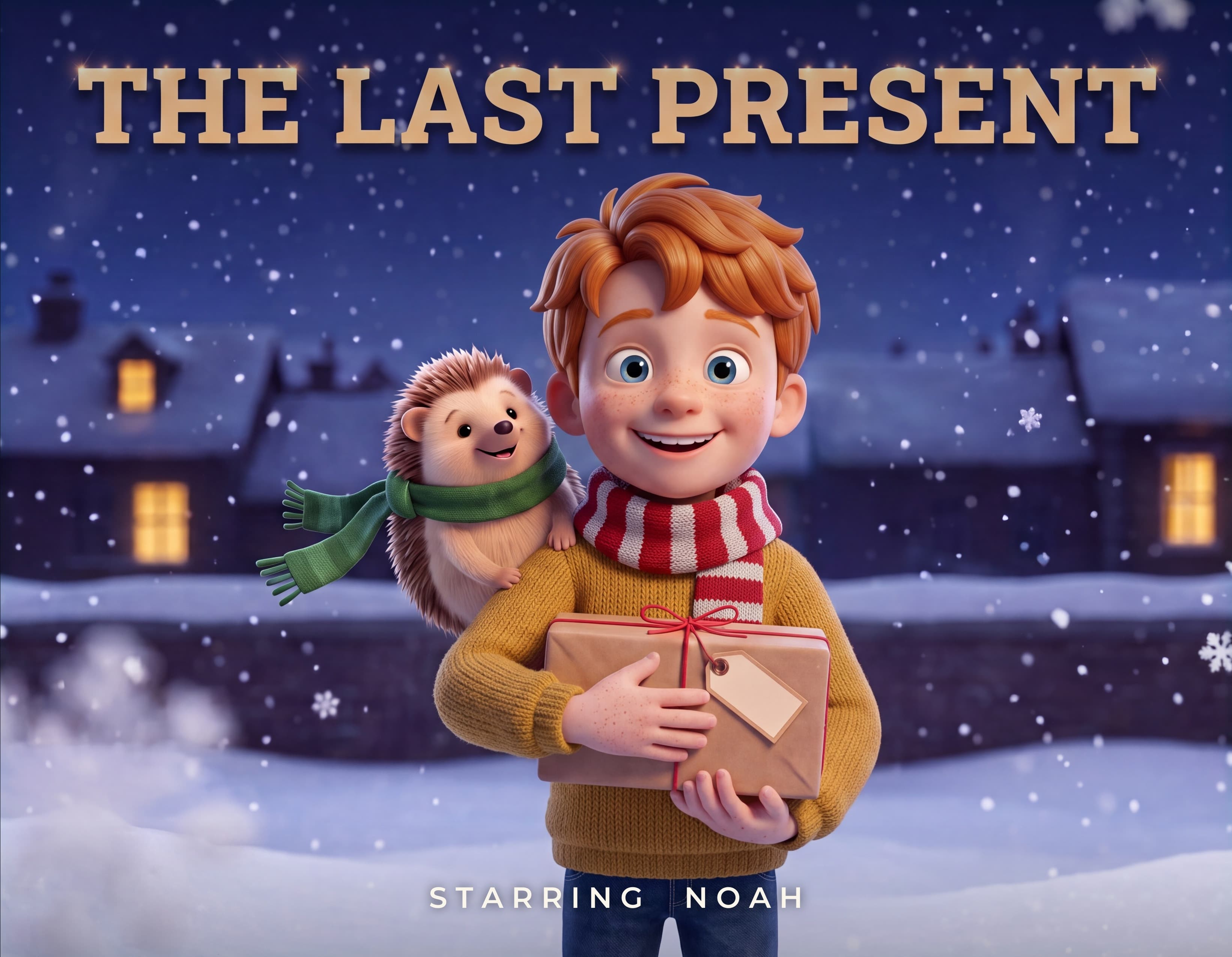
Our Christmas storybook, The Last Present, starts at age 3, so for a baby or toddler the better partner for the note is a sturdy board book. Christmas books for kids lists several, sorted by age.
Early readers, ages 6 to 7: write it so they can read it themselves
Around six or seven, children want to read the message without help and be seen doing it. Print in clear letters, use short words, put their name in full near the top, and tuck in one word or clue they can sound out. Keep it to three or four lines.
Finding their own name in someone else's handwriting is a small triumph at this age. Give them that, and make the note a little game.
- A word to find. Write one word in capital letters and ask them to circle it, or hide it in a clue: "Your next surprise is under the BIG chair."
- A question to answer. "What was the funniest thing that happened this year? Write it on the back and hand it to me." A message that asks for a reply turns into a conversation.
- A plain, tender one: "Imani, this year you read the whole menu at the diner and ordered for the table. I loved being ordered for. Merry Christmas. Mom"
Ages 8 to 10: a message they can read alone
At eight to ten, a child reads the message alone, often twice and in private. You can say a real thing now: what you saw them do, or what you like about them. Keep it to a short paragraph, leave out baby names, and skip anything that sounds like a goal for next year.
- Tender: "Wes, in March you quit the team and told us yourself, to our faces, which took more nerve than the game ever would. I was proud of that, and I still am. Merry Christmas. Mom"
- For a shy one: "Some people take a long time to warm up, and then turn out to be the best company in the room. I have noticed which kind you are. Merry Christmas, Uncle Ned"
Leave a line for a reply, such as "Write back on this side." Some children will answer on paper what they would never say out loud. And if you want the words to survive past January, you can see how one photo of your child comes out.
The child who is too old to say they care
For a child around ten to thirteen who rolls their eyes at anything tender, say it as a fact, not a feeling. Dry works better than sweet. Skip pet names and baby stories, and write something that would survive a sibling reading it over their shoulder.
- A fact: "You took the dog out in the sleet in October without being asked, and you never mentioned it. I noticed. Merry Christmas."
- A dry joke: "I have decided you are the funniest person in this house. The competition is you and the cat. Merry Christmas."
- An open door: "No speech this year. Just a standing offer: any ride, any hour, no questions. Dad"
Put it where they can read it alone, tucked in the pocket of a gift or under the lid, not on the tag where the whole room hears it.
What are some funny Christmas messages for kids?
Funny Christmas messages for kids work when the joke is on you, on the dog, or on a rule that does not exist, and never on the child. Keep it silly and short for ages 5 to 9, deadpan after that, and put the punchline in the first line so it lands even when read fast.
Three kinds, written for this page. Adjust each until it could only happen in your house.
- The official notice, best for ages 5 to 9: "NOTICE: This package was inspected by the dog at 6:14 a.m. Findings: it smells like cinnamon. The dog has asked to be considered for a bonus."
- The fake rule, best for ages 6 to 10: "New house rule, effective today: pie is a breakfast food until New Year's. Signed, the management."
- The pet's statement, best for any age: "Merry Christmas from the cat, who would like it known that the tree fell over on its own."
For the gifts themselves, see Christmas gifts for kids who have everything.
Christmas messages for a son or a daughter
A message to a son or a daughter works best when it names something the child did and says it plainly. It should work for either, so skip strength for boys and sparkle for girls. A message looks back at the year and a wish looks ahead; a good card has one of each.
- For a son, age 5, tender: "Finn, you carried your little cousin's mittens all afternoon without being asked. You are already a kind person. Merry Christmas, Mom."
- For a son, age 11, funny: "To my son, who outgrew every pair of pants I bought in September: Merry Christmas. The new ones are a size up and I have no faith in them. Dad"
- For a daughter, age 7, tender: "Josie, you tell the truth even when it is inconvenient, and you do it kindly. That is rare at any age. Merry Christmas. Dad"
- For a daughter, age 13, short: "Hazel, no speech. Just this: I like who you are. Merry Christmas. Mom"
Christmas wishes for a son or daughter are strongest when they are small and specific. "I wish you happiness" asks nothing of the year. "I wish you a year where the hard thing turns out easier than it looked" does. To see your child drawn before you write anything for the book, start a free preview.
From an aunt, uncle, godparent, stepparent, or a parent far away
When you are not the parent, the message has two jobs: say who you are to this child, and offer one small thing only you can give, like a rule that bends at your house. A stepparent writes what they have noticed and lets the child choose the labels.
- Best for an aunt or uncle: "Rules at my house: one cookie before breakfast, two after, and nobody tells your mother. See you Saturday. Aunt Jo"
- Best for a godparent: "I promised your parents I would be around, and I would have promised anyway. Merry Christmas from your godfather, who wraps badly and shows up well."
- Best for a stepparent: "You never have to call me anything. I am glad you let me sit next to you at the game, and I am glad you are in this house. Merry Christmas."
- Best for a parent far away: "At six tonight I will be eating cold noodles in a hotel and thinking about your pancakes. Save me the burnt one. Merry Christmas. I am coming home soon."
A parent far away should name when they will be back in real words: "after school lets out" beats "soon." If the distance is a deployment, books about deployment for kids covers what helps a child through it. Grandparents have their own lines in what grandparents write to a grandchild at Christmas.
Notes from Santa, for families who do Santa
A note from Santa works when it is short, names the child, mentions one true detail from the night, and promises nothing. Write it the night before, in handwriting that is not yours, and decide beforehand where your family's Santa story stops. If you are not the parents, check with them before you write a word.
- One true detail. The plate, the cookie with the crooked eye, the dog who watched the whole thing. It makes the child believe the note was written in their house.
- No scorekeeping. We would skip "you were good this year." It turns a present into a verdict, and the child who had a hard year hears the other half of the sentence.
- Stay inside your family's story. If your Santa comes by the roof, do not write about the fireplace. The youngest will remember.
A sample: "Dear Gus, thank you for the cookies. The one with the crooked eye was my favorite. The reindeer said the carrot was excellent. Your dog supervised the whole visit and did not bark once, which I appreciated. Santa"
When a child asks straight out whether Santa is real, the note is not the place to answer. For where the note goes, see Christmas Eve box ideas, Christmas morning traditions and the rest of the evening in Christmas Eve traditions for kids. Families who skip Santa can use the same note from "the people who love you."
What do you write to a child who is having a hard year?
Be plain and warm, and do not ask the child to feel merry. Say you see the year they have had, say one thing that has not changed, and offer one small thing you will do. Leave out the adult reasons and the silver lining. This is writing advice, not clinical advice.
A card that cheers "Have the merriest Christmas!" at a child whose year fell apart can feel written about someone else. So can a card that ignores the year. The middle is one true sentence.
- A move: "Everything has a new place and you are the same person in all of them. Merry Christmas from the new kitchen."
- Two homes: "There are two places to wake up this Christmas, and I know that is not what anyone planned. In this house you are loved exactly the same amount, and that part does not change." Speak only for your own house, and never for the other.
- A loss: "We miss Grandpa today. It is okay to miss him out loud, here, any time this week. I am glad you are my kid."
If you are worried about a child beyond a rough holiday, a pediatrician or a school counselor can help in a way a card cannot. Words in a book can also travel between homes, which a card on a mantel cannot, and you can look at a free preview to see whether a book would suit your child.
What do you write in a child's Christmas book?
In a child's Christmas book, write the date with the year, their name, who you are to them, and one plain line they will still like at fifteen. Four short lines are enough. Use the first light page inside the cover and a pen that dries quickly, and leave room underneath, because a Christmas book comes back out every December.
- The yearly line. Write the first message in the top half of the page and leave the rest empty. Each December, add a dated line under the last one. By fifteen, the page holds a row of Christmases in your handwriting, and the child can watch themselves getting older in it.
- The pen. A ballpoint or gel pen in blue or black. A felt-tip can show through thin pages, so test it on the last one, and let the ink dry before you shut the book.
The line that still works at fifteen states something true at any age and relies on no nickname, no prediction and no size. Two that pass the test:
- "Read this one last, after the lights go off. That is the rule, and you made it."
- "The year you were six, you asked for one more verse, then one more, then one more. We read it four times. Dad, Christmas Eve, 2026"
The longer treatment, with what to leave out and a version for every giver, is in what to write in a book for a child.
When the message is printed: the dedication in The Last Present
In our Christmas storybook, the message is the dedication: up to 180 characters, set exactly as you wrote them on a page of its own after the story, five lines at most. Apart from your child's face and name, everything else in the book is ours and the same for every family. That page is yours.
Dreamtale Cartoons, a small studio that has drawn about ten thousand families since 2020, makes The Last Present, a hardcover Christmas Eve story told in rhyme, for children from 3 to 10. Your child, drawn from one photo in the look of a modern 3D animated film, is the character all the way through. In it a hedgehog named Bramble taps at your child's window. His job is to check the sleigh at the end of Christmas Eve, and this year one present is left over with no name on it. They walk the snowy streets together, window by window, and the name that finally goes on the label is your child's to write. The book never says which.
What it is not. It is not a book for babies; it starts at age 3. It is not a message by itself: the story and the pictures are ours, and what is yours is the face, the name in the words, and that page. It holds five printed lines, so a few short sentences fit, not a long note. Two dedications that fit, each well under 180 characters:
- "For Cal, who looked in every window and found the kitchen light. Merry Christmas, 2026. Love, Nana"
- "For Nadia, Christmas Eve, age seven: you stayed up to see who was still wrapping. So did we. Love, Mom and Dad"
Every book is printed after you order it, and the book page and the cart show the real delivery dates before you pay. For this Christmas, order by December 1; after that date we cannot promise it arrives in time, and an order placed later is a book for next Christmas. The preview is free, draws the character in about half a minute, and needs no card and no account, so you can see your child drawn tonight and decide in the morning. A real artist checks every book before printing. If you are comparing kinds of custom books, personalized books for kids lays out the four kinds, from a name printed in the text up to a story written around your family.
Sources
- Beyond Literacy: Shared Reading Starting at Birth Offers Lifelong Benefits · HealthyChildren.org, American Academy of Pediatrics
- Early Literacy · American Academy of Pediatrics
Questions parents ask
What is the best message for Christmas for kids?
The best one is short, starts with the child's name, and holds one detail only true of them and one small wish. For example: "Imani, this year you read the whole menu at the diner and ordered for the table. I loved being ordered for." Read it aloud once. If you need a second breath in a line, split it.
What are some basic Christmas words for kids?
The ones children use most are tree, star, snow, present, stocking, cookie, lights, bell, sleigh, reindeer, wreath and ornament, plus family and giving. For a message, pick the two or three the child actually says, and build one line around them. A card that uses the child's own word for the stocking sounds like home.
What should I write in a children's Christmas card?
Start with the child's name, add one thing they did or love this year, and finish with one small wish, in three or four lines. For a child under six, write it for a parent to read aloud. For eight and up, write it for them to read alone, and say something real rather than a general greeting.
What is a cute Christmas message?
A cute one is specific and a little silly: "This one is from the cat. She would like credit." Or "New house rule: pie is a breakfast food until New Year's." Cute works best when the joke is on the writer, the dog or an invented rule, and never on the child. Keep it to one or two lines.
What do you write in a book you are giving a child for Christmas?
Write the date with the year, the child's name, who you are to them, and one plain line they will still like years from now. Use the first light page inside the cover and a pen that dries quickly. A Christmas book returns every December, so leave room to add a dated line each year.
What is a good short Christmas message for a child?
One line with a real detail in it works best: "For Hazel, who will shake this box. Go ahead." Or "Look under the stairs, then look again." A short message is strongest when it names something true about the child and skips a general wish for joy. A gift tag has room for one line only.
What should I write for my son or daughter at Christmas?
Pick one thing they did this year, say it plainly, and add one small wish. For example: "You carried your cousin's mittens all afternoon without being asked. You are already a kind person." Use the same kind of line for either child, and skip stereotypes about strength or sparkle. For a teenager, make it short and dry.
What do I write to a child who is having a hard Christmas?
Be plain and warm. Say you see the year they have had, name one thing that has not changed, and offer one small thing you will do. Avoid telling them how to feel, promising next year will be better, or explaining the adult reasons. If you are worried about the child beyond the holiday, talk to their pediatrician or school counselor.
Can a Christmas message be printed in a storybook?
In ours, yes. The dedication is up to 180 characters, printed word for word on a page of its own after the story, in five lines at most. The Last Present is for ages 3 to 10, and the story is the same for every family. Your child's face, their name in the words and your dedication are the personal parts.