
Choosing a book
Books About Deployment for Kids: What to Read From the Goodbye to the Homecoming
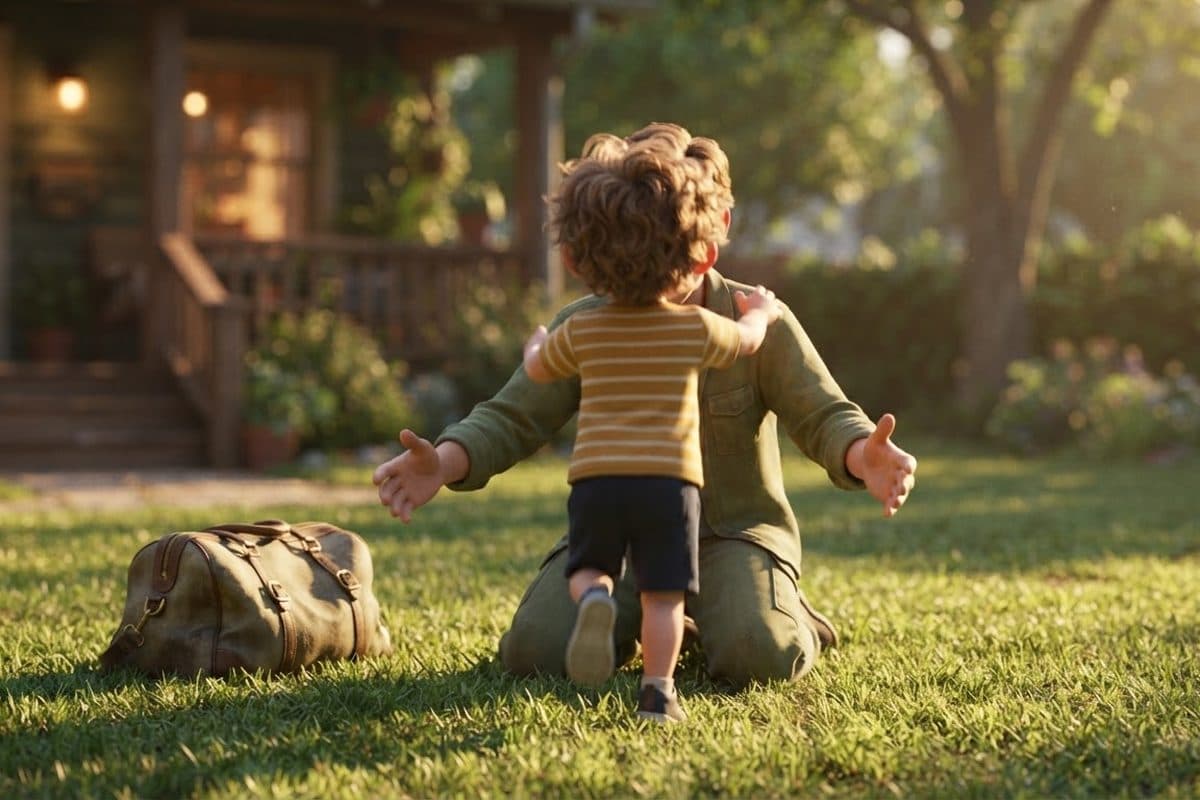
Parents usually start looking for books about deployment for kids at one of two moments: when the orders arrive and somebody has to explain them to a four year old, or a few weeks in, when the same question starts coming back every night at bedtime. Both are good moments. A book gives a small child a version of the situation they can hold, reread and look at from the outside.
But a book is never the whole job. The guidance from the American Academy of Pediatrics, Military OneSource and Sesame Street for Military Families is remarkably consistent, and most of it is about routines, honesty and patience rather than reading. This guide puts the books inside that advice, stage by stage, and ends where most lists stop: the homecoming.
What a young child understands about deployment, age by age
No child is too young to notice: the early childhood organization ZERO TO THREE says even the youngest baby can miss a deployed parent. What changes with age is what they understand, and how the missing comes out.
| Age | What they understand, and what you may see | What helps most |
|---|---|---|
| Under two | Nothing about where or why, only that someone is missing. Sleep, feeding and fussiness may change. | A steady parent at home, photos they can hold and kiss, and a recorded voice at bedtime. |
| Two and three | Bedtime without the parent is the confusing part. Clinginess, tears and anger are all common. | A very simple board book, the same bedtime routine, and time measured in sleeps or seasons. |
| Four and five | A parent working far away, yes; six months, no. Some slip back on potty training or develop new fears at night. | A story that names the feeling, a small job each day, and a nightly ritual that connects them to the parent. |
| Six to nine | They understand distance and danger, pick up the news, may worry the parent will be hurt, and may get stomachaches or headaches. | Simple, honest answers, a map of where the parent is, letters, and less news on screens. |
These reactions, from the AAP and Nemours KidsHealth, are not warning signs but what ordinary missing looks like in a small body. With the youngest, deployment books for toddlers matter less than the face and the voice. And if new night fears have arrived, our guide to books for kids afraid of the dark covers that half.
The four stages, and what each one needs
Military OneSource describes a deployment as a cycle: predeployment, the deployment itself, then reunion and reintegration. For a child it helps to think in four stages, each wanting a different kind of book.
- Before the goodbye. Tell them early and plainly. KidsHealth suggests talking as soon as you know the date, in terms of the child's own day: who will take them to school, who will tuck them in. Read a book that explains, and record stories while the parent is still home.
- During. Routines carry most of the weight, with letters, drawings, care packages and a map on the wall. Read books about missing someone, especially ones that hand the child a ritual.
- Homecoming. Read about the reunion in the weeks before it, so the day arrives as a story they have already heard.
- After. The house rearranges itself around one more person. Now the book is read with the returning parent, not about them.
Most of helping a child cope with deployment happens outside books, which is what the next two sections are about. If you already know you want a homecoming book with his face in it, our personalized book for a military family is the one we make, and you can come back for the rest.
A countdown that does not break when the date moves
The instinct is a countdown on the fridge. But homecoming dates can move, and a small child counting down to a Tuesday experiences a delay as a broken promise.
Sesame Street for Military Families, made by Sesame Workshop with the Department of Defense and free to use, suggests keeping the date as open-ended as you can while still giving children something hopeful to hold on to. Its ideas count up instead of down. Four that work:
- A paper chain that grows. One link a day, each with a word about the parent: kind, funny, soccer champion. By the end it is a portrait.
- A jar that fills. A coin for each day apart, saved for something you will do together at home.
- The same moon. Look at the sky each night, as Sesame suggests, remembering you are all under the same moon and stars. It survives time zones.
- Time in their units. Not six months, but after your birthday, or after Christmas, which is the kind of example KidsHealth gives.
Around that, keep the week ordinary: the AAP's point is that kids thrive on routines. Bedtime matters most, because that is where the absence is felt, and the bedtime routine that ends the stalling is the version we recommend.
Record the bedtime story before the goodbye
If you do one thing before the deployment starts, make it this. ZERO TO THREE recommends that the deploying parent video themselves reading books and singing songs, so the recording can play every day as part of bedtime, and Sesame gives the same advice. The parent is no longer only someone who is missing: they still read the last book of the night.
- Record books you own, so the child can turn the real pages along with the voice.
- Record five or six, not one. The favorite will be played until it wears out.
- End with their name and a goodnight. That is the part children replay.
- Expect tears the first time, and try it in the daytime, on your lap.
Already gone? United Through Reading is a free nonprofit program that helps service members record themselves reading a story wherever they serve, and sends the video home. Grandparents can do a version too: Military OneSource lists video chat book readings among the ways extended family can help.
If Father's Day falls mid-deployment, turn it around: the envelope-sized gifts in our Father's Day guide, a recorded voice or a dictated message, are the ones a dad far from home keeps.
Make a simple book about your own family
The book a small child reaches for most during a deployment is often one nobody bought. A stack of printed photos in a cheap album, with one short line under each, does something no bookstore title can: it shows this house, this parent and this child. It costs an afternoon, and the best time to make it is before the goodbye, with the deploying parent sitting beside you choosing the pictures.
Keep it to eight or ten pages. A page plan that works for children from about two to six:
- Who is going. A clear photo of the parent's face, no sunglasses and no helmet, with one sentence the child can say back in the words your family uses: "This is Daddy. Daddy loves me."
- Where they are going, simply. A map with one sticker for home and one for far away. If the place cannot be named, far away is enough.
- Who does what now. The parent at home doing bedtime, the grandparent at school pickup, the teacher at the door. These are the pages that answer the question a small child is really asking, which is about their own day.
- How we stay close. Photos of your own rituals: the paper chain, the moon from the back step, the tablet playing the recorded story.
- Both feelings are allowed. One photo of the child sad and one laughing, with a line that says both are fine, and that grown ups feel both too.
- The last page stays open. "And one day, Daddy comes home." No date, and no picture yet: you add the homecoming photo when it happens, and the book finishes itself.
Make it sturdy. Plastic sleeve albums survive being chewed, dropped and carried to daycare, and a book that has to be kept on a high shelf is not doing its job. If you would like a printed version rather than a homemade one, our guide to making a custom children's book walks through the routes honestly. And if the page you most want is the last one, the reunion, that is the one we draw: upload a photo and see your child drawn, free.
How to choose a deployment book
These books vary widely. Five checks, in rough order of importance:
- Does it fit your stage? A goodbye book read in month five answers a question your child stopped asking weeks ago.
- Does it promise a date? Skip books that promise the parent home for a birthday or for Christmas. If the date moves, the book becomes one more broken promise.
- Is sadness allowed on the page? A story in which the child is only proud and brave tells a sad child that they have the wrong feeling.
- Are the pictures gentle? The AAP advises keeping young children away from repeated graphic images on screens, and the same logic applies to the page.
- Does it look like your family? Which parent is away, which branch, a ship or a plane. The closer the match, the less translating a small child has to do.
That last check is the one a bookstore shelf cannot always pass, and the one our book is built around. You can try it with your child's photo, free, before deciding anything.
A short, honest list of books for military kids
Well-known books for military kids, grouped by stage. All of them appear on the reading list for military-connected students from the Clearinghouse for Military Family Readiness at Penn State, which notes that it has not vetted each title, so read them yourself first.
Before and during the deployment
- Over There by Dorinda Silver Williams. A very simple board book published by ZERO TO THREE, in a Daddy and a Mommy version. The simplest start under three.
- I Miss You! A Military Kid's Book About Deployment by Beth Andrews. Half guide for the parent, half coloring book, by a social worker who counseled military families.
- Night Catch by Brenda Ehrmantraut. A departing soldier and his son agree to play catch with the North Star each night: a ritual, not just a message.
- The Invisible String by Patrice Karst. Not a military book, but widely used for staying connected to someone you love while apart.
- While You Are Away by Eileen Spinelli. Three children, in simple verse, missing a parent who is away; one of those parents is a mom.
- Hero Dad and Hero Mom by Melinda Hardin. Very short text comparing a parent in the military to a superhero, simple enough for preschoolers.
- Love, Lizzie: Letters to a Military Mom by Lisa Tucker McElroy. Letters and hand-drawn maps to a deployed mother across a year. Better from about six.
Homecoming and after
- My Red Balloon by Eve Bunting. A boy waits for his father's ship with a red balloon, so his dad can find him in the crowd.
- Coming Home by Greg Ruth. Nearly wordless: a boy searching a crowd of reunions for his own soldier, who turns out to be his mother.
- Why Is Dad So Mad? by Seth Kastle. Written by an Army Reserve veteran for families living with combat-related PTSD. Only if that is part of your story.
The homecoming shelf is shorter than the deployment one, and every book on it is about somebody else's father walking through somebody else's door. That is the gap our book was made for.
How to read a deployment book together
A deployment book is not a bedtime story like the others. It touches the thing the child is carrying, and how you read it matters almost as much as which one you picked. A few habits make it easier on both of you:
- Read it alone first. Know where the sad page is before you reach it with a child on your lap, and decide whether to skip it.
- Start in the daytime. The first reading goes better on an ordinary afternoon than at bedtime, when everyone is tired and the missing is loudest. Once it is familiar, it can move to the bedtime pile.
- Change the words to fit. Say your child's name, your parent's name, ship instead of plane. A book is yours to adapt, and small children do not mind.
- Ask small questions, not big ones. "What do you think he is doing right now?" opens more than "Are you sad?", which a four year old often cannot answer. Naming your own feeling, "I miss her too", gives them words without asking for any.
- Let them stop. A child who closes the book halfway is not failing to engage. Put it back on a low shelf where they can reach it alone, and it will come back.
- Let it rest. If the book goes quiet for a few weeks, that usually means the question is quiet too. It will be ready when the homecoming gets close.
Which kind of book to reach for depends on the question your child is asking right now. As a rough map of the list above:
| The moment | What your child may be asking | The kind of book that helps | From this guide |
|---|---|---|---|
| The orders have arrived | Where is he going? Who will take me to school? | A short, plain explanation | Over There, I Miss You!, your homemade book |
| The first weeks apart | When is she coming back? | A ritual that connects you | Night Catch, The Invisible String |
| The long middle | The same bedtime question, again | The parent's own voice | Your recorded read alouds, While You Are Away |
| Six and older, and worried | Is he safe? What is it like there? | Letters, maps, honest detail | Love, Lizzie |
| The weeks before the return | Will he know me? Will I know him? | A reunion story | My Red Balloon, Coming Home, My Hero for a dad |
| After, if the return is hard | Why is Dad upset? | A book for a specific situation | Why Is Dad So Mad?, only if it fits |
If you are in the next to last row, a homecoming book is where a face they know helps most. You can try it with your child's photo before you decide, with no card and no account.
When Mom is the one deployed, or both parents are
Most of the advice in this guide works the same whichever parent is away. The books do not: many deployment titles picture a father, and a child whose mother is the one leaving has to do extra translating. Several on the list above show mothers, so start there:
- Over There comes in a Mommy version, for the youngest.
- Hero Mom, by the same author as Hero Dad, is just as short and simple.
- While You Are Away includes a mother among the three parents who are away.
- Love, Lizzie is written as letters to a deployed mom, for children from about six.
- Coming Home ends with a mother, which is part of its point.
- The Invisible String does not picture a military parent at all, so it fits any family.
Our own book is not the right choice here. My Hero is written for a dad coming home, and we would rather say so than let a family find out on page three. A homemade book with her face on the first page and your own reunion photo on the last one will serve you better.
If both parents serve, or a single parent deploys and the children move in with a grandparent or friend, the routines that carry a deployment belong to the new caregiver. Send the familiar things along: the bedtime books, the recorded stories, the night light, the same pillow. Add a page to the homemade book that shows the new house and the person doing bedtime there, so the change has a picture before it has a date.
Homecoming: the part nobody warns you about
The homecoming gets planned as a party, and it is often harder than that. ZERO TO THREE describes it as commonly the most difficult part of the deployment cycle for families, and the AAP notes that a child's stress can rise rather than fall at the return, sometimes because the child keeps a little distance to avoid the pain of another goodbye.
So a toddler may hide behind the parent who stayed, and a baby may not be sure who this person is, having grown so much in the meantime. None of it is a verdict on the relationship. What helps, from Sesame Street's homecoming advice and from KidsHealth:
- Let the child set the pace. Sesame's advice is to let each child find their own comfortable pace, after seeing the parents hug. Sit on the floor and let them come to you.
- Keep the welcome small for small children. The party can come later.
- Answer the first question simply. It is usually some version of "Where were you?" Give basic, true information and no graphic detail, as the AAP advises.
- Bring routines back slowly, and be patient. KidsHealth says the first days and weeks together can be rocky, and that pressure to feel a certain way makes it harder.
Why a book with their own dad in it helps at homecoming
Every homecoming book on the shelf asks a small child to translate: "this boy and his father are a bit like us." Older children manage that. For a toddler whose father has become a photo on the fridge, it is much harder.
A book with the two of them in it removes the translation, which is the idea behind why kids love seeing themselves in books. The child on the page has their face and the man at the door has his, so the reunion happens first on the couch, as often as they like. ZERO TO THREE recommends photos a child can kiss and talk to because they keep a face familiar; a story gives that face somewhere to go. It also gives the returning parent something to do that is neither discipline nor a hug the child is not ready for, which is why, in My Hero, he sits down on the floor to tell it.
Honest details: it is written for a dad, so if Mom is the one deployed, start with the books above that show mothers. The uniform is plain olive green with no badges, rank, name tape or flag, because we cannot know his unit from a photo and would rather draw nothing than the wrong insignia. There is no weapon anywhere in the book. Any clear photo of his face works, in uniform or not, and since the book promises no date, it works before the homecoming too. More on the My Hero page, and in our guide to personalized books for kids.
The easiest way to judge whether it fits your family is to look. Upload a clear photo of your child and the character is drawn in about half a minute, free, before you decide anything; a real artist checks every book before it is printed.
After the party: reintegration takes longer than the homecoming
Military OneSource describes reintegration as settling back into daily routines, redefining roles and reestablishing connection, and says plainly that it takes time. Its guide to the deployment cycle advises treading lightly and easing back into routines, and that works in both directions: the returning parent should not walk in and start enforcing, and the parent who stayed should not hand everything over on the first weekend.
Keep reading together through this stretch. The stories recorded before the goodbye, now read in person, stitch the two halves of the year together.
Military homecoming gifts for kids, and what to skip
Shirts and signs are lovely for the photos, but the military homecoming gifts for kids that get kept are about the two of them rather than the day:
- Something the child made, given to the parent. KidsHealth suggests a scrapbook of artwork, photos and report cards kept for the return, and the paper chain counts too.
- Something small from where they were, with a story attached, told on the floor.
- A book they are both in, to read together through the rocky weeks.
- A first ordinary Saturday. Children need proof that normal is back more than they need an event.
- For grandparents and friends, room. Military OneSource's advice to extended family is to give the family some time alone when the service member returns.
If you want the book there for the day, it is printed after you order, with the delivery dates shown before you pay, so leave room, because dates move. It is a thirty-page hardcover in rhyme across thirteen spreads, printed in the United States, and the page after the story is yours to write. You can start with your child's photo and see them drawn, free.
Sources
- Effects of Deployment on Children & Families · HealthyChildren.org, American Academy of Pediatrics, 2019
- Helping Your Family Cope With Military Deployment · Nemours KidsHealth, 2024
- 6 Tips for Telling Your Child About a Military Deployment · Nemours KidsHealth, 2024
- Supporting Your Child While a Parent Is Deployed · ZERO TO THREE, 2007
- Deployment and Coming Home: The Realities for Infants and Toddlers in Military Families · ZERO TO THREE, 2009
- Deployments · Sesame Street for Military Families, Sesame Workshop
- Military Homecomings · Sesame Street for Military Families, Sesame Workshop
- Understanding Predeployment to Reunion and Reintegration · Military OneSource, 2025
- Supporting Your Children Through the Deployment Cycle · Military OneSource, 2024
- Supporting the Children You Love During a Parent's Deployment · Military OneSource, 2024
- United Through Reading · United Through Reading
- Books for Military-Connected Students · Clearinghouse for Military Family Readiness at Penn State
Questions parents ask
What is a good deployment book for a toddler?
Keep it very simple: a board book like Over There by Dorinda Silver Williams, published by ZERO TO THREE in a Daddy and a Mommy version, or Hero Dad and Hero Mom by Melinda Hardin. Under three, though, photos they can hold and the parent's recorded voice at bedtime, both recommended by ZERO TO THREE, matter more than any story.
How do you explain deployment to a three year old?
Short, true and concrete: "Daddy is going away for his job for a long time. He will miss you, and I will do bedtime." Measure time in things they know, like after your birthday, and answer the questions they actually ask, which are about their own day. Expect the same question many times; repetition is how a three year old makes sense of it.
Should we do a countdown to the homecoming?
Count up rather than down until the date is firm. Dates can move, and a child counting down experiences a delay as a broken promise, which is why Sesame Street for Military Families suggests keeping the date open-ended and offers ideas that grow, like a paper chain with a link a day. Once the date is confirmed, a short countdown is pure fun.
Why is my child ignoring their dad now that he is home?
Shyness at a reunion is normal, very young children may not be sure who he is after months of growing, and the AAP notes that some children keep their distance to avoid the pain of another goodbye. Let the child set the pace, keep routines steady, and read together on the floor. If it is getting worse rather than better after several weeks, talk to your pediatrician.
Are there deployment books for when Mom is deployed?
Yes. Over There by Dorinda Silver Williams comes in a Mommy version for the youngest, Hero Mom by Melinda Hardin mirrors Hero Dad, While You Are Away by Eileen Spinelli includes a mother who is away, and Love, Lizzie by Lisa Tucker McElroy is a year of letters to a deployed mom, better from about six. Coming Home by Greg Ruth ends with a boy finding his mother in the crowd.
Should I read a deployment book before the parent leaves?
Yes, ideally with the deploying parent there to read it too. A book read before the goodbye gives a small child words and pictures for what is about to change, and it becomes something familiar to return to once the parent has gone. Read it first on an ordinary afternoon rather than the night before, keep it short, and let your child stop whenever they want.
How do I make a homemade deployment book for my child?
Print eight or ten photos and put them in a sturdy plastic sleeve album, one short line under each. A page plan that works: the parent's face, a simple map, who does bedtime and school pickup now, your family's rituals, a sad photo and a happy one with a line saying both are fine, and a last page that promises the homecoming without a date. Add the reunion photo when it happens.
How long does it take a child to adjust after a parent comes home?
There is no fixed number. Military OneSource says reintegration takes time, and KidsHealth warns that the first days and weeks can be rocky. Watch the direction rather than the calendar: a child who is slowly warming up is doing fine, and one whose behavior is extreme, long-lasting or getting worse is worth raising with your pediatrician, as the AAP advises.