
Gifts
Christmas Messages for Grandchildren: What to Write at Every Age, So It Gets Kept
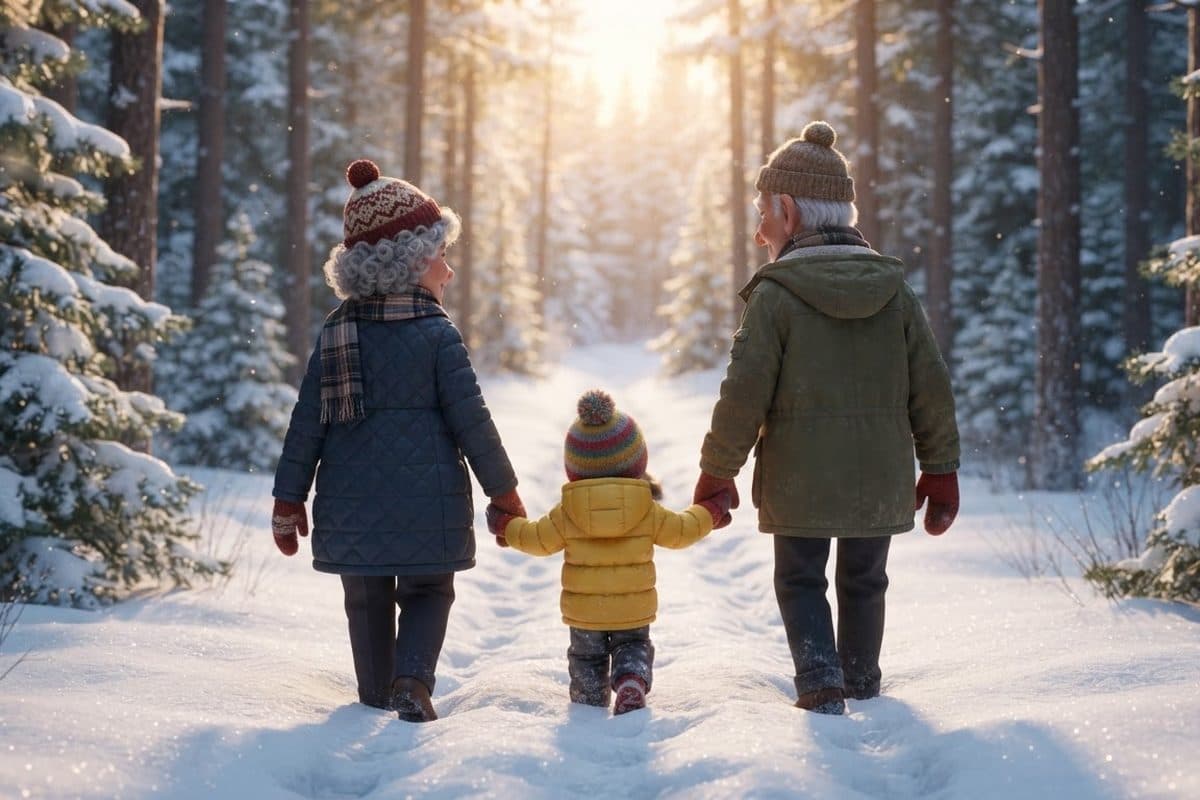
Search for christmas messages for grandchildren and you get pages of lines any grandparent in the country could have signed: a joyful season, a heart full of love, a year of magic. They are kind. They are also what last year's card said, and a line anyone could have written does not feel, to the child opening it, as if it was written to them.
What makes a message worth keeping is smaller than a poem: one memory only you share, one thing you see in them now, and one small promise. It works whether the grandchild is two and will hear it read aloud, fifteen and will read it alone, or thirty-four with children of their own.
Below: why the usual lines fall flat, the formula, a table that matches the age of the grandchild to the length and tone, example messages for every age and situation, how to sign it, and the religious, funny and short ones. At the end, one thing we make, a storybook where the dedication you write is printed word for word, and where it fits and where a card is better.
Why "Merry Christmas, love Grandma" is not enough
There is nothing wrong with those four words. They are kind and they arrive on time. What they cannot do is the one thing a handwritten note is for: telling this particular child that you spent a few minutes thinking about them in particular.
It is easy to write the short version anyway, often from worry that the words will come out clumsy or sappy. That worry has been measured, in another setting. In 2018 Amit Kumar and Nicholas Epley reported four experiments in Psychological Science in which people wrote a letter of thanks, then guessed how the reader would feel. The writers underestimated how surprised and how positive the readers would be, and overestimated how awkward the readers would feel. The University of Chicago's own summary of the work is that the writers worried about choosing the right words while the readers were happy simply because of the warmth of the gesture.
Those were letters of thanks, not Christmas cards, so take it as a clue and not as proof. It is a useful clue: the polish of the sentence matters less than the fact that someone sat down and wrote it. That is the whole answer to what to write in a Christmas card to grandchildren of any age: do not write beautifully, write specifically.
The formula: one memory, one thing you see, one promise
Every example in this guide is built from the same three parts.
- One memory only you share. Not "so many happy times" but the afternoon itself: the pancake shaped like a map of Ohio, the first lap on a bike without training wheels, the night they fell asleep on your shoulder halfway through the movie.
- One thing you see in them now. Not "you are so smart" but something you noticed this year: they hum while they draw, they set a place for the dog, they stood up for a cousin at Thanksgiving.
- One small promise or wish. Small enough to keep: the corner piece of the pie, a rematch at checkers, pancakes next summer. Skip targets like good grades.
The order does not matter, and if you have room for only one, keep the memory. Leave out:
- Advice. "Be good for your parents" turns a gift into a chore list.
- Comparisons with a sibling or a cousin.
- Santa lines, unless the parents run a Santa household. Ask first, because a spoiled card cannot be unsent.
Which message for which age: a quick guide
The formula never changes. What changes is who reads it, how long it can run, and which part carries the weight. This table covers Christmas card messages for grandchildren from a baby to a grown-up.
| Grandchild's age | Who reads it, and how long | Tone | What to put in |
|---|---|---|---|
| Baby to 3 | A parent reads it aloud. Two or three lines. | Warm, rhythmic | Their name, one thing they do, a word they say |
| 4 to 6 | Read aloud, and requested again. Three or four lines. | Playful, concrete | A shared moment with an action in it, a promise with a season |
| 7 to 10 | Aloud first, then alone. A short paragraph. | Warm, a little funny | A memory only you share, praise for something they chose |
| 11 to 13 | Alone, fast. Three or four lines. | Plain, no baby names | One thing you respect, a private joke |
| 14 to 17 | Alone, often twice. Five or six lines. | Straight, dry humor welcome | What you see in them now, an open door |
| 18 to 25 | As an adult, sometimes years later. A real note. | Adult to adult | What you are proud of, a memory of them small |
| Grown, with kids | Read, and shared with their children. A letter. | Warm, grateful | A thank-you, a memory, a line for their kids |
The younger the child, the more the message is really for the parent reading it aloud. The older the child, the shorter and more honest it should be.
There is one more place for these words, the printed dedication page of a storybook, covered at the end of this guide, and you can see your grandchild drawn as a character, free before deciding.
For a baby, toddler or preschooler: write it to be read aloud
Under about six the child does not read the card. A parent does, aloud, often more than once, so write a script for someone else's mouth: short lines, things the child can picture, one sound to join in on. Add a photo of yourself, because a child who cannot read yet can still point at a face.
- "Merry Christmas, Leo! Grandpa saved the biggest puddle for you. Splash, splash, splash. I love you more than every puddle in the world."
- "Dear Ellie, I am thinking about your giggle, which is my favorite sound in the whole house. Nana is counting the days until we make cookies. Merry Christmas!"
- For a first Christmas, to be read years later: "Dear Theo, you slept through most of your first Christmas and we loved every minute. When you are big, ask me about the year you were small, and I will tell you who held you first. Love, Grandma"
A baby will not remember a word, so the real reader of a first-Christmas note is the person they will be at ten or eighteen. Date it and say who you are to them.
For a child of seven to ten: a message they can read alone
Around seven, children start reading the card themselves. A message can now say what a parent would not, such as that you noticed how they handled something hard. Keep sentences short and give them something to answer.
- "Dear Maya, you told me in October that you want to be a vet, and I have not stopped thinking about it. Next time I visit you can examine my cat, who has been practicing looking sick. Merry Christmas! Grandma"
- "Dear Owen, do you remember the day we got lost on the way to the lake and found the best ice cream in the state? I still say we meant to do it. Let's get lost again this summer. Grandpa"
- "To Eli, with a question to answer next time we talk: what was the best part of your year? Mine was your soccer game in the rain. Love, Papa"
If the message goes inside a book rather than a card, our guide to what to write in a book for a child covers where on the page it goes, including the grandparent version.
In our books the dedication has a page of its own, and you can watch one photo turn into a drawing with no account and no card.
For a teenager: short, straight and no lecture
A teenager reads a grandparent's card fast and then, if it is any good, slowly. Advice, the baby they used to be and greeting-card phrases lose them. Honesty and an open door keep them.
- "Dear Jake, you are a hard person to impress and I am not trying to. I just think you are going to be fine, and I am proud of how you handled this year. Grandpa"
- "Dear Priya, no advice this year, I promise. Just this: you are easy to love and interesting to talk to. My kitchen and my phone are open at any hour. Love, Nana"
- "To Chris: the playlist you made me is still the only thing that gets me through the grocery store. Send me another one. Love, Papa"
Skip: "you are all grown up", "I remember when you were this big", advice about school or dating, and outgrown pet names. A teenager is deciding whether you are safe to talk to, and the message is part of the evidence.
For a grown grandchild, and the ones with children of their own
Once a grandchild is an adult, one adult is writing to another. Say what you are proud of, exactly, thank them for something, and share one memory of them as a child that they may not know you kept.
There is a reason to say it. In a study that followed 374 grandparents and 356 adult grandchildren in U.S. families between 1985 and 2004, Sara Moorman and Jeffrey Stokes of Boston College measured affinity (emotional closeness), contact (how often they were in touch) and practical help. Greater affinity went with fewer depressive symptoms in both generations, while more frequent contact went the other way. It is an association, not proof that a card changes anyone's health. Our reading: closeness is not frequency, and a message that says what you feel is the closeness part.
- "Dear Hannah, I am not good at saying this out loud, so I am writing it: watching you become who you are is near the top of everything I got to see. I am proud of you, and I like you. Grandma"
- "Dear Ben, you called me every Sunday this year, and I never said how much I looked forward to it. I did. Thank you. Grandpa"
If you are the grown grandchild reading this for your own grandmother or grandfather, the other direction is in Christmas gifts for grandparents.
A message for a granddaughter from Grandma, and for a grandson from his grandparents
The formula does not change with the child. What changes is the temptation to reach for the stereotype, football for him and sparkle for her. Aim at the specific child you have.
A Christmas message for a granddaughter from Grandma:
- "Dear Ava, you are the only person I know who can explain a beetle for twenty minutes and make me want to hear more. Never lose that. Merry Christmas, love Grandma"
- "To my granddaughter, who beat me at chess in October and was gracious about it, which I was not. I want a rematch. Love, Nana"
Christmas messages for a grandson from grandparents:
- "Dear Noah, I loved baking with you and watching you not mind the mess. You make a better cinnamon roll than your grandfather, and I will deny I said so. Grandma"
- "Dear Jackson, I saw you pick up the little kid who fell at the park and say nothing about it. I noticed. Love, Grandpa and Grandma"
With several grandchildren, write each their own and keep the length and warmth equal, because children notice.
What to write in a Christmas card to grandchildren far away
Distance is common. In the 2026 report from AARP Research, a survey of 3,283 U.S. grandparents at the end of 2025, 29 percent had at least one grandchild 500 miles or more away, and 76 percent said technology such as texting and video calls is a primary way they stay in touch. Screens carry part of the conversation; a card can be held and found again. That last part is our opinion, not AARP's.
- Mail it early, so it is on the table on Christmas morning, not in the mailbox on the twenty-seventh.
- Say where you are: the weather, the windowsill, what you see from your chair.
- Enclose a photo of you and a stamped envelope, with a question to answer.
- Name the next visit with a season or a date. "When school lets out" beats "soon".
- "Dear Ruby, it is snowing here, and I put out a bowl of water for the birds and thought of you, because you would name every one. I wish you were at the window with me. Soon. Grandma"
- "Dear Mia and Jack, there are a lot of miles between us and exactly one hug in my plans for July. I have already marked it on the calendar. Nana"
More to send alongside the card is in gifts for grandchildren who live far away. A printed dedication also travels well: our books ship straight to your grandchild's house in the United States with your words inside.
A first Christmas as a grandparent, a blended family, a hard year
Some Christmases need a different tone. The formula holds, and the job changes.
| Situation | What the message should do | What to avoid |
|---|---|---|
| First Christmas as a grandparent | Write for the child at ten or eighteen, not the baby. Date it. | Predictions about who they will become |
| Blended family or step-grandchild | Start the memories now. Let the child choose your name. | Catching up on lost years, comparisons |
| A hard year | Say you see it and you are on their side. No question to answer. | Fixes, silver linings |
First Christmas as a grandparent: "Dear Theo, you are seven weeks old and you yawned at me today. By the time you read this you will be big, and I hope I am sitting next to you. Grandma"
Blended family: "Dear Ana, we have only known each other a year, and my favorite thing so far is how you set the table for everyone, including me. Merry Christmas!" Sign with whatever name the child has chosen for you.
A hard year: "Dear Sam, this has been a hard year, and I know it. You do not have to feel merry. I am on your side, and my kitchen is open at any hour, with talking or without. Love, Grandpa" If you are unsure how a parent would want it worded, ask them first.
How to sign it: Grandma, Nana, Papa, or both of you
Sign with the name the child uses, in your own hand: Grandma, Nana, Mimi, Grammy, Grandpa, Papa, Pop-Pop. For a card read in twenty years, add who you are, as in "Nana (your mom's mother)".
- From Grandma: "Dear Charlie, here is what I want you to remember about this Christmas: you asked me to teach you the cinnamon rolls and stayed for the whole thing, flour in your hair. Grandma"
- From Grandpa: "Charlie, I am not a letter writer. I am writing anyway. You are the best fishing partner I have had. Same lake, next June. Grandpa"
- From both: "Dear Charlie, Grandpa says he won the last game of cribbage. Grandma says he did not. Come and settle it. Love, Grandma and Grandpa"
Writing as a couple, add a line each under your own name: one shared "we" tends to read like a committee. If the card is for your husband and not for your grandchildren, there is a separate guide to Christmas messages for a husband.
Grandfathers who say they are bad with words sometimes have a workshop or a garden that does the talking. In The Unfinished One, for ages 4 to 9, a child finds a shed of small wooden animals, each one a day from Grandpa's life. Grandpa, drawn from your photo, joins from the third spread, and your dedication is printed word for word on its own page. See the first drawing free.
Short, funny and religious Christmas messages for grandchildren
Three kinds of message people ask for by name. Each is the same formula with the dial turned, and Christmas wishes for grandchildren work best when they name something real.
Religious. If your family keeps Christmas as a religious holiday, say so in your own voice. You can open with a blessing you already know, such as the one in Numbers 6:24 that begins "The Lord bless you and keep you" (NIV), then add the memory.
- Religious: "Dear Grace, on Christmas Eve I will be in church thinking of you. I pray for you every night, by name, and tonight I will thank God for you again. Grandma"
- Funny, aimed at yourself: "Dear Max, Merry Christmas. I have knitted you a sweater, and you will wear it, and we will not discuss the sleeves. Love, Nana"
Short, for a gift tag: a tag has room for one line, so keep the one part only you could write.
- "To Mia, from the person who saved you the biggest piece. Love, Nana"
- "For Leo, who will know what this is before he opens it. Grandpa"
- "Be curious, be kind, and come hungry. Love, Grandma"
- "Wherever you go this year, mine is the house with the light on. Grandpa"
- "You were loved before you did anything at all. Merry Christmas. Grandma"
If the gifts go into a box opened the night before, Christmas Eve box ideas covers what goes in by age, and a tag with your line fits in every one.
Where words outlast the card, and when to start
A Christmas card has a short life: a few weeks on the mantel, and after New Year's they often go into the recycling, words included. Words survive somewhere that stays, such as a letter in a keepsake box or a note inside a favorite book.
One more place is the dedication page of a storybook. We are a studio that has been drawing families since 2020, about ten thousand of them, and every book is checked by a real artist before printing. The House That Remembers, for ages 3 to 10, draws a grandchild and their Grandma from their own photos, in the look of a modern 3D animated film, on every illustrated page. The grandmother can order it herself: one photo of the grandchild, one of herself, and a dedication of up to 180 characters that we print word for word on a page of its own after the story. That page is a Christmas message that does not go in the recycling in January.
What it is not: a Christmas story. It is one slow afternoon, a tin with a small brass key and old things around the house that each have a story behind them, which she finally tells, the same story for every family. Yours are the two faces, the names and the dedication, so the Christmas part is the dedication and the timing. For a book actually about Christmas, The Last Present is a Christmas Eve story for ages 3 to 8 in which the child, drawn from one photo, looks for who an unnamed present belongs to. A grandparent is not drawn in it, but your words go on its dedication page the same way.
Every book is printed after you order it. For Christmas, order by December 1; the book page and the cart show the real delivery dates before you pay. The preview is free, with no card and no account, so you can see your grandchild drawn tonight and decide in the morning. Our guide to personalized books for kids explains what separates a keepsake from a name dropped into a generic story.
- Early November: write the cards for faraway grandchildren, and mail them.
- December 1: order by this date for a printed dedication to be there for Christmas. After that we cannot promise it.
Sources
- People underestimate value of sending letters of appreciation · University of Chicago News, 2018
- People Underestimate the Power of Saying 'Thanks' · Association for Psychological Science, 2018
- Solidarity in the Grandparent-Adult Grandchild Relationship and Trajectories of Depressive Symptoms · The Gerontologist, via PubMed, 2016
- Powering Families: The Essential Role of Grandparents in Care, Connection and Support · AARP Research, 2026
- Powering Families: The Essential Role of Grandparents in Care, Connection and Support, Key Findings · AARP Research, 2026
Questions parents ask
What should I write in my grandson's Christmas card?
Write one memory only the two of you share, one thing you have noticed in him this year, and one small promise, signed with the name he uses for you. For example: "Dear Noah, I loved baking with you and watching you not mind the mess. Next time, you are in charge of the icing. Merry Christmas, Grandma." Keep it to what you would say across the table, and skip advice and comparisons.
What are some special messages for grandchildren?
The special ones are specific. "You hum when you draw, and I hope you never stop" is more special than "you bring joy to our lives." Name a real moment from this year, say what you see in them now, and add a promise small enough to keep, such as pancakes in July or a rematch at checkers. Any message that only you could have written to that one child qualifies.
What is a heartfelt Christmas message I can write to my granddaughter?
Try this: "Dear Ava, you are the only person I know who can explain a beetle for twenty minutes and make me want to hear more. Never lose that. I am proud of you, and I like you very much. Merry Christmas, Grandma." The pattern is one specific thing you admire, said plainly, plus a line that tells her she is liked as well as loved.
What do you write in a Christmas card to grandchildren far away?
Say where you are, what you can see from your chair, and when you will see them next. For example: "It is snowing here, and I put out water for the birds and thought of you, because you would name every one. Soon." Mail it early, add a photo of yourself, and ask a question with a stamped envelope enclosed, so there is something to answer.
Should a Christmas message to grandchildren be short or long?
Match it to the age. A toddler needs two or three lines a parent can read aloud, a school-age child a short paragraph, a teenager five or six honest lines, and a grown grandchild a real note or a letter. When you are unsure, shorter is safer: four lines you mean beat a page you had to fill. A teenager especially will read a short note to the end.
What are some short inspirational Christmas greetings for grandchildren?
Keep them to one line with something real in it: "Be curious, be kind, and come hungry. Love, Grandma." "You were loved before you did anything at all." "Wherever you go this year, mine is the house with the light on." Short messages work best when they name something true about the child instead of wishing a generic joy.
How should I sign a Christmas card to my grandchildren?
Sign with the name the child actually uses for you, in your own hand: Grandma, Nana, Mimi, Grammy, Grandpa, Papa, Pop-Pop. If the card may be read years from now, add who you are, as in "Nana (your mom's mother)." Grandparents writing together can each add a line under their own name, which tends to read better than one shared "we."
What should I write in a Christmas card to a grown-up grandchild?
Write adult to adult. Say what you are proud of, thank them for something specific from this year, and share one memory of them as a child that they may not know you kept. If they have children, add a line about what you see in them as parents. Skip the health report and the advice, and keep the news for a phone call.
How can a Christmas message to my grandchild last longer than a card?
Put the words somewhere that stays: a letter in a keepsake box, a note inside a favorite book, or a recorded voice message. Another option is a personalized storybook with a dedication page, where your words are printed on a page of their own after the story. Whatever the form, date it and say who you are to them.