
Reading together
Christmas Eve Traditions for Kids, by Age, and How to Borrow Iceland's Book Flood
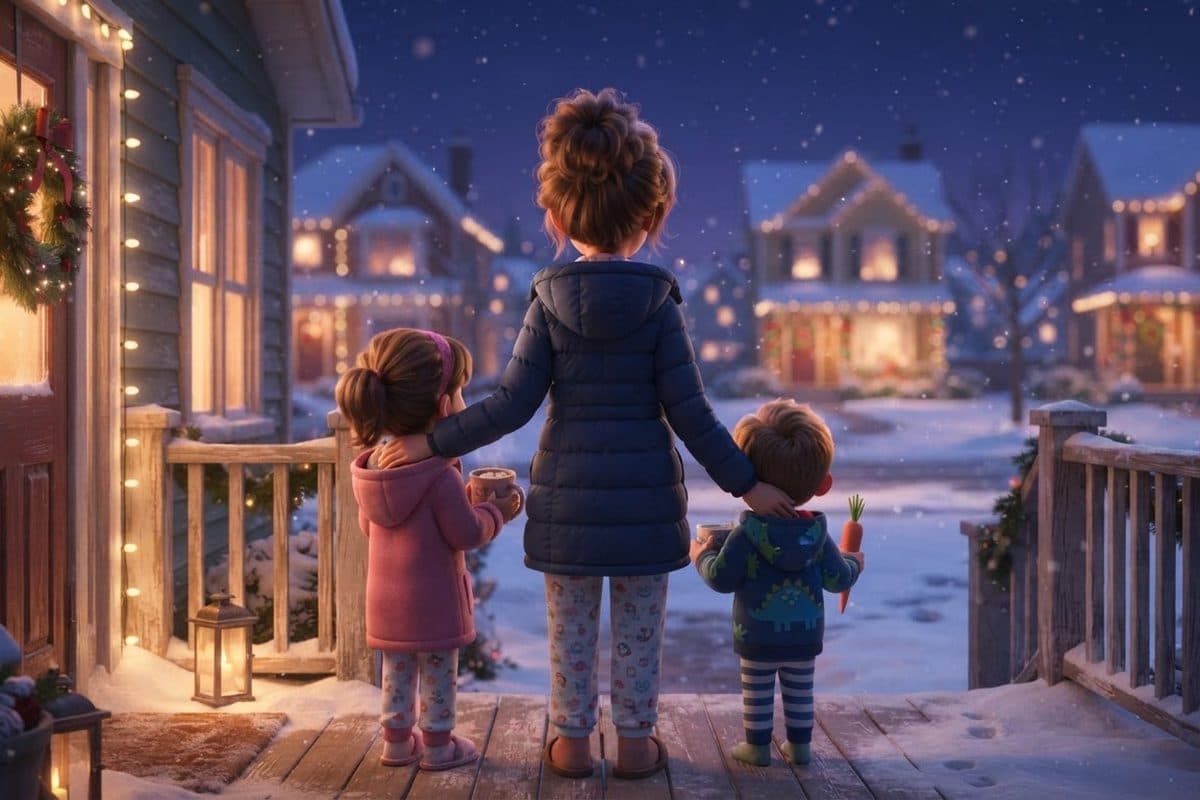
Search for Christmas Eve traditions and the same list comes back a hundred times: matching pajamas, a box on the doorstep, cookies for Santa, carrots for the reindeer, a movie, a drive to see the lights, a book. Every one of them is lovely. All of them in one evening with a three year old is how Christmas Eve ends in tears at a quarter past nine, and not always the child's.
A tradition is not an activity. It is the fact that the activity comes back next year, at the same point in the evening, so a child can tell you what happens next. That is why the ones that last are small.
Below: what makes a tradition stick, what fits each age, the one present before bed, what Iceland's Christmas book flood actually is, how to borrow it with children too young to read alone, reading aloud on the night, tracking Santa, inherited traditions, and Christmas Eve away from home. One idea is a book we make, a Christmas Eve story with your child drawn into it, and we will say plainly where it fits and where something else is better.
What makes a Christmas Eve tradition stick
Psychologists who study families draw a useful line here. A 2002 review of fifty years of research, in the Journal of Family Psychology, separates routines, what a family observably does, from rituals, what the doing stands for. Brushing teeth is a routine. The Christmas Eve story, in the same chair, with the same voice for the reindeer, is a ritual. The review linked both with children's adjustment and parenting competence, and was candid about the limits of the studies behind those links.
Three studies published in 2016, with just over a thousand participants, looked at holidays directly. People with family rituals at Christmas reported enjoying it more; doing a ritual together added to the pleasure of simply being together, while rituals kept alone were not linked to enjoying the holiday more. The tradition is the part you do together.
The ones that last share three things:
- They are small, small enough for a feverish child or a tight year.
- They happen at the same point in the evening. The order is what lets a child predict the night, and predicting it is half the pleasure.
- There is a part for the child. The child who carries the carrots out to the step owns the tradition in a way the child who watches does not.
Christmas Eve traditions for kids, by age
A two year old and a nine year old need different evenings. Use the table as a starting point.
| Age | Traditions that fit | How many | What to leave for later |
|---|---|---|---|
| 2 and 3 | Lights from the stroller or the car in pajamas, one present before the bath, carrots for the reindeer, the same short story in bed | Two or three, done by bedtime | Anything that asks them to sit still after dark |
| 4 and 5 | The plate for Santa, one look at the NORAD map, a call to a grandparent, a Christmas Eve book in bed | Three, in last year's order | Changing the order to surprise them: at this age the order is the tradition |
| 6 and 7 | A job of their own: setting the table, choosing the book, reading a page aloud, wrapping a present for someone | Three or four, one theirs to run | Traditions that only work while they believe in Santa, with nothing ready to replace them |
| 8 to 10 | Running the book exchange, cooking one dish, reading to a younger sibling | Whatever they keep asking for | Retiring a tradition without asking them: they may be the ones holding on to it |
Two things hold at every age. The order matters more than the content: a child who knows the present comes before the story feels the evening moving toward bed instead of being sent there. And children grow into traditions, not out of them, as long as each tradition grows a part for them.
With toddlers, finish early. Everyone in the house is excited, and a two year old soaks it up with no way to spend it. Do the traditions in the late afternoon, keep the usual bath and bedtime, and let the grown-up evening start after they are asleep. In late December the sun sets before dinner across most of the country, so the lights are on well before a toddler's bedtime.
One present on Christmas Eve, or a box
Is it a tradition to open gifts on Christmas Eve? In much of the world it is the main event: in Germany, Poland, Iceland, Sweden, Brazil, Argentina and French-speaking Quebec, among others, presents are opened mostly on the evening of the 24th. In the United States, as in Britain and Italy, the main opening mostly waits for the morning, and the familiar American compromise sits in between: one present tonight.
The one present works best when it belongs to tonight:
- Pajamas, put on straight away, so the photo on the stairs has everyone in the new ones.
- A book, which becomes tonight's story. This is the Icelandic version, and it gets the next two sections.
- Something for the evening: a puzzle, a card game, a flashlight for looking at the lights from the bedroom window.
- Not the big wanted present. That one belongs to the morning, which needs something to wait for.
A Christmas Eve box is the same idea in a container: pajamas, a book, hot chocolate and something small, opened between dinner and bed. It has its own way of growing out of hand, so it has its own guide: Christmas Eve box ideas.
If the one present is a book, the strongest choice is a story set on this exact night. We make one with your child drawn in, and you can see them as the character in about half a minute, free, before deciding anything.
Jólabókaflóð: what Iceland's Christmas book flood actually is
Jólabókaflóð means the Christmas book flood. The version that traveled abroad has every Icelander reading in bed all night on Christmas Eve, with hot chocolate. It is lovely, partly true, and leaves out what the word actually names.
- The flood is a publishing season: the wave of new books released in Iceland before Christmas. It opens with Bókatíðindi, the Icelandic Publishers Association's free catalog of new titles, which comes out in November and goes to every household in the country. In 2022 the association's president told Smithsonian Magazine that the four months nearest Christmas bring in half of Iceland's book sales.
- It took hold during the Second World War, when import restrictions left little to give and paper was easier to come by than most goods. Books became the Christmas present, and stayed that way.
- Presents are opened on the evening of the 24th. Christmas in Iceland begins at six, when church bells ring, and the presents come after dinner. In 2012 the head of the Iceland Publishers Association told NPR that people spend that night reading.
- The reading in bed is the part that traveled. Not every Icelander spends the night under a lamp. The editor of Iceland Review told Smithsonian Magazine there is a grain of truth in it but it is not that simple, and a translator of Icelandic literature called it "somewhat romanticized for the benefit of foreign book lovers", though still alive.
Some of what you read about it in English comes from outside Iceland. Jolabokaflod.org, for one, is a British initiative, launched in 2015 by a publishing executive who read about the custom in a trade magazine, according to its own founding story as we read it in October 2026. It has carried book giving well beyond Iceland, and it describes the flood as a yearly retail cycle.
None of this makes the custom less worth borrowing; it changes what to borrow. An older Icelandic custom fits small children better: for centuries, on winter evenings in the farmhouses, the household worked in one room while one person read aloud to everyone else. It was called the kvöldvaka, roughly the night vigil.
How to borrow the book flood with small children
The Icelandic picture assumes readers who can vanish into a book alone. A three year old cannot. Keep the core, a book as the present that matters, opened on Christmas Eve, and make the reading something done together.
- One book for every person, adults included.
- Chosen for that person, not for the shelf: a board book at two, a picture book at four, a first chapter book at seven.
- Opened after dinner, all at once, as the one present of the evening: the book flood meets the American one-gift custom.
- Read aloud, smallest reader first, in one bed or on the couch. The adults' books wait until the children are asleep.
- A line inside the cover, with the date. Years from now it is often the part they look for; if you are stuck, see what to write in a book for a child.
For a book exchange, draw names in early December so everyone buys one book for one person. It puts an eight year old in charge of choosing a book for a four year old.
The best book to open on Christmas Eve happens on Christmas Eve, and we wrote one for this night. Our personalized Christmas book, The Last Present, begins on December 24 with a child who is not even slightly sleepy and a hedgehog in red mittens tapping at the window.
What it is not: your family's own Christmas Eve. The story, the snow and the hedgehog are ours, the same for every family. What is yours: your child's face on every illustrated spread, their name in the words, and the dedication you write, printed word for word. For a two year old, a short board book is the better choice. It is printed after you order, so for this Christmas order by December 1, the date on our shipping page. How it compares with other kinds is in our guide to custom children's books.
Reading aloud on the night
Christmas Eve may be the most excited evening of a child's year, and the story is what brings it down. The lead author of the American Academy of Pediatrics' 2024 statement on reading with young children suggests making books the bedtime routine, a way to connect and wind down after a busy day. No day is busier for a five year old.
Keep the routine and add the traditions in front of it. The lights, the present and the tracker happen before the bath; after it, the evening is the usual one. The bedtime routine that ends the stalling has the scripts for the classic stalls, which tonight will be extra creative.
What to read. A story set on this exact night works best, because the child is living the evening it describes:
- A Visit from St. Nicholas, the poem that begins "'Twas the night before Christmas", first published anonymously in a Troy, New York, newspaper on December 23, 1823. It named Santa's eight reindeer, and who wrote it is still argued over.
- The Polar Express by Chris Van Allsburg, a boy's train ride to the North Pole on Christmas Eve, winner of the Caldecott Medal in 1986.
- A book with them in it. Between about three and six, children find it hard to carry a story about someone else over to themselves, and a book where the child is unmistakably them shortens that step: why children respond so strongly to seeing themselves in a story.
The same book every year. By the third year the child will correct you if you skip a line, and that correction is the tradition working.
Tracking Santa with NORAD
One of the most American Christmas Eve traditions began with a wrong number. NORAD's own site tells it this way: in 1955 a young child, after seeing a newspaper advertisement telling children to call Santa, accidentally dialed the unlisted number of the Continental Air Defense Command's operations center. The director of operations, Colonel Harry Shoup, answered and had his staff check the radar for signs of Santa. The tradition continued when NORAD was formed in 1958.
Today, on December 24, noradsanta.org follows Santa's route on a map with short videos, and volunteers answer a phone line, 1-877-HI-NORAD. By age:
- Three to five: one look at the map, just before the bath. Show them where he is and where you live, and let the distance do the work.
- Six to eight: they check, and report to everyone else. A call to the line is a big event at this age.
- Older children who have worked it out: put them in charge of the tracker for the younger ones. Being asked is its own kind of present.
NORAD's frequently asked questions add that Santa only comes once the children in a house are asleep, which is worth borrowing at bedtime. The one rule: check the tracker before the story, never after. A map still open at nine o'clock is a reason to stay up.
Christmas Eve traditions for the whole family
Some of the best Christmas Eve traditions are not built around the children, and children love them for exactly that reason.
- A dinner that is always the same. Not elaborate: this dinner, on this night, every year.
- A service, if your family goes. An early or family service suits a small child far better than midnight, and a candlelight service, with the flame passed from candle to candle, is a sight worth staying up a little for.
- The lights, on foot or by car, in pajamas under coats, with something warm to drink. Thirty minutes, no cost, any age.
- A call to someone who is not there, a grandparent in another state or a parent on shift, at the same time every year.
- A photo in the same spot, same stairs, every year. In ten years it is the record of everybody growing.
- Wrapping one present for someone else. The child chooses, wraps and labels it, and gives it before bed. It turns the evening from getting toward giving without a speech.
That last one is the whole idea of our Christmas book, which ends with a line for the reader: somewhere in your house tonight, somebody is wrapping, so go and find them. If that sounds like your house on the 24th, see your child drawn into the story first. The preview is free, with no card and no account.
New traditions, and the ones you inherited
When two families become one, so do two Christmas Eves, and they rarely match: one side opened everything on the 24th, the other would not touch a present before morning.
Traditions that feel ancient are often younger than they seem. Britannica notes that the Italian American Christmas Eve dinner of fish dishes is simply the dinner of the Vigil in Italy, and that the name Feast of the Seven Fishes is believed to be Italian American, first known in print in a Philadelphia newspaper in the 1980s. Families serve other odd numbers of dishes, and the fish runs from lobster to fish sticks. A tradition is allowed to bend for the people at the table.
- Keep one tradition from each side, the one each of you would miss most, and tell the children where it comes from.
- Add one that belongs only to this family, started on purpose. By the third year nobody remembers it was invented.
- Ask the children in January what they remember. Keep what they mention, and let go of what nobody does.
New Christmas traditions do not need a launch. Plenty of the best start as an accident somebody asks for again the next year.
Keep it small enough to repeat
Christmas Eve traditions rarely end by being dropped. They end by growing: one year a box, the next a box with a movie in it, then a themed dinner and a scavenger hunt, until it needs a week of preparation and one exhausted adult.
- Three things, in the same order. More, and something gets dropped every year, which teaches children the traditions are optional.
- At least one that costs nothing, so a tight year changes nothing that matters.
- Nothing only one adult can do. If the evening depends on one person's energy, it ends the year that person is tired or working.
- Finished before the children's bedtime. The grown-ups' Christmas Eve can start after.
The tradition that lasts is the one everybody in the house can do half asleep.
When Christmas Eve is at someone else's house
Grandparents' house, a cousin's apartment, an in-law's guest room: plenty of children spend Christmas Eve away from home, and their traditions have to travel.
- Pack what fits in a bag: the pajamas, the book, the closing line. A child in a strange room has an easier time when the last ten minutes of the day are the ones from home.
- Tell the host the order in advance, especially the bedtime part.
- Give the reading to a grandparent. It is a tradition in its own right, and a role worth offering before they have to ask.
- Leave room for theirs. Join one of the host's traditions and keep one of yours.
- If Christmas is split between two homes, let the traditions follow the child, not the house. The book, the closing line and the NORAD map work in either place.
The book is the easiest tradition to carry, which is one more reason to make it a good one. If you would like it to be a book they are in, start with one photo of your child and see the drawing first.
A short list, if you want one
The traditions in this guide, with the age they start to work, how long they take, and whether they survive a hard year.
| Tradition | From about age | Time it takes | Survives a hard year |
|---|---|---|---|
| Lights in pajamas, on foot or by car | 2 | Thirty minutes | Yes |
| One present opened before bed | 2 | Ten minutes | Yes |
| A story set on Christmas Eve, read aloud | 2 | Fifteen minutes | Yes |
| A book for everyone, opened after dinner | 2 | The evening | Yes, if the books are small |
| A call to someone who is not there | 2 | Ten minutes | Yes |
| Carrots for the reindeer, a plate for Santa | 3 | Five minutes | Yes |
| A Christmas Eve box | 3 | Fifteen minutes | If it stays small |
| One look at the NORAD tracker | 4 | Ten minutes | Yes |
| Wrapping one present for someone else | 4 | Twenty minutes | Yes |
| An older child reading to a younger one | 7 | Ten minutes | Yes |
| The same dinner, even if it is fish sticks | Any | An hour | If you let it bend |
Choose three and do them in the same order next year. If one is a story read aloud on the night, you have the one that travels, survives a bad year and costs nothing. For the rest of the pile, see Christmas gifts for kids who have everything; our personalized books for birthdays and Christmas all start with a free drawing of your child.
Sources
- A review of 50 years of research on naturally occurring family routines and rituals: cause for celebration? · Journal of Family Psychology, via PubMed, 2002
- Family Rituals Improve the Holidays · Journal of the Association for Consumer Research, via Experts@Minnesota, 2016
- Christmas Eve · Wikipedia
- Icelandic Christmas book flood · Wikipedia
- Um félagið (About the association) · Félag íslenskra bókaútgefenda (Icelandic Publishers Association)
- Iceland's Christmas Book Flood Is a Force of Nature · Smithsonian Magazine, 2022
- Literary Iceland Revels In Its Annual 'Christmas Book Flood' · NPR, 2012
- Christmas in Iceland · Wikipedia
- Founding story · Jolabokaflod CIC
- Beyond Literacy: Shared Reading Starting at Birth Offers Lifelong Benefits · HealthyChildren.org, American Academy of Pediatrics
- A Visit from St. Nicholas · Academy of American Poets, Poets.org, 1823
- The Polar Express, book by Van Allsburg · Encyclopaedia Britannica, 1985
- Caldecott Medal & Honor Books, 1938 to present · Association for Library Service to Children, American Library Association
- NORAD HQ (history and frequently asked questions) · NORAD Tracks Santa, North American Aerospace Defense Command
- Feast of the Seven Fishes · Encyclopaedia Britannica
Questions parents ask
What should you do on Christmas Eve?
Two or three small things, in the same order every year, finished before the children's bedtime. A walk or a drive to see the lights, one present opened before bed, a call to someone far away, one look at the NORAD Santa tracker and a story read aloud are the classics. What turns any of them into a tradition is not the activity but the repetition: the same evening, in the same order, next year.
Is it a tradition to open gifts on Christmas Eve?
In much of Europe and parts of Latin America, yes: in Germany, Poland, Iceland, Sweden, Brazil and Argentina, among others, presents are opened mostly on the evening of December 24. In the United States the main opening mostly waits for Christmas morning, and a familiar compromise is one present on Christmas Eve, often new pajamas or a book that becomes that night's story.
What is a Jólabókaflóð?
It is Icelandic for the Christmas book flood: the wave of new books released in Iceland in the months before Christmas, opened by a free catalog of new titles that goes to every home in November. Books are the classic Icelandic Christmas present, opened on the evening of December 24. The picture of the whole country reading in bed all night is partly true, and people who know Iceland's book world call it somewhat romanticized.
Why do Icelanders read so much?
Part of it is history: Iceland has written down its own stories since the medieval sagas, and for centuries farm households spent winter evenings with one person reading aloud to the rest. Part of it is the book flood itself, which makes books the standard Christmas present and which Iceland's publishers describe as the backbone of their trade. The result is a culture that treats a book as a serious gift.
What do Icelanders do on Christmas Eve?
Christmas in Iceland begins at six in the evening on December 24, when church bells ring. Families who go to church attend then, and others sit down to dinner straight away. After the meal the presents are opened, and since books are the classic present, a good part of the evening goes to reading, though not in every house and not by everyone in it.
What are good Christmas Eve traditions for toddlers?
Short ones that finish before their usual bedtime: seeing the lights from the stroller or the car in pajamas, opening one present before the bath, carrying carrots out for the reindeer, and the same short Christmas story in bed. Two or three are plenty. Keep the usual bath and bedtime order, and let the grown-up part of the evening begin once they are asleep.
How do you start a Christmas Eve book exchange with kids?
Draw names in early December so each person buys one book for one other person, children included, with an adult helping the youngest choose. Wrap them, open them together after dinner on Christmas Eve, and read the children's books aloud first, smallest reader first, before bed. Write the date and a line inside each cover. The adults read theirs once the children are asleep.
What are some examples of family traditions?
Anything a family repeats on purpose that means something to them: the same dinner on the same night, a walk to see the lights, a story read aloud every Christmas Eve, a photo on the same stairs every year, a call to a grandparent at a set time, a present each child wraps for someone else. The best ones are small enough to keep in a hard year.
When does NORAD start tracking Santa?
On December 24. NORAD's site follows Santa's route on a map through the day and evening, with short videos, and volunteers answer a phone line, 1-877-HI-NORAD, with his current position. The tradition dates to 1955, when a child's call to Santa reached a military operations center by mistake. NORAD's own answers add that Santa only arrives once the children in a house are asleep.
NORAD Tracks Santa, The Polar Express, Caldecott Medal, Smithsonian Magazine, NPR, Iceland Review and Britannica are trademarks of their respective owners. Dreamtale Cartoons is an independent studio, not affiliated with, sponsored or endorsed by any of them.