
Reading together
Christmas Morning Traditions: How to Make the Morning Last Longer Than the Wrapping Paper
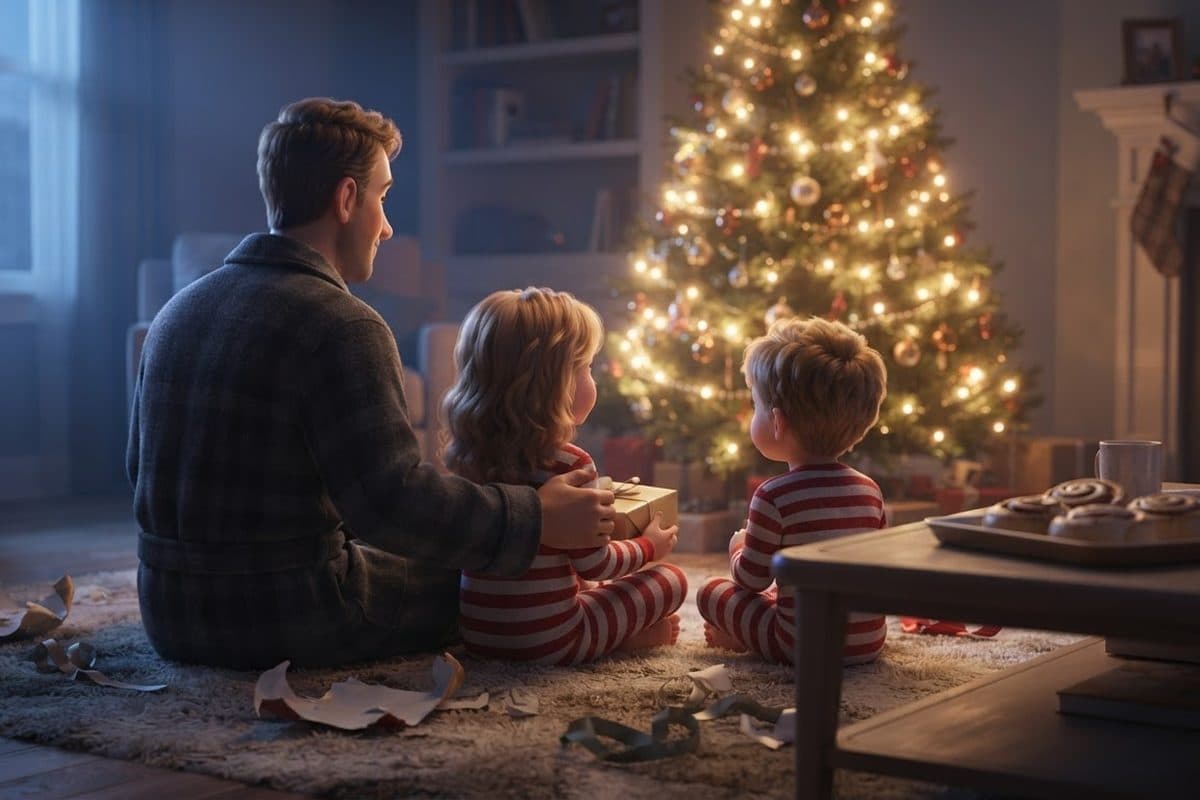
Search for Christmas morning traditions and you get ideas: cinnamon rolls, matching pajamas, stockings first. All lovely. What they rarely say is that the morning needs a shape, because it is the shortest part of the whole season.
That is the real problem, and it is hardly ever said out loud: months of waiting get unwrapped in a few minutes. A tradition is whatever slows that down and gives the morning a middle and an end, for a toddler, a house of teenagers, a family in two homes, or two adults with no kids.
Below: the morning hour by hour, pacing, the 7 gift rule, breakfast, traditions by age, the lull, and mornings for separated families, couples and empty nesters. Two ideas are books we make; we say where they fit and where not.
The real problem: months of waiting, opened in minutes
Christmas morning is hard to get right because it squeezes weeks of anticipation into the few minutes it takes to open what is under the tree. The fix is not more presents. It is a shape for the morning: a few small traditions in a set order, so the best part lasts longer than the paper takes to clear.
The waiting is long, then paper tears faster than anyone planned, and by the time the coffee is cool it is over. The morning can go wrong in three ways:
- The pile. Fifteen things opened at speed, and the child is looking for the next one by the sixth.
- The lull. Ten o'clock, paper everywhere, nothing planned.
- The one who runs it all. One adult cooks, films and cleans, and is the only person who did not get a Christmas morning.
One piece of research we found looks at holiday rituals directly: three studies published in 2016, with 1,098 participants in all. People who reported family rituals on Christmas were more likely to spend the day with family and enjoyed it more, and doing a ritual while with family added to the enjoyment of simply being together. Rituals done alone were rare and were not linked to enjoying the holiday. It is a link, not proof, and it covered Christmas and New Year's Eve rituals, not the morning and not presents. Applying it here is our reading: it supports putting shared rituals into the morning, and says nothing about how many presents to give.
How should Christmas morning go, hour by hour?
A Christmas morning that lasts has about seven beats, in the same order every year: everyone gathers before anything is touched, stockings come first, breakfast was made the night before, presents are opened in two rounds with a pause between them, one gift is saved for last, and something is planned for after, like a walk, a call or a game. Think in beats, not clock times, because the right hour depends on when your youngest wakes up. With toddlers, shrink every beat. With teenagers, give them a job in one. With two adults and no kids, keep the beats and drop the pile. These are Christmas morning traditions for families of any size: the order stays the same, and the table gives each beat a planning length.
| The beat | What happens | Planning length |
|---|---|---|
| 1. Gathering | Everyone in one room, mug in hand, before anything is touched. | 5 to 10 minutes |
| 2. Stockings | One each, on the couch or in bed. | 15 to 20 minutes |
| 3. Breakfast | Made the night before, eaten now or between rounds. | 30 to 45 minutes |
| 4. Round one | Presents one person at a time, each shown to the room. | 20 to 30 minutes |
| 5. The pause | Nobody opens anything. Play, clear the paper, refill the mugs. | 15 to 30 minutes |
| 6. Round two | The rest of the presents, then one gift saved for last. | 20 to 30 minutes |
| 7. After | A walk, a call, a game, a nap. | The rest of the day |
These lengths are planning guides, not averages. Stretch them to fit the youngest person in the room, and write the order down once so nobody invents it at six in the morning.
Stockings first, and one rule about waking up
Open stockings first, in our view. Stockings give everyone something small to open before the big presents, they can happen in pajamas on the couch while breakfast bakes, and they set a slower pace for everything after. The one exception is a house where the stocking is the main event, and then the order can flip.
The rule about waking up. Early risers are the first problem of the morning. Pick a rule a child can follow without waking you: stay in your room until a lamp on a timer comes on, then everyone walks in together, mug in hand, before anything is touched.
- Best for ages 2 to 5: on your bed or the couch, one item at a time, with an adult saying what each thing is.
- Best for ages 6 to 10: take turns pulling out one thing, showing it, and passing the stocking on.
- Best for teenagers and adults: a round of their own, with coffee.
A stocking idea for a book that is still on its way. If a personalized present has not arrived yet, roll a handwritten note into the toe that says a story about them is coming, with the arrival date your cart shows. To see your child drawn as a story character first, start with one photo, free, with no card and no account.
How do you slow down opening presents on Christmas morning?
Slow it down by changing who opens and when, not by scolding. Open one person at a time, in an order that rotates each year. Let a child hand out each gift. Ask the opener to show it to the room, and let the giver say why they chose it. Pause after every few presents to play with what was just opened, and split the pile into two rounds with breakfast or a walk in between. In our view, tearing through the pile is less greed than a morning with no shape yet, and a shape gives children something to do besides open. Start with the youngest if they are the least patient, or the oldest if the little ones need to watch first. Whatever you pick, keep it for next year, because the repeating is what makes it a tradition.
- Best for one or two kids and a video call with grandparents: one at a time, youngest first, so the screen sees every gift.
- Best for a restless six year old: the hander-outer, who finds the next gift and reads the name on the tag.
- Best for a bigger group: pass and open. Each person who finishes hands the next gift to someone else.
- Best for a family that rushes: show and say. The giver says one sentence about why they chose it.
- Best for toddlers and anyone easily overwhelmed: two rounds, half before breakfast and half after.
In our view, adults set the pace more than rules do, so open yours slowly too. And if your family likes the rush, keep it. The shape is for families who finish and feel flat.
What is the 7 gift rule for Christmas?
The 7 gift rule is a Christmas shopping rule that gives each child seven presents, one for each of seven categories. The versions we read agree on something to want, something to need, something to wear and something to read, and then differ on the last three. It builds on the simpler 4 gift rule, and none of the pages we opened says who invented it. Because the two versions differ, treat it as a framework, not a law. The pages we read present it as a way to keep spending down and the holiday simple. On Christmas morning it does a second thing: with seven presents instead of twenty, each one gets looked at, and the opening has room for a pause.
| Version | The categories | Best for |
|---|---|---|
| 4 gift rule | Want, need, wear, read | A firm, simple cap |
| 7 gift rule, per Simply Well Balanced (2021, updated 2024) | Want, need, wear, read, do, something for me, something for the family | A list with a shared gift |
| 7 gift rule, per Unanswered | Want, need, wear, read, do, eat, something for the family | One edible, one shared gift |
On Understood, Amanda Morin wrote in October 2019 about giving each of her sons four gifts, chosen with them, and a calmer holiday with less disappointment. It is one parent's experience, not a test. Alanna Gallo, a purposeful play expert quoted by Scary Mommy, says around six to ten presents might be ideal for ages 5 to 7, as long as the same amount of old toys goes out, and gives no fixed number for ages 2 to 4, because children that age are not really counting presents.
The rule caps the number, not the feeling: seven gifts opened in two minutes is still two minutes, so pair it with the pacing above. And something to read is the easiest of the seven to make personal: watch your child get drawn as a story character in about half a minute, free.
What should you eat on Christmas morning?
Eat something you made the night before, so nobody is cooking while the presents are opened: cinnamon rolls or a baked egg casserole that go into the oven during stockings. The best Christmas breakfast needs ten minutes of attention and then looks after itself, because the cook is also part of the morning.
- Best for early risers: a baked egg casserole, put together on Christmas Eve and baked during stockings.
- Best for a sweet tooth: cinnamon rolls, rolled and refrigerated the night before, or from a tube.
- Best for toddlers and picky eaters: a grazing plate of fruit, toast and yogurt, eaten between rounds.
- Best for a crowd: a pancake or waffle bar, if one adult is happy at the stove.
- Best for no cooking at all: bakery pastries and a hot chocolate bar, set up on Christmas Eve.
Before the presents or after? Eat first if the children can wait, and between the rounds if they cannot, so breakfast becomes the pause. What makes it a tradition is the same dish on the same morning, with a small job for each person.
Christmas morning traditions for kids, from toddlers to teenagers
Christmas morning traditions for kids should match the age: toddlers need a small pile and a short morning, four to seven year olds need a job and an order, eight to twelve year olds need a part of the morning that is theirs to run, and teenagers need sleep first and then one role.
Toddlers, about 1 to 3. Christmas morning traditions for toddlers should be short and quiet. A study of 36 toddlers aged 18 to 30 months, published in 2018, gave each child supervised, individual free play with four toys and with sixteen. With four toys the children picked toys up less often but played with each one for longer and in more different ways, and the authors suggest that fewer toys let toddlers focus longer and play more creatively. It was a small study in a lab playroom, with toys rather than presents, so take it as a hint: bring out a few presents at a time and keep the rest for later.
Ages 4 to 7: a job and an order. Give each child a job: handing out gifts, reading the names on the tags, carrying the paper to the bag.
Ages 8 to 12: a part to run. Let them run one beat: the hot chocolate, the music, the photos, or the order of opening.
Teenagers: sleep first, then one role. Let them sleep a little later and name the beat they are needed for, such as the stockings or the coffee.
Save one gift for last, and make it the one that means something
Save one gift for last, because the last thing opened is where the morning ends. Make it small or soft rather than expensive, and make it about the people in the room, not the thing in the box. A story read aloud right after is the easiest ending, because it keeps everyone on the couch.
- Best for a child who counts their own presents twice: a gift they give, wrapped and labeled by them.
- Best for children from about 3 to 10: a story about them, which is the idea behind the book below.
Dreamtale Cartoons, a small studio that has drawn about ten thousand families since 2020, makes The Last Present, a personalized hardcover Christmas Eve story in rhyme for ages 3 to 10, with your child drawn in the look of a modern 3D animated film on every illustrated spread.
What it is not: your family's own Christmas morning. The story and the hedgehog are ours, the same for every family; yours are your child's face, their name in the words, and the dedication you write, printed word for word on its own page after the story (what to write in a book for a child has ideas). It is a Christmas Eve story, so it fits read on the 24th or opened last on the 25th. For a child under 3, a short board book is better.
It is printed after you order, so for this Christmas order by December 1, the date on our shipping page; the book page and the cart show real delivery dates before you pay. Our guide to personalized books for kids compares it with other kinds.
The lull after the presents, and what to do with it
The lull is the stretch after the last present when the paper is on the floor and everyone is suddenly bored or tired. It is predictable, so plan it: something outside, something the whole family does together, something quiet, and a phone call. A planned lull feels like part of the day. An unplanned one feels like the end of it.
- Best for kids with energy: get outside. A walk before dinner, a first ride on the new bike.
- Best for the whole family together: one shared project, like a jigsaw puzzle on the floor.
- Best for far-away family: the calls, at a set time, so the morning is yours until then.
- Best for adults who need a break: the nap. Nobody has to earn a nap on Christmas.
For a gift the whole household shares, see a gift for the whole family. We also make One More Hour, for ages 3 to 12 and a household with a mom, a dad and a child, all three drawn from your own photos, one photo each. In it the hall clock strikes thirteen, an hour that is not on any clock, and the three of them spend it outside on the wet grass doing the things there is never time for. It is not a Christmas story. It is about an hour with nothing in it but the three of you. The story is ours and the same for every family; the three faces and the dedication are yours. For a differently shaped household, a different book fits better. Draw all three of you from your own photos, free.
Christmas morning traditions for separated and blended families
When a family lives in two homes, give each home its own Christmas morning and keep the same shape in both. Children do not need two identical mornings. They need to know what happens in each one. Keep the order the same, let the traditions travel with the child, and do not compete over the size of the pile.
Who has the children on which day is for the adults, or a court, to decide; this is only about the shape of the morning. The American Academy of Pediatrics, on a HealthyChildren.org page last updated in September 2020, says children should keep as many routines as possible during times of change. It is about separation, not holidays, so applying it to Christmas is our reading: the same order in both homes gives a child one routine in two places. Brittany Peters, MD, writing for Prisma Health in November 2022, advises talking with the other parent about gifts so you do not duplicate or try to outspend each other.
- Best for parents who alternate years: a second Christmas morning on the day the children arrive, with the same beats.
- Best for blended families: let each child keep their own tradition and add one shared one. A count rule like the 4 or 7 gift rule is easy to explain across step-siblings.
- Best for a child who goes between homes: a tradition that fits in a bag, like a stocking, a card game or a story. A book is the easiest to carry, and trying one on a photo of your child costs nothing.
Christmas morning traditions for couples and empty nesters
Without children at the tree, the morning can go too quiet or too busy, and both are fixed the same way: keep the shape and shrink the pile. Couples and empty nesters can do stockings for each other, open one gift at a time, make a long breakfast, and call the family at a set hour.
Christmas morning traditions for couples. Do the stockings first, in turns, and open the main presents one at a time. End with a letter or a photo, not a purchase. Christmas traditions for couples has more, and Christmas gifts for couples is about what to put under the tree.
Christmas morning traditions for empty nesters. The new problem is timing: grown children arrive on different days, or cannot come.
- Best for children who arrive on Christmas Eve night: a quiet morning of your own first, the family's morning second.
- Best for children who cannot come: a video call at a fixed time, and a stocking sent in the mail for them to open on the call.
- Best for a house that misses the old noise: hand a tradition to a grown child, who makes the cinnamon rolls or runs the hot chocolate bar.
How do you make Christmas morning more magical?
Make Christmas morning more magical by preparing the night before and doing less on the day: breakfast ready, camera charged, a clear path to the tree, one small sign that something happened in the night, and the first ten minutes free of phones. In our view, magic is mostly attention, and a calm adult with a warm mug gives more of it than a bigger pile of presents.
How to make Christmas morning magical is mostly about what you do after the house is quiet. The 24th itself is in Christmas Eve traditions for kids and Christmas Eve box ideas; this page starts when the box is closed.
- Batteries, tape and a trash bag, where you can find them.
- The camera, with a spot to stand, and a clear path for the youngest coming through the door.
- One sign of the night. A plate with crumbs, a note back from Santa, a boot print in flour by the fireplace, set up after the children are asleep.
Best for children who believe: the sign of the night, which they find with their own eyes. Best for children who have stopped believing: let them set up the sign for a younger sibling. None of these Christmas morning ideas needs a budget, only half an hour at the end of Christmas Eve.
A short list, if you want one
If you choose only one Christmas morning tradition, choose the one that gives the morning an end: one gift saved for last, opened with everyone watching. The table gives each tradition its best fit, a planning time (a guess, not an average) and what you need, so you can pick three or four and write them down.
| Tradition | Best for | Planning time | What you need |
|---|---|---|---|
| Everyone gathers first | Any family | 5 to 10 minutes | A rule for waking up |
| Stockings first | Ages 2 and up | 15 to 20 minutes | One stocking each |
| Presents one at a time | One to three children | 20 to 30 minutes | An order, written down |
| Two rounds with a pause | Toddlers | Most of the morning | A walk or breakfast between |
| One gift saved for last | Any family | 10 to 15 minutes | One wrapped gift, hidden |
| A walk, a game or a call | The lull | 30 to 60 minutes | Coats, a game, a phone |
For the rest of the pile, see Christmas gifts for kids who have everything. And if you want the morning to end on a story, see your child drawn into one first.
Sources
- Family Rituals Improve the Holidays · Journal of the Association for Consumer Research, via Experts@Minnesota, 2016
- The influence of the number of toys in the environment on toddlers' play · Infant Behavior & Development, via PubMed, 2018
- Want Need Wear Read: The holiday gift strategy that works for my kids · Understood, 2019
- The 7 Gift Rule for Christmas Gift-Giving to Kids · Simply Well Balanced, 2021
- What Is the 7 Gift Rule for Christmas? A Guide to Thoughtful Gifting · Unanswered, 2026
- How Many Gifts Should A Child Get For Christmas? Experts Weigh In · Scary Mommy, 2022
- How to Support Children after Their Parents Separate or Divorce · HealthyChildren.org, American Academy of Pediatrics, 2020
- 9 holiday coping tips for divorced families · Prisma Health, Flourish blog, 2022
Questions parents ask
What are some good Christmas morning traditions for families?
The ones with a fixed order and a job for everyone: stockings first, breakfast made the night before, presents opened one person at a time in two rounds, one gift saved for last, and something planned for after, like a walk or a call to family far away. Keep three or four, do them in the same order next year, and add nothing that only one adult can run.
What should you eat on Christmas morning?
Something you made the night before, so nobody cooks while the presents are opened: a baked egg casserole or cinnamon rolls that go into the oven during stockings, a grazing plate of fruit, toast and yogurt for toddlers, a pancake or waffle bar for a crowd, or bakery pastries with a hot chocolate bar if you want no cooking at all. The dish matters less than doing it again next year.
What is the 7 gift rule for Christmas?
A shopping rule that gives each child seven presents, one per category. The versions we read agree on something to want, need, wear and read, and then differ: one adds something to do, something for me and something for the family; another adds something to do, something to eat and something for the family. It builds on the simpler 4 gift rule, and none of the pages we opened says who invented it.
How do you make Christmas morning more magical?
Prepare the night before and do less on the day: breakfast ready, camera charged, a path cleared to the tree, one small sign that something happened in the night, and the first ten minutes kept free of phones. In our view, magic is mostly attention, and a calm adult with a warm mug gives more of it than a bigger pile of presents.
What are good Christmas morning traditions for toddlers?
Short and quiet ones: stockings in bed or on the couch, a few presents opened one at a time, a snack between them, and the rest held back for later. A small 2018 lab study of 36 toddlers aged 18 to 30 months found longer play with each toy, and more varied play, with four toys than with sixteen. Expect the wrapping paper to be a favorite, and stop when they do.
How do you handle Christmas morning when parents are separated?
Give each home its own morning and keep the same shape in both: stockings, breakfast, a round of presents, a last gift. The American Academy of Pediatrics advises that children keep as many routines as possible when a family changes, and a physician at Prisma Health suggests talking with the other parent about gifts instead of competing. Let the traditions travel with the child, and keep the pile small.
What are some unique Christmas Day traditions?
Unique mostly means yours. Ideas to try: the youngest hands out every gift, each person who finishes opening passes the next one to someone else, the giver says why they chose it, one gift is saved for last and opened by everyone together, or a walk happens before dinner. Pick one that fits your house and repeat it. What makes it unique is that it comes back.
What are good Christmas morning traditions for empty nesters?
Keep the shape and shrink the pile: stockings for each other, one gift at a time with the story behind it, a long breakfast, and a call to the family at a set hour. If grown children arrive later, do your own morning first and the family's second. If they cannot come, a video call at a fixed time and a stocking sent in the mail keep the tradition alive.
Do you open stockings or presents first?
We suggest stockings first, because they are small and quick and can happen in pajamas while breakfast cooks, which sets a slower pace for the big presents. The exception is a family where the stocking is the main event, or a house with a toddler who will not wait. Whichever you pick, keep the same order every year, because the order is what makes it a tradition.
Understood, Simply Well Balanced, Unanswered, Scary Mommy, Prisma Health and HealthyChildren.org are trademarks of their respective owners. Dreamtale Cartoons is an independent studio, not affiliated with, sponsored or endorsed by any of them.
Keep reading
Reading together
Christmas Eve Traditions for Kids, by Age, and How to Borrow Iceland's Book Flood
20 min read
Gifts
Christmas Gifts for Kids Who Have Everything (Without Adding to the Pile)
23 min read
For the two of you
Christmas Traditions for Couples: How to Start Ones You Will Actually Keep
20 min read