
Gifts
A Gift for the Whole Family: Who It Is Really For, and the Ideas That Get Used
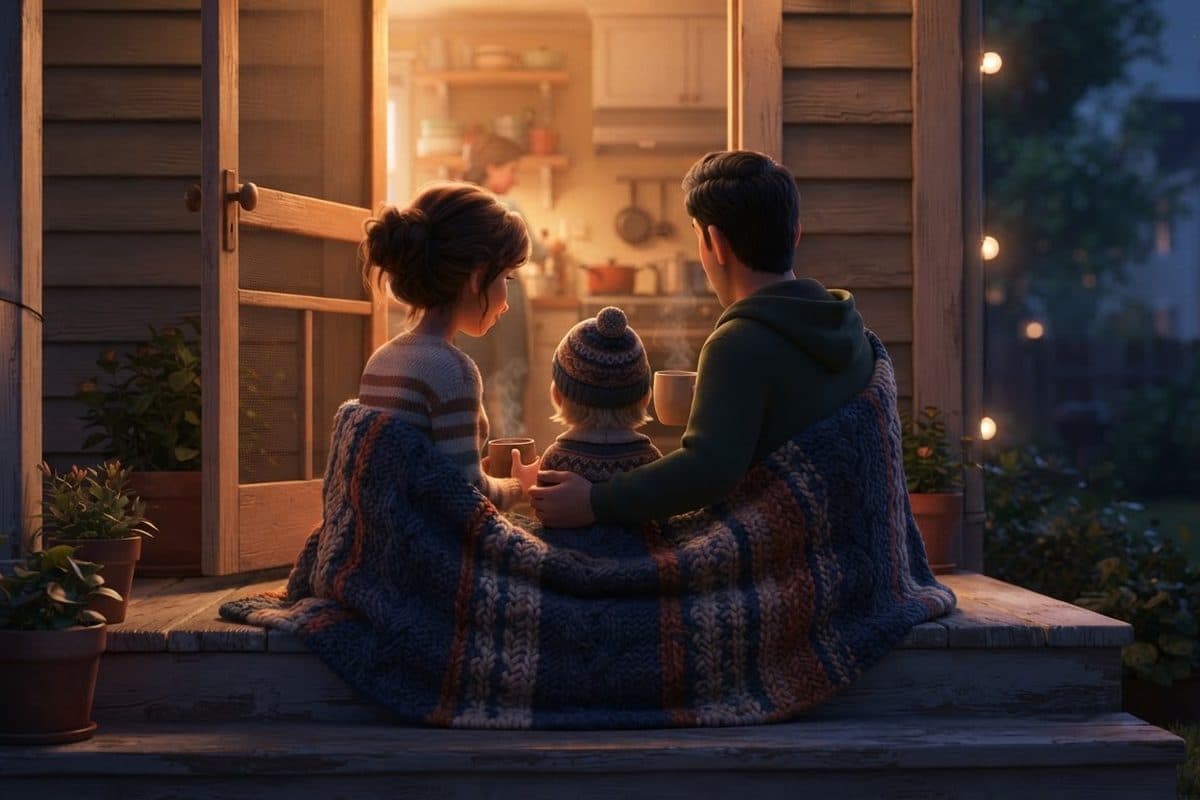
Looking for a gift for the whole family usually means one of two things: you are invited somewhere for the holidays and would rather bring one present than four, or you are buying for a household you love from a distance, and one shared gift feels warmer than a pile of separate ones. Either way the search returns the same page: board games, snack baskets, a blanket big enough for four.
What none of those lists asks is the question that decides whether the gift gets used: who is it really for? In a house with young children, the kids unwrap it and the parents live with it.
Below: three questions that sort a family gift in a minute, what the research on gifts found, five kinds of gift by age, ideas from memberships to pizza night, what grandparents and friends can give, what to skip, and the dates. One idea is a thing we make, a storybook with Mom, Dad and their child drawn in, and we say plainly which families it fits.
Who a gift for the whole family is really for
A gift addressed to the whole family is really two gifts in one box: a good moment for the children when it is opened, and a set of small jobs for the parents afterward. The trouble starts when the giver only pictures the first one.
Three questions sort it out before you buy:
- Will they use it at the same time? A family gift gets used together, in one room or one car. A tablet game for the nine year old with a tag that says "to all of you" is a gift for one person.
- Who does the work? Assembly, batteries, scheduling, driving, supervising, cleaning up. If it all lands on one adult, the gift came with a chore.
- Where will it live? A house with small children runs out of floor before it runs out of presents, and anything without a home is in the garage by spring.
The gifts that pass all three make time together instead of adding one more object to the shelf.
What the research on gifts found, and what it did not
One careful study speaks to this. In 2017 Cindy Chan of the University of Toronto and Cassie Mogilner of UCLA published experiments in the Journal of Consumer Research comparing material gifts, objects to keep such as jewelry or gadgets, with experiential gifts, events to live through such as concert tickets or a photography lesson.
Across four studies of real gifts in real relationships, experiences strengthened the recipient's relationship with the giver more than objects did, whether or not the two used the gift together. The difference did not come from the unwrapping, which was about as emotional for both kinds, but from the emotion felt while using the gift. Most people give objects anyway: in the authors' survey, 78 percent of 219 givers said their most recent gift was material.
Two details matter. Material gifts that made people feel something in use, such as photographs or jewelry marking a wedding or a birth, did about as well as experiences. And the study measured how close people felt to whoever gave them a gift, in the short term. It did not look at young children, at whole households, or at whether family members grow closer to each other.
So the honest translation is modest: choose a family gift by what happens when it gets used, not by how it looks unwrapped. That applies to what we make too. A storybook is an object, and it earns its place only if the evenings it gets read are worth something.
Five kinds of family gift, and the ages they suit
Almost every household gift that works falls into one of five groups, and which one fits depends less on the budget than on the youngest child, who decides how long an outing lasts and what can be left on the coffee table.
| Kind of gift | With a baby or toddler | Ages 3 to 6 | Ages 7 to 10 | Who does the work |
|---|---|---|---|---|
| Time together, booked | A short morning out, around the nap | A day out with the date on the card | A trip they help plan, a game night | The giver, if it is booked and paid |
| A membership | Somewhere close, for short visits | A zoo, an aquarium, a children's museum | A science center, a pool, a park pass | The parents pick the days, nothing to store |
| Something to make | Washable paint and a roll of paper | A baking night, recipe and jars included | A real project with real tools | One adult supervises, and cleanup is the catch |
| Something to eat | A breakfast box for a slow Saturday | A pizza night, toppings for each | A cookie decorating evening | Very little, and it gets used up |
| Something to keep | A photo book of the year | A storybook with the family drawn in | A family photo session | One photo or one afternoon, then a shelf |
With small children, two rows usually win: booked time, the one thing parents cannot buy themselves on a weeknight, and something to keep, because this year's family will not be next year's. If the second caught your eye, see your family drawn as storybook characters, free.
A family with a toddler is not a family with a nine year old
The same gift can be perfect for one household and wrong for the next, and the reason is usually the youngest child.
With a baby or a toddler, the day runs around naps and an early bedtime, so outings need to be short, close and in the morning. Small pieces are a hazard, not a nuisance: federal rules ban small parts in products meant for children under three, and a toy or game for ages three to six that contains them must carry a choking hazard warning. A game labeled 3 and up can be perfectly legal and still wrong for a house where somebody is one.
With school-age children, roughly six to ten, a family can sit through a game and last a whole day out. The children also have opinions, so a gift they help plan lands better, and their weekends fill with practices and parties, which is why a date on the card matters.
With both at once, look for gifts that work at both ends: anything outdoors, anything you eat, anything read aloud, since the older one can read to the younger. The American Academy of Pediatrics' guidance on toys makes a related point: traditional card games, board games and books, not their app versions, are what get adults and children playing together.
Experiences and memberships, booked rather than promised
A voucher for a family day out, handed over in December, has a way of still being on the fridge in May. A voucher is a job; a date on the calendar is a present.
- Put the date on it. Book the day, print the tickets and write the plan in the card, so none of the organizing falls on the parents.
- Give something to unwrap: the printed tickets, a map with the route drawn on it, binoculars for the zoo.
- Size it to the youngest. A morning that happens beats a weekend that never gets organized.
A membership is the experience that comes back, and leaving after forty minutes because somebody is tired stops feeling like a waste. Some memberships even travel: members of science centers in the ASTC Passport Program can get free general admission at participating centers more than 90 miles from both their home and their own center, and a membership for more than three people can cover up to two adults and four children. Benefits vary, so check before a trip.
If there is a fourth grader in the family, the federal Every Kid Outdoors program gives them, or a home-school equivalent, a free pass for the 2026 to 2027 school year, valid through August 31, 2027. At participating federal parks, lands and waters it admits all children under 16 and up to three adults where the fee is per person, or everyone in one passenger car where it is per vehicle. Camping, parking and tours are not included, and neither are state or city parks unless they accept it. The pass is free, so the gift is everything around it: the date, the route and the picnic.
Games the whole family will actually play
Most family games end up in a closet for the same reasons: too long, too hard for the youngest, or too easy for the adults. Four rules pick the ones that come out on a Wednesday:
- Twenty minutes or less, so it fits between dinner and bath.
- Some luck, some choice, so a six year old can beat a grown-up fairly.
- Cooperative when the ages are far apart: everyone wins or loses together against the board, and nobody has to let the four year old win.
- Matched to the youngest player in the house, which with a toddler around means big pieces, no pieces, or a high shelf.
The most underrated game gift is a good deck of cards with a handwritten list of five games inside, from a simple matching game to one the parents played as kids. Better still, give the evening rather than the box: a note that says Friday is game night all January, and the first one comes with pizza.
If a record of the family is the idea you keep coming back to, try it with the photos you already have: each face takes about half a minute to draw, free, with no card and no account.
Things to make and things to eat
The quietest success in this category is a gift that disappears. A household with small children is short of space, and something eaten or used up is welcome in a way a new object rarely is.
- A baking night in a box: the recipe written by hand, the dry ingredients measured into jars, cookie cutters and a date. Every age has a job.
- A breakfast box for a slow Saturday: pancake mix, good syrup, coffee, and a card that says breakfast is on you.
- Pizza night: dough, sauce, cheese and toppings for each person, so everybody builds their own.
- A project with a finish line: a birdhouse kit, a seed tray for March, a puzzle for the dining table.
The catch with anything to make is the cleanup, and it falls on whoever lives there. Glitter, slime and a kit with five hundred beads are gifts to the children and evenings of work for the parents. Give the version with three materials instead of thirty, or come over, make it with them, and leave with the leftovers.
A record of the family as it is this year
Families change faster than anybody inside one notices. The baby who could not say his sister's name is telling long stories by next Christmas. A record is the only kind of family gift that gains value every year, because this version of them will not come around again.
- A family photo session, booked and paid. Parents are often missing from their own photos, because one of them is holding the camera.
- A photo book of the year, if somebody will spend the evening choosing pictures.
- A storybook with the three of them drawn in. The one we make.
Ours is called One More Hour, for ages 3 to 9. The hall clock has been slow for years, and tonight it strikes thirteen. An hour that is not on any clock does not count, so nothing in it counts either. Mom, Dad and their child go out the back door in whatever they had on, into a backyard far bigger than it should be, and spend it on the things there is never time for: lying on the wet grass looking up, a race the child wins with cold toes, the wrong food at the wrong time on the back step. When the child asks to keep the hour, the answer is "No. But we get one every so often." In the morning nobody mentions it, and all three yawn at exactly the same moment.
What it is not: your family's own evening. The story and scenes are ours, the same for every family who picks this title. What makes it yours is the three faces, drawn from one photo of each of you, your child's name and the words they use for their parents, in the rhyming verses, and the dedication, which you write and we print word for word after the story. All three of you are on the cover and in twelve of the thirteen spreads; the first shows only the child, lying awake.
Bedtime is where a book like this earns its place. Why children go quiet at a picture of themselves is in why kids love seeing themselves in books; if bedtime is a negotiation, start with the bedtime routine that ends the stalling; and how custom books work in general is in our guide to custom children's books.
Which families One More Hour fits, and which it does not
Before you order a personalized family book, it helps to know exactly which family it was written for.
It fits a mom, a dad and one child between about three and nine. We fill in Mom and Dad, and you can change either word to Mama, Mommy, Momma, Daddy, Papa, Pop, or whatever your child really says at home; it is printed in the story and on the cover, after your child's name. A stepmom or stepdad fits the same way.
It does not fit these families, and we would rather say so now than when the package arrives:
- Two moms or two dads. The first grown-up is drawn as a woman and the second as a man, and the verses call him he.
- One parent. Both grown-ups are in the story from the second spread on. I Love You, Mom and I Love You, Dad have one parent and the child.
- Two or more children. The story has one child. You can order a copy for each child, but no single copy holds them all; The One Who Goes First has two children in it.
- Grandparents. They are not in this one. The House That Remembers has Grandma and the child, and The Unfinished One has Grandpa.
They all sit on our shelf of personalized books about family. If none of them holds your household, a framed family portrait holds everybody at once, and does it better than any book of ours. If it is a mom, a dad and one child, start with your child's photo and look before you decide.
When the gift comes from the grandparents
A grandparent can give the thing a house with small children is shortest of: time, and help the parents actually trust.
- A day with all of you, booked and paid, lunch included, grandparents driving.
- A membership renewed every year, so the family thinks of you every time they go.
- A night off for the parents, with you at the house and the children in pajamas.
- A family photo session, with you in at least one picture.
If the gift is One More Hour, three practical things. It needs a clear photo of each of the three: ask one parent, which makes them an accomplice, or use recent photos you already have if the parents are happy with that. Write your own dedication, because the one we print when it is left empty is signed by the parents; what to write in a book for a child helps if you are stuck. The cart offers one more copy of the same book, meant for the grandparents' shelf.
You are not drawn in this one. A book with a grandparent and a grandchild together is a different gift, covered in gifts for grandchildren and, from the other side, gifts for grandma from the grandchildren. If One More Hour is the one, run the free preview with the photos the parents send.
When you do not know the family well
Buying for a household you rarely see is harder, because you cannot see their shelves or their calendar. A few defaults keep it safe:
- Ask one good question. Not "what do the kids want?" but "what does a good Saturday look like at your house?" It tells you whether they are a park family, a kitchen family or a movie family.
- Default to something used up: food, a baking night, a meal at a place they already like. It cannot duplicate anything.
- Buy for the youngest. What suits the youngest works for everyone; what suits the oldest leaves somebody watching.
- Skip anything for display. The parents have already decided how their home looks.
- Ask before anything with the children's faces on it, say what the photo is for, and never save one from social media. What happens to a photo once it is uploaded is in what happens to your child's photo.
If several friends want to give together, pool it into one bigger thing, a membership or a booked day, rather than five small things that vanish into the pile.
What to skip: noise, mess and the big plastic thing
Most whole-family gifts that fail, fail the first question: the children enjoy them, and the parents pay in time, space or quiet.
| Instead of | Try | Why |
|---|---|---|
| A toy that sings, beeps or talks | A game the family plays together | The noise lands on whoever is home all day |
| A craft kit with glitter or five hundred beads | A baking night with the recipe and jars | It gets used up, and cleanup is one sink |
| A giant inflatable, a play tent, a ride-on car | A membership somewhere they already like | Nothing to store, and it comes back all year |
| A box that ships every month | One booked day with a date on it | A monthly box is a monthly chore |
| A toy with button batteries or high-powered magnets | Something with no batteries at all | Pediatric guidance on toys says to avoid both |
| A pet, as a surprise | A morning at a farm | An animal is a household decision, never a surprise |
| A gift card for a store they never visit | A dated plan at a place near them | A plan gets used; a card gets lost in a drawer |
A household gift is judged in March, not on the morning it is opened. The children's own presents are a different problem, covered in Christmas gifts for kids who have everything.
Timing, and the one date that matters for Christmas
In December every part of a household gift slows down.
- Experiences: book in November. A date in January is a perfectly good Christmas present, and often an easier one to keep.
- Memberships: ask whether it can start on the day you choose, and put the printed card in the box.
- Anything personalized is made after you order it. For our book, order by December 1 for Christmas; the rest of the year, the book page and the cart show the real delivery dates before you pay.
- Photos are the slow step when you are not part of the household, so ask for them in early November.
If the gift is meant for Christmas Eve, Christmas Eve box ideas shows what goes in one, by age. If you are late anyway, put the plan in the card, the booked date or the book on its way, and let the family have a second small Christmas when it arrives.
Our books are printed in the United States after you order, and a real artist checks every one before printing. The preview works at any hour, so see the three of them drawn tonight and decide in the morning.
Sources
- Experiential Gifts Foster Stronger Social Relationships Than Material Gifts · Chan & Mogilner, Journal of Consumer Research, 2017
- The science of gift giving: U of T research on the best kind of present to receive · University of Toronto News, 2016
- Toy Buying Tips for Babies & Young Children: AAP Report Explained · HealthyChildren.org, American Academy of Pediatrics, 2021
- Small Parts Ban and Choking Hazard Labeling · U.S. Consumer Product Safety Commission
- 16 CFR § 1500.19, Misbranded toys and other articles intended for use by children · Legal Information Institute, Cornell Law School
- ASTC Passport Program · Association of Science and Technology Centers
- Rules and instructions · Every Kid Outdoors, U.S. federal interagency program, 2026
Questions parents ask
What is a good gift for an entire family?
One that everybody uses at the same time and that does not hand the parents a new job. In practice that means a booked day out or a membership, a game that works for the youngest player, something to make or eat together, or a record of the family as it is this year, such as a photo session or a storybook with them drawn in. Before buying, ask who will store it, organize it and clean up after it.
What are good presents for families with young kids?
Short, close and used up. With a baby or toddler in the house, a morning outing near home, a breakfast box, a membership for quick visits or a photo book of the year works better than an evening ticket or a game full of pieces. Federal rules ban small parts in toys meant for children under three, so a family game labeled 3 and up can still be wrong for a house with a one year old.
What do you get a family that has everything?
Something that needs no space: time, food or a record of them. A booked day together, a membership somewhere they already like, a baking or pizza night, or a family photo session cannot duplicate anything they own. A household that has everything has usually run out of room first, so anything that has to live on a shelf should be something they could not have bought for themselves.
What is a good gift for multiple people?
Something they use together rather than one object split four ways: a game short enough for a weeknight, an outing with the date already booked, a meal or a kitchen project, or a shared keepsake. If the group spans ages, choose for the youngest person in it, because a gift that suits the oldest usually leaves somebody watching. One shared gift also avoids the question of who got the better present.
Are experience gifts better than physical gifts?
For the bond between giver and recipient, the research says usually yes. In experiments published in the Journal of Consumer Research in 2017, experiences strengthened that relationship more than objects, because of the emotion felt while using the gift, not while unwrapping it. Objects that stirred real emotion in use, such as photographs, did about as well. The study did not look at young children or at whole households.
What can grandparents give the whole family?
Time first: a day out together, booked and paid, a membership renewed every year, or a night off for the parents with the grandparents babysitting. A family photo session with the grandparents in one picture makes a good keepsake. For a personalized book of the family, ask a parent for the photos, write your own dedication, and consider one more copy for your own house.
What is a good Christmas gift for a family with young kids?
Something that works on a dark December evening and is still in use in February: a game they can finish in twenty minutes, a cookie or pizza night kit, an outing booked for January, or a storybook with the family in it to read at bedtime. Anything personalized is made after you order it, so order early. Our book needs ordering by December 1 to arrive for Christmas.
What is the best gift for family members?
If you are buying for each person, tie the presents together: a game for the household plus a small thing for each person to use with it, or a day out where everyone chooses one part. If you are buying one gift for all of them, pick something used together and sized for the youngest. Either way the test is the same: who uses it, and who has to look after it.
When should I order a personalized family gift for Christmas?
In November if you can, because anything personalized is made after you order it, and the photos are usually the slow step, especially when you are not part of the household. For our storybook, order by December 1 for Christmas. Outside December, the book page and the cart show the real delivery dates before you pay, so you know when it will arrive before committing.
ASTC Passport Program and Every Kid Outdoors are trademarks of their respective owners. Dreamtale Cartoons is an independent studio, not affiliated with, sponsored or endorsed by any of them.