
Gifts
Christmas Messages for Grandparents: What a Baby, a Child, a Teen or a Grown Grandchild Can Write
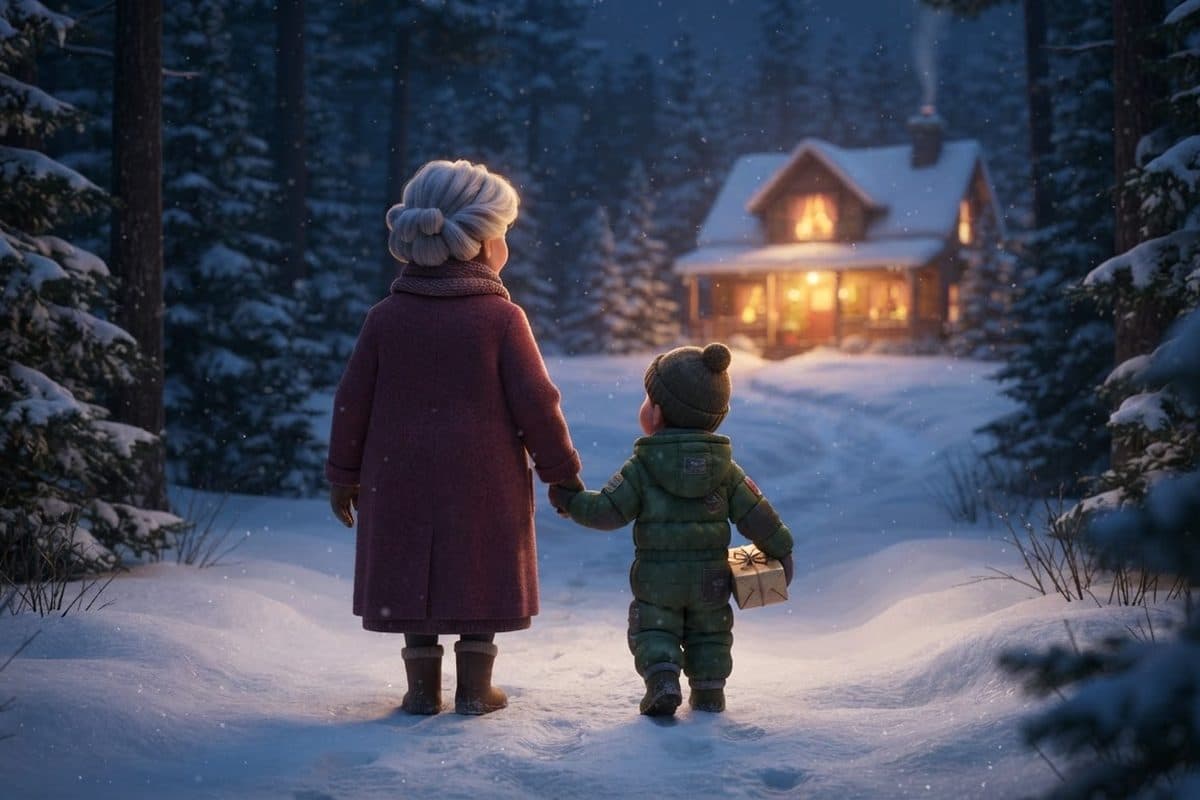
Search for christmas messages for grandparents and most of what comes back is verse: a heart full of love, a season of joy, thank you for being you. It is kind, and it all sounds the same. It also assumes the writer is an adult who writes verses, when the person holding the pen is usually a two year old with a crayon, a seven year old with an eraser, a fifteen year old with a phone, or a parent doing it for all of them.
This guide is the mirror of our Christmas messages for grandchildren, which is for the grandparent writing to the child. Here the grandchild writes, from a baby whose mother holds the pen to a grown grandchild with children of their own, and then by situation: grandparents far away, in assisted living or with memory loss, the first Christmas after a death, and step-grandparents.
At the end, the one thing we make that fits, and where a card is better.
What do you write in a Christmas card to your grandparents?
Write three things: one specific thank-you, one piece of news only you can give, and one plan for the next visit. Name the real thing, such as the lemon bars or the porch swing, and sign with the name you actually call them. A card with one true detail gets reread. A card with a verse gets filed.
- The thank-you. Best for any age. Not "thanks for everything" but the sled in the garage, the Sunday phone call, the way she saves you the last lemon bar.
- The news. Best for grandparents who are not at the table every night. They miss the small things: a lost tooth, a new teacher, the day you finally whistled.
- The plan. Best for a card you want answered. One concrete thing: a visit in March, a recipe you will cook together, a call on Sunday at six.
Which message for which age: a quick guide
A grandchild's message should match what the child can really do. A baby cannot write, so a parent does. A child of 3 to 5 can say what they want written. A child of 6 to 12 can write a few lines, a teenager three honest ones, and an adult a letter.
| Grandchild's age | Who does the writing | How long | A sample line |
|---|---|---|---|
| Baby to 2 | A parent, in the baby's voice or their own | Two or three lines | "Merry Christmas, Nana. I wave at your photo every morning." |
| 3 to 5 | The child dictates, an adult writes the exact words | Two or three sentences | "Grandpa, my tooth is wiggly and I like it." |
| 6 to 12 | The child writes, spelling and all | A short paragraph | "Dear Grandma, I can swim to the deep end now. Come watch." |
| 13 to 17 | The teenager, with a phone nearby | Three honest lines | "Merry Christmas, Nana. Your texts are the only ones I answer right away." |
| Adult, with or without children | The grandchild, on paper | A short letter | "Dear Grandpa, my daughter folds her napkin like you, and I never told you I noticed." |
A baby or toddler: a parent writes, and the child supplies the facts
For a child under three, the parent holds the pen and the child supplies the facts. Write two or three lines about something the child did this month, add a photo, handprint or scribble, and put the date and the child's age on the back. The grandparent reads the card but is really reading the child.
- In the baby's voice, or yours. Best for a first Christmas: "Merry Christmas, Nana. I have two teeth now and I am using both on the dog's ear. Love, Wren"
- With a scribble. Best for a toddler: "This is Milo's picture of you. The big circle is you and the little circle is the dog. He told me so himself."
Date it. If the grandmother is your mother-in-law and you are still looking for her gift, there is a guide to Christmas gifts for a mother-in-law.
How do you write a Christmas card when your 3 to 5 year old dictates it?
Taking dictation means writing down a child's words exactly as they say them. For a Christmas card, ask one easy question at a time, write each answer without improving it, then read the card back and ask whether they want to change or add anything. Do not correct grammar or pronunciation as you go.
The no-correcting and the read-back come from a tip sheet on story dictation from the Illinois Early Learning Project, for preschoolers aged 3 through 5. Its one example of a tidy-up is a sound the child cannot yet make: you might write "this" when the child says "diss". The questions are ours, and they get real sentences:
- What happened this week that Grandpa would want to know about?
- What would you show Nana if she were here right now?
- Is there anything you want to ask Grandma?
The exact version: "Grandpa, I have a loose tooth and it hurts a little but I like it. Do you have a tooth that wiggles? Love, Ben." The polished version, "Dear Grandpa, I am so excited to share that I am losing my first tooth!", is a better card for nobody. The first has a question Grandpa can answer on the phone.
It is a fair thing to ask of them. The CDC's milestones for age 4 include talking about at least one thing that happened during the day, and for age 5, writing some letters in their name, so let a five year old sign with their own letters. A dictated card can also be the dedication in a storybook, as we explain at the end: see your child drawn first, free.
A child of 6 to 12: let them write it, spelling and all
From about six, the child writes the card and the parent stays out of the spelling. Two to four sentences in their handwriting, mistakes included, beat a neat version typed by an adult. The parent's jobs are the envelope, the stamp, the date on the back and one question to get things started.
Ask what a grandparent would ask, not "write something nice": What is the best thing that happened this month? What do you wish Grandma could see?
- Best for a child who likes facts: "Dear Grandma, I am on level four in reading and Mrs. Alvarez says I read fast. My favorite is the one about the octopus that escapes. I will read it to you in the summer. Love, Zoe"
- Best for a shy writer: "Dear Grandpa, I drew you a card. The truck is yours. The dog is Pepper. Merry Christmas, from Sam, age 7." (with the drawing)
- Best for a child who wants an answer: "Dear Nana, I have a question. What was your favorite Christmas when you were little? I will write down what you say. Love, Priya"
Leave the crossing-out, and fix nothing when they read it back to you. The spelling is the part the grandparent will keep.
Teenagers: three honest lines beat a paragraph they dread
A teenager should write less and mean it: three lines that name one real thing, in whichever form they will actually do. A short handwritten note is best, a voice message is next, and a text is better than nothing. Skip the apology for not keeping in touch, which turns the card into a confession.
- Best for a teen who hates writing: "Merry Christmas, Grandpa. Thanks for the ride to practice every Thursday. It is the only time I talk to anyone about anything. Dev"
- Best for a teen who jokes: "Nana, you are the only person who still mails things to me and gets my middle name wrong. I love that. Merry Christmas, Jo"
- Best for a rough fall: "Grandpa, it has been a hard few months. I am not going to explain it in a card. I just wanted you to know I read your note twice. Merry Christmas."
In AARP's survey of 3,283 U.S. grandparents, published in June 2026, half of those aged 80 and over text with their grandkids, so a text is a real option. Our view: send the paper card too, because it can sit on a shelf. Parents, set the date and leave the words alone.
Adult grandchildren: say the thing you have been saving
An adult grandchild's best card is a short letter on paper that says one thing out loud: what you learned from them, what you still do because of them, or something you noticed as a child and never mentioned. Add one piece of current news and one date for the next visit. Plain beats polished.
The worry that it will come out clumsy has been measured, in another setting. In four experiments published in 2018, Amit Kumar and Nicholas Epley of the University of Chicago had people write letters of appreciation: the writers underestimated how positive the readers would feel, and the readers responded to the warmth of the gesture. Those experiments were about appreciation letters, not Christmas cards, so treat the finding as a hint rather than proof.
- Best for a grandchild with children: "Dear Grandma, my son folds his napkin in a triangle before he eats, exactly like you, and nobody taught him. I do it too, and I never told you I noticed. Love, Marcus"
- Best for a grandchild who is not close: "Dear Nana, I have been thinking about the summers at your house, and they are still some of my best memories. I would like to call you Sunday around four, if that works."
A free drawing of your child next to Grandma is a fair first step toward the book we describe at the end.
Christmas messages for Grandma, for Grandpa, and for both
Address the card to the person, not the title, and sign with the name you really use: Grandma, Nana, Grammy, Grandpa, Papa, Pop-Pop. Grandma and Grandpa can get the same three parts. What changes is the detail, and when you write to both, give each one a line of their own.
- For Grandma, best for the one who bakes: "Dear Grandma, my kitchen smelled like yours this week because I tried the lemon bars. Mine are flat. Come show me. Love, Ana"
- For Grandpa, best for the one who fixes things: "Dear Grandpa, the shelf you hung in my room is still straight. I checked it with the level you gave me. Merry Christmas. Joel"
- For both, a line each: "Dear Grandma, thank you for the Sunday calls. Dear Grandpa, thank you for staying on the line until I hang up. Love, Leila"
Short lines, best for a gift tag or a text:
- "Nana, I confess: I ate the last cookie. Merry Christmas."
- "For Grandpa, who asked for nothing. I wrapped it twice."
If the card goes with a present, our guide to Christmas gifts for grandparents who have everything has ideas by age.
What do you write in a Christmas card to grandparents who live far away?
Make the card do what a visit would: say where you are, what you can see, and when you will see them next. Mail it early in December, earlier if it crosses the country, so it is on their table before the day. A call carries the conversation. A card is the thing that stays on the fridge.
Distance is common. AARP's survey of 3,283 U.S. grandparents (fieldwork November and December 2025, published June 2026) found that 29 percent lived 500 or more miles from at least one grandchild, and 76 percent named technology, such as texting and video calls, as a main way of staying in touch.
- Best for a child who cannot write yet: a drawing of your street with your house marked, so Grandma can picture where you are when she calls.
- Best for a school-age child: three things you saw this week, and Grandpa picks his favorite on the phone.
"Dear Grandma and Grandpa, the nearest hug is eleven hundred miles away and I am coming for it on the first of July. Save me the good chair." An identical copy of the same book at each end of the miles also lets you read the same page on a video call: start with the free drawing, and the cart offers one more copy, which arrives with yours for you to send on.
What do you write to a grandparent in assisted living or with memory loss?
Keep it short, warm and in the present. Write large, one idea to a line, start with who you are ("It is Maya, your granddaughter"), say one simple thing you are glad about, and ask nothing that has a right answer. You do not need the card to be remembered. You need it to be warm when it is read.
The Alzheimer's Association advises being patient, avoiding criticizing or correcting, and considering the feelings behind words or sounds, since the emotions being expressed can matter more than what is said. It lists written notes as helpful when spoken words seem confusing, and creating holiday greeting cards among the activities to enjoy with someone who has dementia.
- Best when she knows you: "Dear Grandma, it is Maya. I am thinking of you today and I hope your tea is hot. I am wearing the green scarf. I love you. Merry Christmas."
- Best when names come and go: "Hello Grandpa, it is Sam, your grandson. It is snowing at my house and I thought of you in your chair by the window. Merry Christmas. I love you."
Our reading of that advice: instead of "Do you remember the beach house?", write "I was thinking about the beach house today. I love it there." Add a photo with the names on the back, and ask a relative or a staff member to read the card aloud.
When you cannot visit, the Association suggests a video holiday card with personalized messages, and a simple phone call when a video call is not possible for a loved one in a care community. Its page on talking to kids suggests this answer to a child who asks, "Will my grandma forget me?": as her brain changes, she may forget many things, but she will still be able to feel your love.
The first Christmas after a grandparent has died
Write to them anyway, if the writer wants to. A card or a letter to the person who died, a memory on a strip of paper, or a drawing is a gentle way to keep them in the season. Let a child choose to write, draw, dictate or skip, and keep the card to one real memory.
The Dougy Center, a grief center for children and families, lists writing a card or letter to the person who died among its holiday ideas, along with a paper chain of written memories and a wrapped box where family add memories to read together later. It also tells families they may keep, change or start traditions, and to involve children in talking about what they would like to do.
- A child's card to the grandparent who died, for the memory box: "Dear Grandpa Ray, we put the tree up and it is too tall, like you said it would be. I put your hat on the shelf."
- To the surviving grandparent, best for a card that arrives early: "Dear Grandma, this will be a different Christmas, and I am thinking about you and Grandpa today. I will not tell you it will be fine. I will be there on the twenty-fourth."
- From a teen or adult grandchild, best for a letter you keep: "Dear Grandma, I cooked your soup on Sunday from memory, and it came out exactly wrong and exactly right. Merry Christmas. I miss you."
Our advice, not the Dougy Center's: name the person who died, add one specific memory, and ask nothing of the reader. Picture books to read with a child about a grandparent who is forgetting or who has died are sorted by situation in books about grandparents.
Step-grandparents, and grandparents you barely know
To a step-grandparent, write a short, specific, low-pressure card. Do not write "I have loved you my whole life" if you have not, and do not skip the card because the relationship is new. Thank them for one real thing, share one piece of news, and sign with whatever name you have chosen for them.
This is not rare: in AARP's June 2026 survey, 19 percent of grandparents had step-grandchildren (the figure includes great-grandchildren). An AARP article from 2021 quotes a University of Nebraska-Lincoln professor who advises step-grandparents to start as a friend rather than stepping straight into a parenting role, and not to treat step-grandchildren differently from biological grandchildren, holidays and gifts included.
- Best for a young child who just met them: "Dear Grandpa Tom, thank you for teaching me dominoes. I won once. Merry Christmas, Lila"
- Best for an adult step-grandchild: "Dear Grandma Ruth, I am still working out what to call you, and I am glad you have let me. You were at every table this year, and I noticed."
If you are the parent, ask the child what they want to call this grandparent, and let them keep the answer, even if it changes.
A message that stays on the shelf: the dedication page of a storybook
A Christmas card lasts a few weeks. A message printed in a book stays as long as the book does. The dedication in one of our books gets a whole page after the story, printed word for word, so what a grandchild writes at Christmas can sit on a shelf for years. An extra copy of the same book carries the same words.
Dreamtale Cartoons, a small studio that has drawn about ten thousand families since 2020, makes The House That Remembers, a personalized hardcover for ages 3 to 12 in which your child and their Grandma are both drawn, from your photos, on every illustrated spread, in the look of a modern 3D animated film. It is one slow afternoon at her house, a tin with a small brass key, old things that each hold a question, and a grandmother who finally sits down and tells the whole story, in rhyme. A real artist checks every book before it is printed.
- Best when the grandparent is Grandma: the book above, which is the child's book with her drawn on every illustrated spread. Her word, whether Grandma, Nana or Nonna, is printed throughout.
- Best when the grandparent is Grandpa: [The Unfinished One](/books/the-unfinished-one) (ages 4 to 12). A shed open for once, small wooden animals that are each a day of his life, and one carving not yet finished: the child. It is not a book about him dying.
The dedication is yours to write, up to 180 characters, and it gets a page of its own, printed word for word. One dedication serves the book and its extra copy, so the grandparents' copy cannot carry a different one: write it to read well in either house, for example: "For Wren and Nana, who are in every picture. Merry Christmas." Leave it empty and we print a short line of our own to your child.
A message meant only for Grandma belongs in a card. Tuck a handwritten one into the extra copy before you pass it on: "For Nana, from Wren, age 6: I made the dog sit for this picture. I will read you the whole book in July."
What it is not. Not a Christmas story: it is one afternoon in any season, which leaves the dedication and the day it arrives to supply the Christmas. Not her real stories: the tin and the key are ours, the same for every family. And not for every family. If her memory is failing, a grandmother who tells a whole afternoon may feel kind or painful, and if she has died, a book drawn from a photo is for some children a way to keep her and for others too soon. Only you can say, and a card or a paper chain may be the better first step.
The cart offers one more copy of the same book, so one can stay with your child and one can go to the grandparents' house; both come in one order, to the address you give at checkout. Try the preview first. It is free, asks for no card or account, and takes about half a minute for each face: see them drawn tonight. Then order by December 1 for Christmas. Every book is printed after you order it, and the book page and the cart show the real delivery dates before you pay. Our guide to personalized books for kids explains how to tell a real keepsake from a generic story with a name dropped in, and the handwritten dedication is the subject of our guide to writing inside a child's book.
Sources
- Young Authors at Work: Story Dictations · Illinois Early Learning Project, 2023
- Milestones by 4 Years · Centers for Disease Control and Prevention, 2026
- Milestones by 5 Years · Centers for Disease Control and Prevention, 2026
- People underestimate value of sending letters of appreciation · University of Chicago News, 2018
- Powering Families: The Essential Role of Grandparents in Care, Connection and Support · AARP Research, 2026
- Powering Families: The Essential Role of Grandparents in Care, Connection and Support, Key Findings · AARP Research, 2026
- Communication and Alzheimer's · Alzheimer's Association
- The Holidays and Alzheimer's · Alzheimer's Association
- Activities to Enjoy With Someone Who Has Alzheimer's or Dementia · Alzheimer's Association
- Talking to Kids About Alzheimer's and Dementia · Alzheimer's Association
- Tips for Getting Through the Holidays · Dougy Center: The National Grief Center for Children & Families, 2025
- 5 Ways to Be a Better Step-Grandparent · AARP, 2021
Questions parents ask
What can I write in my grandparents' Christmas card?
Write one specific thank-you, one piece of news only you can give, and one plan for the next visit, in your own voice and signed with the name you really call them. For example: "Thank you for the truck rides to get the tree. This month I learned to whistle, and the dog comes now. When you visit in March I will whistle you a whole song."
What is a short Christmas message for grandparents?
One line with something real in it: "Thank you for being the first phone number I learned by heart." "For Grandpa, who asked for nothing. I wrapped it twice." "Merry Christmas, Grammy. Same time Sunday?" A short message works when it names something true, such as a call, a cookie or a chair, instead of wishing a generic joy.
What are good Christmas wishes for grandparents from grandkids?
The best wishes are specific and a little personal. For example: "I wish you a warm kitchen, a loud house in July, and a grandchild who calls without being asked." A wish tied to something you will really do together, such as a visit, a recipe or a Sunday call, lands better than a wish for health and happiness, because the grandparent can hold you to it.
What should a young child say in a Christmas card to Grandma and Grandpa?
Whatever they say when you ask a plain question, written down exactly. Ask what happened this week, what they would show Grandma if she were here, or what to tell Grandpa about the dog, and write the answers word for word. Read it back and let the child change it. A card with the child's own odd phrasing is the one a grandparent reads aloud to friends.
What should a Christmas card say to grandparents who live far away?
Tell them where you are, what is outside your window right now, and when you plan to see them next. Something like: "The nearest hug is eleven hundred miles away, and I am coming for it on the first of July." Mail it early in December so it is there before the day, and follow it with a call so they can answer.
What do I write to a grandparent with dementia at Christmas?
Keep it short, warm and in the present: start with who you are, say one simple thing you are glad about, and ask nothing with a right answer. Write large and add a photo with names on the back. The Alzheimer's Association advises patience, avoiding correcting, and considering the feelings behind the words. A relative or a staff member can read the card aloud.
Is it okay to write a Christmas card to a grandparent who has died?
Yes. The Dougy Center, a grief center for children and families, lists writing a card or letter to the person who died among its holiday ideas, along with a paper chain of written memories and a box where family add memories to read later. Let a child choose whether to write, draw or skip it, and keep the card to one real memory.
Can a storybook be a Christmas message for grandparents?
Partly. In our books the dedication, which you write, goes onto a separate page exactly as typed, so it can carry a Christmas message that stays on a shelf, and an extra copy prints the same one. The book itself is the child's, with the grandparent drawn in it, and the story is ours. It will not fit every family, so we say plainly where a card is the better choice.
Keep reading
Gifts
Christmas Messages for Grandchildren: What to Write at Every Age, So It Gets Kept
21 min read
Gifts
Christmas Gifts for Grandparents Who Have Everything, Except Enough of the Grandkids
20 min read
Guide
What to Write in a Book for a Child, So It Still Means Something When They Read It Alone
20 min read