
Gifts
Christmas Gifts for Mom From Kids: What Each Age Can Really Do, and How to Make It Theirs
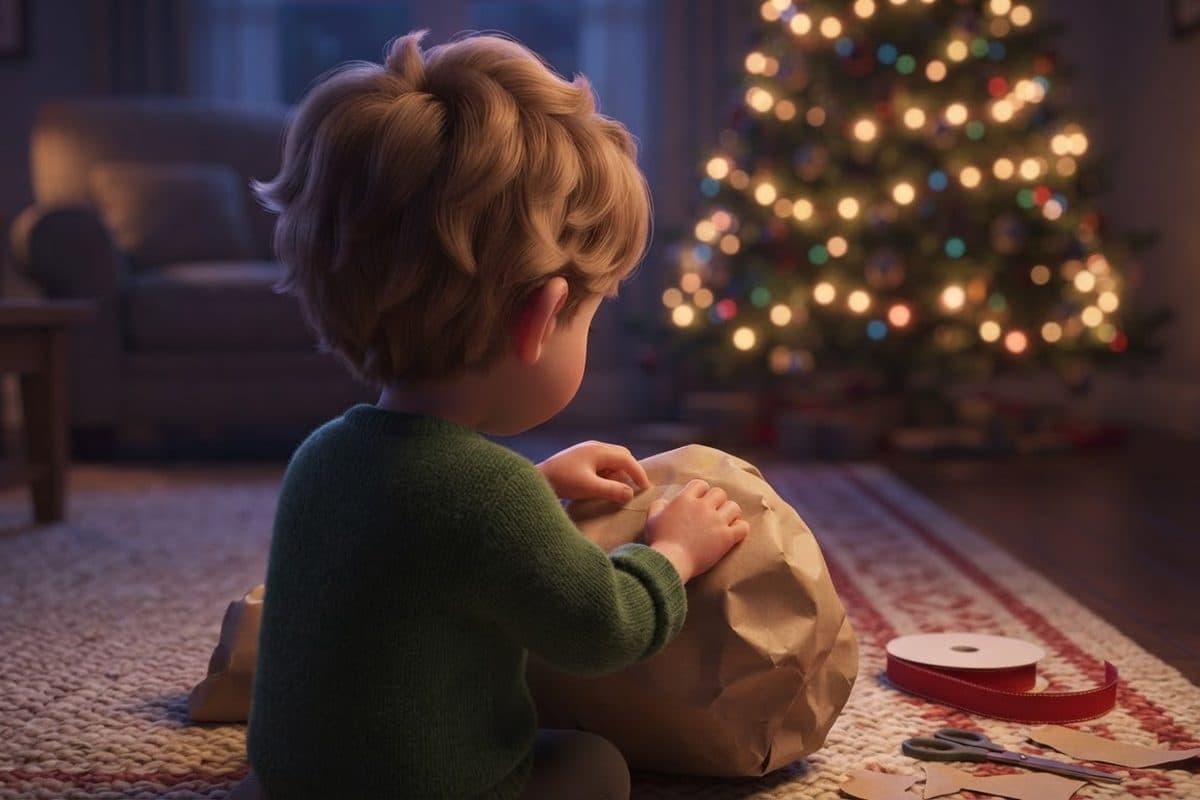
Search for christmas gifts for mom from kids and the lists could have been written for anybody: a mug, a candle, a necklace with initials. They are fine gifts. What they are not is from the kids, and that is what you are really shopping for, because many of the people typing this are probably a dad or a partner with children who are too young to shop, too young to wrap properly, and too young to keep a secret past Thursday.
What nobody seems to sort the ideas by is what the child can actually do. A two year old can press a hand into paint. A three year old can answer questions about her while you write down the answers. A five year old can sign the card. A nine year old can write and wrap it. The right gift is the one where the child does the real part at their age, and you do the rest without it showing.
Below: a table by age built on the CDC's developmental checklists, then handmade gifts, gifts a child can choose, a gift from all the kids, the words a child can dictate, how to make a bought present feel like theirs, and the dates. One idea is a book we make, I Love You, Mom, and we say plainly where it fits and where it does not.
Who is really giving: the three jobs a child can do
Plenty of searches for a gift from the kids are probably made by the other parent. The child is the name on the tag, and the adult is the one with the car keys and the deadline. That is nothing to hide: it is the thing to design around.
Stop asking what to buy and ask what the child can do. At any age, it is some mix of three jobs.
- Make. Something with their own hands: a handprint, a drawing, a macaroni garland. A clumsy result beats a neat one an adult finished.
- Choose. Pick between two or three things you have already approved: the flowers, the slippers, the ribbon. One real decision makes the gift theirs.
- Give. Wrap it, sign it, carry it in and put it in her hands first.
A gift with all three feels like it came from the child. A gift with none, however good, feels like it came from you, and she can tell. The jobs grow with the child, which is why the rest of this guide goes by age.
What a child can really do at each age
The table starts from the checklists of the Centers for Disease Control and Prevention for two, three, four and five years, read on October 6, 2026. They list what most children can do by each age, and define most as 75% or more. Use the second column as a guide to what to offer, not a test: a milestone is something most children do, not something every child does on schedule, and any worry about your child's development is a question for your pediatrician. The CDC checklists stop at five, so the two older rows are our own suggestions, not milestones.
| Age | By this age, what the CDC checklist says most children can do | So the child can | You do |
|---|---|---|---|
| Two | Holds something in one hand while using the other, says two words together, uses gestures beyond waving and pointing. | Press a hand into paint, point to choose between two things, say a few words to record. | Hold the paper, clean up, record, date it. |
| Three | Draws a circle when shown how, strings large beads or macaroni, holds a short conversation. | Scribble a drawing, string a garland, answer a few questions about Mom. | Ask, write the answers exactly, frame. |
| Four | Draws a person with three or more body parts, holds a crayon between fingers and thumb, says sentences of four or more words, pours water with an adult watching. | Draw Mom, dictate a short list, scoop and stir with you, choose from three. | Cut, do anything hot, write out the list. |
| Five | Writes some letters in their name, tells a story with at least two events, pays attention for five to ten minutes during activities such as crafts, does simple chores at home. | Sign the card, tell a story into a recording, do a real job for her. | Write the rest of the card, pick a job they can finish. |
| Six to eight | No CDC checklist covers this age. The next two columns are our suggestion, not a milestone. | Draw on purpose, write a few sentences, choose within a small budget, wrap. | Set the budget, spell on request. |
| Nine to twelve | No CDC checklist here either. Again, our suggestion, not a milestone. | Write a whole note, plan part of the day, wrap and hand over alone. | Drive, photograph, stay quiet. |
The pattern is the same in any family: the child's part grows from being present at two to being the author at nine, and yours shrinks the other way. The mistake at every age is taking back a job the child could do.
Homemade Christmas gifts for mom that kids can really make
Handmade is where a gift from the kids is easiest to keep real, and easiest to break, because the adult ends up making it. These five survive a toddler, a kitchen table and one free evening. Mess and time are honest estimates.
| Gift | The child's part | Mess | Time | The catch |
|---|---|---|---|---|
| Handprint ornament in salt dough | Pressing a hand in | Medium | Minutes to make, then baking and cooling time | Do it a week ahead, and poke the ribbon hole before baking. You handle the oven. Salt dough is a craft, not a snack: keep it away from a child who mouths things and from the dog. |
| Painted wrapping paper | Stamping hands or a sponge on plain paper | High | Ten minutes, a night to dry | Turns a bought present into one that looks made by them. Use washable, non-toxic paint and keep wipes at hand. |
| Macaroni or big-bead garland | Threading | Low | Ten to twenty minutes | Large beads only, and sit next to a child who mouths things. |
| A drawing of Mom, framed | Drawing | Low | As long as the child likes | The frame does half the work: framed goes on a wall, unframed on the fridge. |
| A card in their words | Dictating or writing | None | Ten minutes | Write what they say exactly. |
Two honest warnings. Handmade takes an evening you will not have on December 23, so do it in the first week of December. And stop while the child is still enjoying it: ten minutes of handprints beats forty minutes chasing the perfect one, and if the first one smudges, keep that one.
For handprints and recorded voices in more depth, see Mother's Day gifts from a small child. The same ideas work in December.
Gifts the child chooses, with your help
Choosing is the job a child can do before they can make anything neat, and it changes what they say when they hand the gift over. You shortlist two or three things she would be glad to get, and the child picks. The choice is real, because any of them would have pleased you, and why they chose it becomes the story.
- Something she uses every day and never upgrades. Slippers, a robe, good gloves, a mug that keeps coffee hot. The child picks the color.
- The ornament that marks this year. The child decides which goes on the tree, and it comes out every December after.
- A printed photo of her with the kids. If Mom is usually the one holding the camera, this picture is probably missing. The child picks which of three goes in the frame.
- Her favorite thing to eat or drink, in a very good version. The child decides which tin or box.
On honesty: the money comes out of an adult's wallet, and that is fine. Pretending is not. If she asks whether the child bought it, the true answer is that they chose it.
If one of the choices could be a book she and the child are both in, you can see the two of them drawn first, free and with no card.
The words: a list the child dictates
The cheapest gift on this page costs a pencil: a list of what a child loves about her, in the child's exact words. It works when it is specific, and children are specific if you ask the right question. "Why do you love Mom?" tends to get "because she's nice." These get real answers.
- What does Mom do when you are sick?
- What does Mom say when she is in a hurry?
- What is Mom best at in the whole world?
- What does Mom do when she thinks you are asleep?
- What does Mom cook that nobody else's mom cooks?
- What do you think Mom does all day?
Ask about what she does, not what she is. Write down what comes out, exactly: do not fix the grammar or add a good line of your own, because the odd phrasing is the gift. Date it, and let the child sign.
Keep it short. The CDC checklist for three years describes a conversation of at least two back-and-forth exchanges, and the one for five describes attention on an activity for five to ten minutes. That is why we suggest two or three questions at three and four.
Why bother with something so small? Thanks may land harder than the person giving them expects. In a study published in Psychological Science in 2018, people who wrote letters of gratitude underestimated how surprised and how positive the recipients would feel, and overestimated how awkward the recipients would feel, according to the University of Chicago's summary. Those were letters of thanks, not lists from a small child, so take it as a reason not to talk yourself out of a plain list.
Frame the list, read it aloud on Christmas morning, or fold it into the card. Our guide to what to write in a book for a child has more on short written words that last. A few lines like these can also go on the dedication page of a storybook, and the free preview comes before any payment.
One gift from all the kids together
With two or three children, the trap is three small gifts, the oldest's neat, the youngest's a scribble, and a quiet argument about whose was better. One gift with three jobs avoids it.
- Split the jobs by age. The youngest presses a handprint, the middle child writes what the family loves about her, the oldest wraps and hands it over.
- One frame, three drawings, on a single mat.
- One list, three voices. Each child answers the same three questions, and you write all three on one page with names and ages.
- A shared choice. Two options and a vote. Whoever loses the vote gets the wrapping job.
Keep it to one gift: a pile of small things from each child turns Christmas morning into a second round of objects. For what goes under the tree for the children, see Christmas gifts for kids who have everything. And if you want something the whole house shares, a gift for the whole family starts from who ends up living with it.
For a new mom, from a baby
A baby's first Christmas is the one case where the child can do none of the three jobs, so the gift is given on their behalf and nobody needs to pretend. We think what lands best with a new mother is evidence that she is seen.
- A printed photograph of her holding the baby. She may have thousands of the baby and few of herself with it, if she is the one holding the camera.
- A dated handprint or footprint, pressed with your help, with a non-toxic ink pad and a wipe ready, and framed.
- A short letter from you, on the baby's behalf: the early mornings you watched her get up, the lullaby, the one trick the baby saves for her.
No book belongs in this section: I Love You, Mom is written for ages 2 to 10, so it is not for a baby's first Christmas. The first Mother's Day section of our guide to gifts from a small child covers that first year.
Time, not things
One of the cheapest gifts is a stretch of time when nobody needs her. It is also a kind of gift that has been studied. A 2017 paper in the Journal of Consumer Research by Cindy Chan and Cassie Mogilner reported that experiential gifts improved relationships more than material ones, according to the people who received them, whether or not giver and recipient shared the experience. It is about gifts in general, not mothers of small children, so take it as a nudge, not proof.
- A morning with a date on it. She sleeps, and you and the kids handle breakfast and clean-up. The child hands over the card announcing it.
- The kids' afternoon. The children run a plan she did not have to make: a walk, a movie she picked, a bake.
- An evening out, already booked. The sitter asked, the table reserved, the date on a card. A booked date is a present; a voucher is a to-do.
- A coupon book written by you and decorated by the child, with promises specific enough to redeem. Vague ones, like one hug, tend to go unused.
Time has one weakness: nothing to unwrap on Christmas morning. Put something physical in the box, like a handwritten card or the printed reservation.
A book she is in: I Love You, Mom
We make this book, so weigh this section accordingly. I Love You, Mom is the title on our shelf that is a thank you to Mom from your child.
It is one ordinary Saturday seen by somebody very small: the light already on in the kitchen when the child wanders in, the burnt toast she eats without a word, the one umbrella held over somebody else, the shoe she finds in three seconds, the four minutes she falls asleep sitting up and the child fetches the blanket. It is written in rhyme across thirteen illustrated spreads, with the child and their Mom drawn together on every one of them, from two photos, one of each.
The point is gratitude for the specific things. It does not call her the best mom in the world. It says the burnt toast and the rain on her shoulder, which is what the dictated list does too, only printed, and written by us rather than by your child. The free preview shows the two of them in about half a minute for each face, with no card and no account.
What it is not. It is not a Christmas story: nothing in it is about Christmas, and it is the same book in any month. Christmas morning is a good moment to read it together. The story is ours, the same for every family who picks it. What is yours is the faces, your child's name, the word your child uses for her, and the dedication.
The dedication is where the kids come in. You write it and we print it word for word on its own page after the story, so it can come from the kids, in the words you took down at the kitchen table. It is one short page: up to 180 characters, about thirty words, and the order form tells you when the page is full, so use the best line of the list. Whatever your child calls her, Mom, Mama, Mommy or Momma, is printed in the story wherever she is named; only the title painted on the cover stays I Love You, Mom.
Where it is not the right gift. It is written for ages 2 to 10, so it is too early for a baby, and a teenager would probably say more with a letter. You need a clear, recent photo of her, and if she is usually the one behind the camera, start looking early. A real artist checks every book before it is printed.
The Mother's Day version of this advice is in Mother's Day gifts from a small child. For what separates a keepsake from a name on a generic story, see our guide to personalized books for kids. The book page is I Love You, Mom.
How to make a store-bought gift feel like it came from the kids
Most gifts from the kids are bought by a parent, and that is fine. A few small moves turn a bought gift into the children's, and none needs a craft kit. For a Christmas gift for a wife from the kids, the same rule holds: she knows who did the shopping, and wants to see that the kids were in on it.
- Let the child choose one thing. The paper, the ribbon, which of two gifts.
- Let them wrap it, badly. Too much tape is the proof.
- Let them make the tag: a scribble with the date, or a line they say and you write down exactly.
- Let them hand it over first, before the coffee. You are the photographer, not the presenter.
- Do not coach the line. A rehearsed sentence is easy to forget; an unrehearsed one may be the story told for years.
- Photograph the handover, not the gift. In five years the object may be on a shelf, and the fifteen seconds of the child holding it out may be what you want to look at.
None of this needs you to say the child made what they did not. What they did is real, however small, and it is what she will remember. If Christmas Eve in your house already has an evening routine, that is the natural time for the child to wrap hers, and Christmas Eve box ideas has the rest of that evening in order.
If the bought gift is the book, the child's jobs are the words you take down for the dedication and the unwrapping, and you can start the free preview once they are asleep.
The same idea for Dad
The structure is identical for a Christmas gift for Dad from the kids: make, choose, give, sized to the age, with the same table. What changes is the questions: what does Dad do when the car is quiet, what does he say a lot, what does he get wrong every time. Write down the answers exactly.
Our guide to Father's Day gifts from kids has the whole version, and most of it works in December. The book is I Love You, Dad, for ages 3 to 10: the songs in the car, the dinosaur name he gets wrong, the stone in his pocket. It is not a Christmas story either, just a good book to read on Christmas morning.
What to skip
Not because these are bad, but because they tend to land flat when the point is a gift that feels like the children's.
- A kit that needs her to supervise. A craft or baking kit to make for Mom turns into a job for Mom.
- A surprise a toddler has to keep. It lasts until the next room. Let them announce it instead.
- The perfect handmade object. If you finished it, she can tell, and so can the child.
- Breakfast in bed made by small children alone. The gift is a clean kitchen: make it with them, then clean up.
- A gift that is really an instruction. A fitness tracker, a planner, a gadget for the house arrives as a to-do.
- A pile of small things from each child. One real gift beats five little ones.
The dates, and a plan for the last weeks
Handmade needs time, because dough bakes and paint dries. Anything made to order needs the calendar: our books are printed after you order, and December 1 is the last date we can promise for Christmas. The book page and the cart show the real delivery dates before you pay.
- Late November. Decide each child's jobs. Order anything made to order, and find a photo of her if the book is the plan: that is the step that slips.
- First week of December. The handmade items, so they have time to bake and dry. Frame the drawing.
- Mid December. Record the dictated answers and write them out. Confirm the booked evening.
- Christmas Eve. The child wraps, with too much tape.
- Christmas morning. The child hands it over first. You take the picture.
If you miss December 1, do not buy something worse in a hurry. Put a card under the tree that says what is coming and let the child hand it over. A gift announced on Christmas morning and arriving after Christmas feels planned; one bought on the twenty-fourth feels rescued. The preview works at any hour, so you can see the two of them drawn tonight and decide in the morning.
Sources
- Milestones by 2 Years · Centers for Disease Control and Prevention, 2026
- Milestones by 3 Years · Centers for Disease Control and Prevention, 2026
- Milestones by 4 Years · Centers for Disease Control and Prevention, 2026
- Milestones by 5 Years · Centers for Disease Control and Prevention, 2026
- People underestimate value of sending letters of appreciation · University of Chicago News, 2018
- Experiential Gifts Foster Stronger Social Relationships Than Material Gifts · Chan & Mogilner, Journal of Consumer Research, 2017
Questions parents ask
What is the best gift for my mom from my kids?
The best gift is one where the child does a real part: a drawing she can frame, a list of things they love about her in their own words, or a present they chose and wrapped and handed over themselves. The rest is yours to organize quietly. Add time with nobody needing her, such as a morning that is booked and written on a card, and you have covered what matters.
What can kids make for mom for Christmas?
It depends on the age. A two year old can press a handprint into paint or salt dough. A three year old can scribble a drawing or string a macaroni garland. A four year old can draw her and dictate a short list. A five year old can sign the card and do a real job for her. Older children can write a whole note. The adult does the cutting, the baking and the framing.
What is a good Christmas gift for mom from a toddler?
A dated handprint, a drawing you frame properly, a recording of the toddler answering a few questions about her, or wrapping paper they painted around something you bought. A toddler cannot make anything neat or keep a secret, and does not need to. Let them choose between two things, hand it over first thing in the morning, and take the picture of the handover.
What is a good Christmas gift for my wife from the kids?
The same things that work for any mom: a framed drawing or a list the children dictated, a printed photograph of her with them, or a morning off with the date written on a card the kids hand over. She knows you did the shopping. What she wants to see is that the children were in on it, so give them one real job.
What is a good Christmas gift for mom from a daughter or son?
For a teenager or an adult child, words often go further than objects: a letter about this year in specific detail, plus a booked afternoon together. For a younger child, the dictated list and the framed drawing still work. Our book I Love You, Mom is written for ages 2 to 10, so it suits a younger child but not an older daughter or son, who would probably say more with a letter.
How do I make a store-bought gift feel like it came from the kids?
Give the child one real job in it. Let them choose between two options, wrap it with too much tape, sign the tag, and hand it over first. Do not rehearse what they say, and take a picture of the handover rather than the gift. None of this asks you to claim the child made it. What they did is real and small, and that is the part she remembers.
What do moms want for Christmas gifts?
There is no single answer, and we have no survey to quote. What tends to land is evidence that she was thought about as a person, from the children, plus a stretch of time when nobody needs her. A way to find out is to offer her two specific options a week ahead, because an open question like "what do you want?" often gets a shrug.
Is I Love You, Mom a Christmas book, and when should I order it?
It is not a Christmas story. It is one ordinary Saturday seen through the child's eyes, the same book in any month, and Christmas morning is a good time to read it together. Order by December 1 for Christmas. Every book is printed after you order, and the book page and the cart show the real delivery dates before you pay. The free preview shows you both faces first.
What can a baby give mom for her first Christmas?
A baby cannot do any of the jobs, so the gift is given on their behalf: a printed photograph of her holding the baby, a dated handprint or footprint, and a short letter from you about what you saw this year. I Love You, Mom is written for ages 2 to 10, so it is not for a baby's first Christmas.