
Gifts
Christmas Gifts for Dad From Kids: What Each Age Can Really Choose, Make or Say
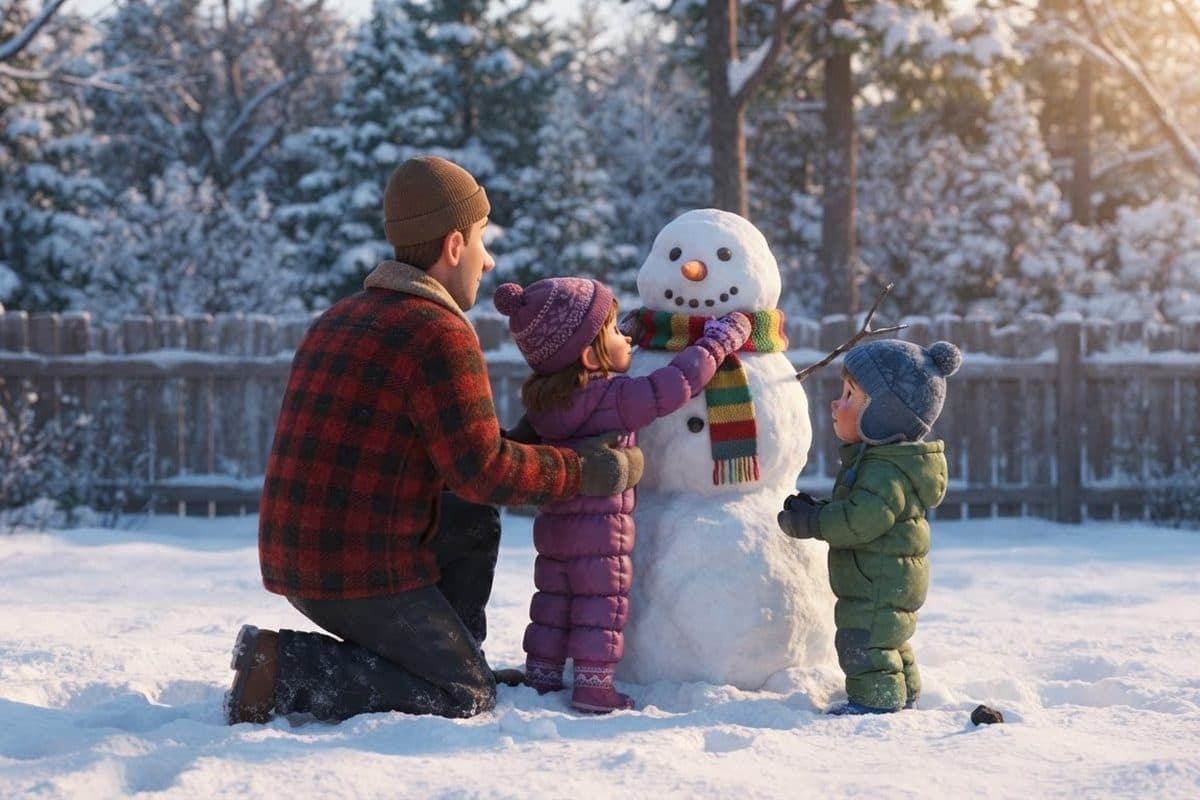
Search for christmas gifts for dad from kids and the page that comes back is mostly gifts for dads in general: a grill tool, a watch, a shirt with a joke on it. None of it is from the kids, which is what you are really shopping for. Many of the people typing this are probably the other parent, standing between a child with no money or car and a man who says he needs nothing.
What the lists never say is what a child can actually do. A two year old can stamp a hand in paint. A four year old can answer questions about Dad while you write down what comes out. A seven year old can choose, and an eleven year old can plan an afternoon. Child development research adds what most gift guides skip: in one lab study of gifts for mothers, three and four year olds were worse than five year olds at choosing for someone whose wish differed from theirs.
Below: the four jobs a child can do, a table by age, gifts that cost time, homemade and store-bought ideas that still count as the kids', a dad who wants nothing, one hour that makes it theirs, the 7 gift rule, and Dad being away. One idea is a book we make, I Love You, Dad, and we say plainly where it fits and where it does not.
Who is really giving: the four jobs a child can do
Swap the question "what should we buy Dad?" for "which part of the gift does the child do?" At any age the answer is some mix of four jobs.
- Make. Something with their own hands, however clumsy: a handprint, a drawing, a sheet of wrapping paper they stamped.
- Choose. A real decision between options you already approved. Any of them would please Dad, so the child cannot get it wrong.
- Say. Words in the child's own voice, written down or recorded exactly as they come out.
- Do. Time spent: a job done together, an hour at the park, a game he picks.
A gift with at least one of the four feels like it came from the child. A gift with none is a purchase with a tag on it, and a dad can tell. The jobs grow with the child, so the rest of this guide goes by age.
Giving may make a small child happy too. In one early experiment (PLOS ONE, 2012), twenty toddlers under two showed more happiness giving treats to others than receiving them. The authors call it initial support and ask for a larger sample, so take it as a nudge.
What a child can understand about what Dad wants
Before you ask a four year old what Daddy would like, it helps to know what developmental psychology says they can do with that question. Two studies matter, and we read both abstracts on October 13, 2026.
In 1997, Repacholi and Gopnik, at the University of California, Berkeley, tested 14 and 18 month olds with a food-request task. An experimenter showed disgust at one food and happiness at another, and the child was then asked which food the experimenter would want next. The 14 month olds offered whichever food they preferred themselves. The 18 month olds offered the one she had enjoyed, even when it was not their favorite. An early, narrow skill, shown in a lab, with food.
In 2010, Cristina Atance, Michèle Bélanger and Andrew Meltzoff gave children a gift-giving task: work out what Mom wants when it differs from what you want. Three and four year olds did worse than five year olds. In a second experiment, children whose own wish had been granted first, or who merely expected it to be, picked a fitting gift more often than children whose wish was left unmet.
Both are lab tasks, not shopping trips, and the gift study was about mothers, so we apply it to fathers by analogy. Neither says a small child cannot give a lovely gift. They say what to ask the child to do.
- At three and four, skip "what would Dad like?" Ask about him ("What does Dad do in the car?") and let the child pick from a shortlist where every option fits him. Two year olds were not in that study, so using the same approach for them is our judgment, not a finding.
- At five, the choice can get more real, because five year olds did better than three and four year olds. Widen the shortlist, but keep drawing it yourself.
- Let the child have their turn first. This is our reading of the second experiment, not something it tested at a store: a child who is still wanting something is a poor shopper for somebody else.
By age: what the child does, and what you do
The table starts from the Centers for Disease Control and Prevention checklists for two to five years, read on October 13, 2026, plus the two studies above. The CDC defines a milestone as something most children (75% or more) can do by that age. Use it as a guide to what to offer, not a test, and take any worry about development to your pediatrician. Nothing we opened sorts these abilities by the child's sex, so the table goes by age: it covers "from daughter", "from son" and "from toddler" alike. The two older rows are our suggestions.
| Age | What the sources say | The child's part | Your part |
|---|---|---|---|
| Two | Points to things in a book, says two words together (CDC). In a lab food task, 18 month olds offered what another person liked (Repacholi and Gopnik). | Stamp a hand in paint, point to one of two things, name Dad in a photo. | Shortlist the two things, hold the paper, record, date it. |
| Three | Holds a short conversation, draws a circle when shown how, strings large beads (CDC). Did worse than five year olds at choosing a gift for Mom (Atance and colleagues). | Scribble a picture, thread a garland, answer two questions. | Ask, write the answers exactly, frame the picture. |
| Four | Draws a person with three or more body parts, likes to be a helper (CDC). Still behind five year olds at choosing for Mom (Atance and colleagues). | Draw Dad, dictate a short list, pick from three. | Do the cutting and anything hot, write out the list. |
| Five | Writes some letters, tells a story with two events, does simple chores (CDC). Better than younger children at choosing for Mom (Atance and colleagues). | Sign the card, tell a story into a recording, do a real job for Dad. | Write the rest of the card. |
| Six to eight | No source we opened covers this age. The row is our suggestion. | Write a few sentences, choose within a small budget, wrap. | Set the budget, spell on request. |
| Nine to twelve | Not covered either. Our suggestion. | Write a whole note, plan a date with Dad, wrap and hand over alone. | Drive, pay, keep quiet. |
If one option on your shortlist could be a book Dad and your child are both in, you can try the free preview with his photo before you decide anything else.
A date with Dad he can actually redeem
A coupon sounds like the easiest gift there is, and it can go wrong in a way you can fix: a vague one is easy to leave unused. "One hug" is spent in four seconds, and "a day at the lake" may never be spent at all. A date with Dad works when it carries three things.
- A what. One activity small enough to happen: pancakes at the diner, a flashlight walk to the creek, the child teaching Dad their favorite game.
- A rough when. A Saturday morning in January, written on the coupon and on your calendar. A coupon with no date is a promise, and January eats promises.
- A who decides. Dad chooses the movie, the child chooses the snack. Two decisions, no negotiating on the day.
Three coupons beat a book of twelve, which is a list of chores for February. A child who can write designs them. A younger one decorates what you write and hands one over each time Dad cashes in.
In a 2017 paper, Cindy Chan and Cassie Mogilner reported that, by the recipients' own ratings, experiential gifts did more for a relationship than material ones, whether or not giver and recipient shared the experience (Journal of Consumer Research). The paper is about gifts in general, not children's, so it is a nudge, not proof. What it asks of you: when the coupon says Saturday, the other parent keeps Saturday free.
A recorded interview and a handwritten list
The interview. Record the child for five minutes at most, when everyone has eaten and nobody is tired: in the car, on a walk, at the table. Questions about a habit tend to get more specific answers than questions about a feeling, so ask what Dad does, not why you love him. Try these.
- What is the first thing Dad does when he gets home?
- What does Dad say when he cannot find his keys?
- What is Dad really good at, and what is he really bad at?
- How can you tell when Dad is tired?
- What does Dad say is his favorite food? Is that true?
- What do you two do that nobody else does?
Do not correct anything: a child who says Dad's job is "typing" has just given him the best minute of the tape. Save the file in two places, with the year in its name.
The list. "Ten things I like about Dad," numbered. Under six, the child says it and you write the exact words, spelling and all. From six, they write it. Date it and have them sign. If it feels too small: Amit Kumar and Nicholas Epley reported in Psychological Science in 2018 that people who wrote gratitude letters underestimated how positive their recipients would feel. Their writers were not small children, so take it as encouragement to give the simple version, nothing more.
Homemade gifts a five year old can really make for Dad
These four survive a kitchen table and one free evening.
- A drawing of Dad doing his thing, framed. At the grill, in the car, at his desk. The frame is what moves it from the fridge to a wall.
- A photo frame the child decorates, with a picture of the two of them inside. Stickers, paint pens, and glitter you will find until March.
- Stamped wrapping paper. Hands or a sponge on plain brown paper, wrapped around something you bought. Washable, non-toxic paint only.
- A jar of his favorite snack, filled by the child with a scoop. You buy and pour; they scoop and write the label.
Make them early: paint needs a night to dry, and the last days before Christmas have no spare evening. Keep sessions short, and keep beads, buttons and glitter away from any child who still mouths things.
Store-bought gifts that still count as the kids' own
Most gifts from the kids are bought by an adult, and that is fine. What matters is whether the child had a hand in it and whether it fits the man's actual Tuesday.
- The child chose. One decision between two or three things that all work. The reason they give is the story.
- It fits his week, not his hobby. A hobby gift is a guess, and if he has not touched the bike since the baby came, you have bought a nice thing about cycling. A better version of something he uses daily is not a guess.
- He will use it before February. A gift that needs an occasion or a setup afternoon goes into a closet.
| Gift | How the child makes it theirs | Why it passes |
|---|---|---|
| A better travel mug, gloves or wallet, whichever he uses daily | Picks the color from two | He touches it every day, and the story comes with it. |
| A printed, framed photo of him with the kids | Picks the picture from three | If he usually holds the camera, he may have few of himself with them. |
| Tickets to something the two of them do together | Picks the day | An experience with a date already on it. |
| His favorite food or drink in a very good version | Picks the tin or the box | Gets used up and adds nothing to the pile. |
Skip the joke mug, the tie, and anything that doubles as a hint about what he should change. The June version of this advice is in Father's Day gifts from kids, and most of it works in December. If a book he is in is on your shortlist, a free preview shows whether he comes out recognizable.
When Dad says he wants nothing
"I don't need anything" is a familiar answer from dads, and we have no survey of what it means. In our reading it is usually one of three things, and the children's gift answers all three.
- "I have enough stuff." Then no object. Give something that takes no shelf: time, a recording, something he can eat.
- "Don't spend money on me." Then the answer is effort, not a cheaper object. A gift that visibly took work from the children cannot be priced.
- "I don't know what I want, and I hate being asked." Then stop asking him. Ask the children what they see him do, and give from the answers.
What a dad cannot buy himself is anything with his children in it. If you are the grown child of a dad who has everything, the same logic works on a different scale, and our guide to sentimental Christmas gifts goes through it for adults.
One hour that makes it theirs
Here is the whole gift as one hour, for the other parent. You do the parts that need an adult; the children do the parts that make it theirs. If you searched "christmas gift for husband from kids" because Dad is your husband, this is your plan.
- Minutes 0 to 10: say. Record each child answering the same three questions about Dad. Do not prompt or correct.
- 10 to 25: make. Handprints, the drawing, the stamped paper. Hold the paper, keep wipes close, and stop when the first print smudges: that one is the keeper.
- 25 to 40: choose. Put two shortlisted things on the table. With several children, split the decisions: color, card, photo.
- 40 to 55: wrap. Let the children do it, and let the corners come out wrong.
- 55 to 60: hide. Somewhere a three year old will not look, which is a shorter list than it sounds.
On Christmas morning the order matters more than the object. The children give Dad his gift first, before the coffee and the pile, while you hold the camera. Do not script what they say: whatever comes out unrehearsed may be the sentence he repeats for years. Take the photo while the package is changing hands, a small arm held out with something lumpy at the end of it, not of the gift afterward. If time is short, the hour still works close to Christmas: skip whatever needs drying. A grandparent helping can ask the parents for a photo and a shortlist first.
If a book is on the list, upload the two photos after bedtime and decide in the morning.
The 7 gift rule, and where Dad fits
Search for Christmas gift ideas and the "7 gift rule" turns up within a click or two. It is a household convention for children's presents. On the blog we opened, each child gets seven gifts, no more and no less, and the suggested categories are something to want, need, wear, read and do, plus something just for the child and something for the family. Other sites we opened name the seven slots differently, so treat the list as a suggestion.
Where does it come from? We found no inventor we could document. That blog calls it a variation of the 4 gift rule, which keeps want, need, wear and read. A parent's account on Understood from October 2019 already describes four gifts per child that way, and in 2022 a parent educator at Children's Hospital New Orleans told Scary Mommy she had noticed the four-category approach on social media in the last few years. Two pages we opened credit a parenting blogger, but we could not open her original post to date it, so we will not call it an old tradition or a trend with an author. It has no official status, and it limits what children receive, not what Dad gets.
If your family uses it, the kids' gift fits two slots: the date coupon is "something to do" and a game or tickets is "something for the family". The four gift version is in our guide to Christmas gifts for kids who have everything.
A book he is in: I Love You, Dad
We make this book, so weigh this section accordingly. I Love You, Dad is written for ages 3 to 10, with your child and their Dad drawn together on every illustrated spread, from two photos, one of each.
It is a list of the things only one person knows about him: he sings in the car with the windows wound tight, has said one dinosaur's name wrong for years, does a wolf voice in the supermarket, carries a plain gray stone in his pocket, and checks the doors twice at night, certain nobody is watching. Somebody is.
Then there is the page where he is not fine. One Tuesday the car is too quiet, and when your child asks if he is sad, he says he is okay in exactly the voice your child uses when they are not. Nothing is explained and nothing bad happens. At the crossing, in the rain, your child takes his hand. We would rather you knew that page is there before you wrap it. If Dad is having a hard year, read it first and decide whether Christmas morning is the moment.
What is yours and what is ours. The story is ours, the same for every family. Yours are the faces, your child's name, the word your child uses for Dad (Dad, Daddy, Papa, Pop), printed wherever he is named, and the dedication. Only the cover title stays I Love You, Dad.
The dedication page can be the kids' own. You write it and we print it word for word on its own page after the story, up to 180 characters, and the order form tells you when the page is full. It can be what the children said at the kitchen table, taken down exactly. Write it to Dad: if you leave it empty we print a short line of our own that speaks to the child. Our guide to what to write in a book for a child has examples.
Where it is not the right gift. It is too early for a baby or a toddler, and a child of eleven or twelve will probably say more in a letter. It needs a clear, recent photo of him, and if he always holds the camera, that photo is the step that slips, so start looking in November. It is also not a last minute gift: every book is printed after you order it, and December 1 is the last date we can promise for Christmas. The book page and the cart show the real delivery dates before you pay.
The preview is free, takes about half a minute for each face and asks for no card or account: draw Dad and your child and see whether he looks like himself. Our guide to personalized books for kids explains how to tell a keepsake from a name swap, and the book page is I Love You, Dad.
When Dad travels, works away or lives in another home
A gift from the kids matters more when Dad is not in the room, because it may be the one physical piece of them he opens that day. Three rules.
- Something he can hold. A package or a folded card beats a photo sent by message. If he is on the road, put it in his bag with a note saying which night to open it.
- The child's own hand in it. A signed card or a rough drawing is the part he will look at twice.
- One part that repeats. A recording he can replay, or a book he and the child read over a video call, a few spreads at a time, turns one day into a regular call.
If he lives in another home, the section on that in Father's Day gifts from kids goes further. If he is deployed, our guide to books about deployment for kids covers the stretch from the goodbye to the homecoming. If the man your child calls Dad is a stepfather or a father figure, the child's word is the one that counts, and it is the word the book prints. The mirror of this guide, with its own table, is Christmas gifts for mom from kids.
Sources
- Early Reasoning About Desires: Evidence From 14- and 18-Month-Olds · Developmental Psychology, via PubMed, 1997
- Preschoolers' Understanding of Others' Desires: Fulfilling Mine Enhances My Understanding of Yours · Developmental Psychology, via PubMed, 2010
- Giving Leads to Happiness in Young Children · PLOS ONE, 2012
- Milestones by 2 Years · Centers for Disease Control and Prevention, 2026
- Milestones by 3 Years · Centers for Disease Control and Prevention, 2026
- Milestones by 4 Years · Centers for Disease Control and Prevention, 2026
- Milestones by 5 Years · Centers for Disease Control and Prevention, 2026
- Experiential Gifts Foster Stronger Social Relationships Than Material Gifts · Chan & Mogilner, Journal of Consumer Research, 2017
- Undervaluing Gratitude: Expressers Misunderstand the Consequences of Showing Appreciation · Psychological Science, via PubMed, 2018
- Want Need Wear Read: The holiday gift strategy that works for my kids · Understood, 2019
- How Many Gifts Should A Child Get For Christmas? Experts Weigh In · Scary Mommy, 2022
- The 7 Gift Rule for Christmas Gift-Giving to Kids · Simply Well Balanced, 2021
Questions parents ask
What is a good gift for my dad from my child?
One where the child does a real part at their age, and that fits his everyday life instead of guessing at his hobbies. A drawing he can frame, a recording of the child answering questions about him, a dated coupon for an outing he can really redeem, or something the child picked from two options you chose. The part the child did is what he will remember.
What are some gift ideas for dad from kids?
By age: at two, a handprint and a recording of the child naming him in a photo. At three and four, a drawing of Dad and a few answers you write down. At five, a signed card and a story told into a recording. At six to eight, something chosen on a small budget. At nine to twelve, a planned outing with a coupon.
What can a toddler give Dad for Christmas?
A stamped handprint with the date, a short recording of the toddler pointing at a photo and naming him, or a drawing you frame. Neat work and secrecy are out of reach at this age, and Dad does not need either. Offer a choice between two things you picked, and let the toddler be the one who carries it to him on Christmas morning.
What do you give a dad who says he wants nothing?
Take him at his word about objects and give him something that is not one: a dated outing with his child, a recording of the kids answering questions about him, a list of things they like about him in their own words, or his favorite food in a very good version. What a man cannot buy for himself is whatever has his children in it.
What is the 7 gift rule for Christmas?
It is a household convention, not a tradition: each child gets seven presents, and on the blog we read the slots are something they want, need, wear, read and do, something for themselves, and something for the family. Other sites name them differently. It is a variation of the 4 gift rule, we found no documented inventor, and it limits what children receive. It does not tell you what to give Dad.
How can kids pick a gift for Dad on a budget?
Give a child under six a choice between two cheap things that both suit him, and give a six to eight year old a small budget and a short list. Free options are often the best ones: a recorded interview, a handwritten list, a coupon for a dated outing, a framed drawing. What costs money is usually the frame, and the child can decorate it.
What homemade gift can a 5 year old really make for Dad?
A drawing of Dad doing something he does, signed and dated, and framed by you. A decorated photo frame holding a picture of the two of them. Plain paper stamped with handprints as wrapping. A jar of his favorite snack the child fills with a scoop. Five year olds can also sign a card and tell a story into a recording. You do the cutting and anything hot.
What is a good Christmas gift from the kids for a dad who travels or works away?
Something he can hold, in his bag or at the door on the day, with the children's own writing or drawing in it, plus one part that repeats: a recording he can replay, or a book he and the child read over a video call. For a short trip, a numbered card for each night away works. If he is deployed, that is a different stretch with its own guide.
Is I Love You, Dad a Christmas book, and when should I order it?
It is not a Christmas story. It is the same book in any month, built from the small things a child knows about Dad, and Christmas morning is a good time to read it together. Every book is printed after you order, so order by December 1 for Christmas. The book page and the cart show the real delivery dates before you pay, and the preview is free.