
For the two of you
Why I Love You Book: The Four Kinds, and How to Write Reasons Worth Keeping
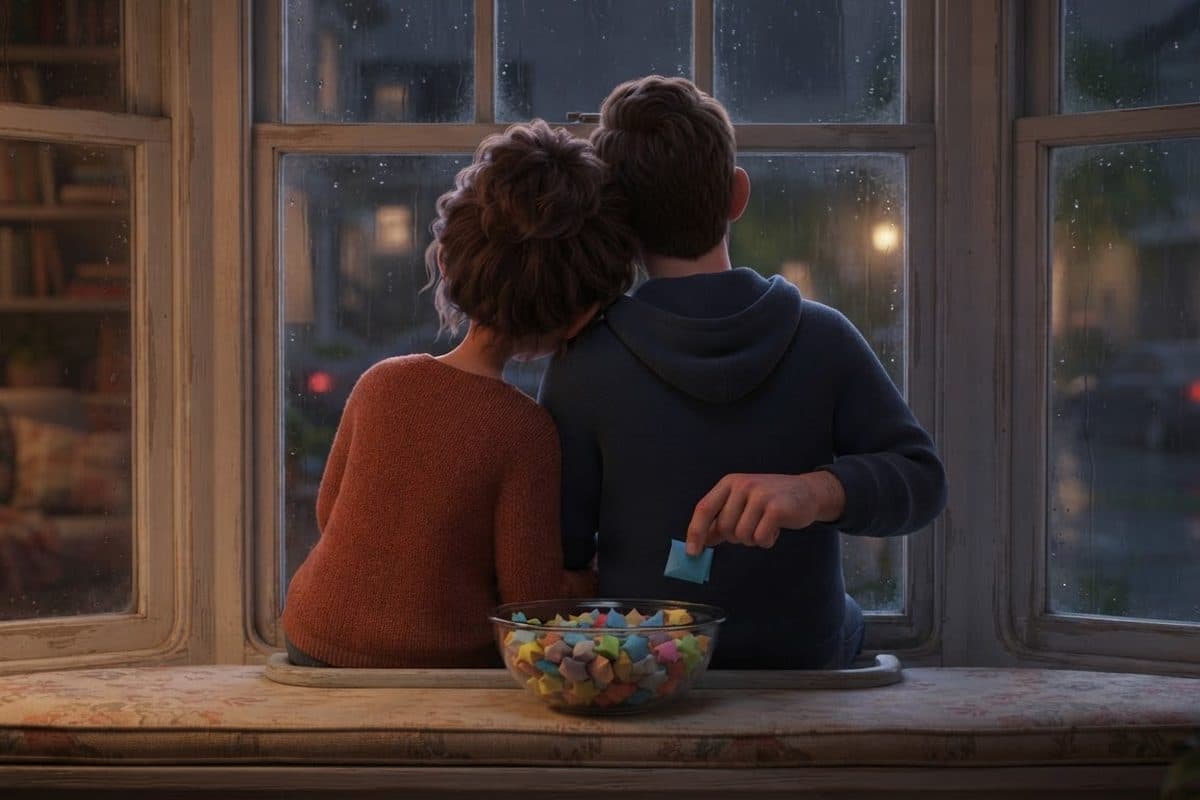
Search why I love you book and the first page hands you three different things under one name: a fill-in journal with the questions already printed, a personalized book that prints your own reasons beside cartoon versions of the two of you, and a children's picture book about love. A fourth kind, the book you make yourself, is where the searches for prompts and DIY versions lead. They share a name and almost nothing else, and nobody on the page says which one is for you.
This guide sorts them out: the four kinds in a table, what the first page sells, how to write reasons that do not all sound alike, fifty prompts to borrow, how many reasons to write, how to make a book by hand, when to give it, and the version for a child.
One disclosure first. We make personalized books too, and one of ours, Us, Ever After, gets its own section, where we say plainly that it is not a list of reasons. We did not order or test any other book mentioned here. What we say about each comes from its own page, read in October 2026.
Four different things sit under one name
The same words sit on four products with different authors, different effort and different results. Knowing which one you are shopping for is most of the decision.
| Kind | What it is | Who writes the reasons | Time it asks of you | Best for |
|---|---|---|---|---|
| Fill-in journal | Printed prompts with blank space under each | You, answering questions someone else wrote | A few evenings, at your own pace | Someone who will keep a handwritten book |
| Personalized printed book | An online builder that illustrates and prints the book | You, entered in the builder | An evening to build, then printing and shipping | A printed, bound book with no handwriting |
| Children's picture book | A published story about love, the same for every reader | An author; you add a note inside the cover | Minutes to read, none to make | A child, or a child's gift to a parent |
| Homemade book | A notebook, a jar of slips or cards on a ring | You, in your own words and handwriting | Ten minutes a day for weeks, or one long evening | Anyone with the attention to spare |
The first three can be bought. Only the picture book arrives with the words already written, which is why most of this guide is about writing the reasons yourself, whichever container you pick.
What the first page actually sells, checked in October 2026
We make personalized books, so weigh this section accordingly. Everything below comes from each company's own page as we read it in October 2026. We did not order or test any of these books, and opinions are labeled as ours.
- A fill-in journal: Peter Pauper Press, Why I Love You: A Journal of Us. Its page invites you to "Write your love story in your own words!" across 96 hardcover pages of guided prompts. It does well what a journal does: the questions are written for you and every answer is in your handwriting. Our opinion: it hands you the questions, so how specific the answers are is up to you.
- A personalized printed book: LoveBook. Its shop lists books of 10, 50 and 100 reasons. The page for the 50 describes characters illustrated to look like you and your partner, built page by page with 50 reasons about your own story, and printed as a keepsake hardcover or softcover. It is the most literal answer to the search: the reasons are the whole book, at the length you choose.
- A personalized book with your answers inside: Wonderbly, Ten Reasons I Love You. You add both names, answer ten prompts of up to 100 characters each, and it comes back as 44 illustrated pages with a love poem written around your words. Its page calls it "for the grown-ups". Our opinion: ten short answers make it the quickest of these to fill in, and the 100 character cap means each reason has to fit in about one sentence.
- A children's picture book: Todd Parr, The I LOVE YOU Book. A 32-page hardcover from Little, Brown Books for Young Readers, listed on its publisher's page for ages 3 to 6. It is about love in general, for a child, which is a different job from telling one person why you love them.
A fifth kind sits outside these pages and is ours, so it gets its own section below: a personalized story with both of you drawn in, which is not a list at all. If you would rather look than read, see the two of you drawn, free, from one photo.
Why specific reasons land, and what the research does and does not say
Left to themselves, lists of reasons drift toward the same sentence in different clothes: you are kind, you make me laugh, you are my best friend. All true, and true of nearly anyone, which is why a hundred of them read like one.
Our own approach goes the other way. I Love You, Mom is built on a child learning to thank a parent for the specific things: not the best mom in the world, but the burnt toast she takes without a word and the wet shoulder from the one umbrella. That is our design choice, not a finding, and we are not citing a study for it.
There is real research nearby. In 2018, Amit Kumar and Nicholas Epley, then both at the University of Chicago's Booth School of Business, published Undervaluing Gratitude in Psychological Science. Participants wrote gratitude letters and predicted how surprised, happy and awkward the recipient would feel; recipients then reported how it actually felt. Writers underestimated how surprised recipients would be about why they were thanked, overestimated how awkward recipients would feel, and underestimated how positive they would feel.
Hedges, since they matter. According to the Association for Psychological Science's summary, the first experiment used students in a business class writing to peers, and in the second writers could pick anyone. The paper is about gratitude letters, not lists of reasons you love someone, and it did not test printed books. Its abstract does not compare specific reasons with general ones. And it measures predictions against reactions, not a book opened at the table.
It is most useful when you are about to put this off. If you worry it will be awkward, or that you cannot find the right words, the paper suggests the person is likely to take it better than you expect; the university's news story puts it as writers worrying about the words while recipients were happy with the warmth of the gesture. Our reading, and only ours: a reason they did not know you had noticed is news to them, which favors the specific over the general, though the paper does not claim it.
A formula for a reason that could only be about them
Specific does not mean long. It means the reason could not be pasted into anyone else's book. Four ingredients get you there, and not every reason needs all four.
- A moment: a place or a time of day, such as the kitchen at half past eleven.
- A verb: something they did or said, not something they are. Adjectives are where reasons start to sound alike.
- One detail you could draw: the cup, the coat, the sound, the thing in their hand.
- What it told you: one plain clause, such as "and that is when I knew". Skip it when the moment says it already.
Borrow the shape of these, not the facts:
| Too general | Specific | What changed |
|---|---|---|
| You are so kind. | You stopped the car in the rain to move a turtle off the road and never mentioned it. | A verb and a moment replaced the adjective. |
| You make me laugh. | When I am in a bad mood you narrate the cat's thoughts in a deep voice until I give in. | A detail only the two of you share. |
| You are so thoughtful. | You wrote my dentist appointment on the back of your hand so you would remember to ask. | Thoughtful became something we can picture. |
Four habits keep a long list from blurring into one:
- Write to them, not about them. "You" in every line; the third person turns a reason into a reference letter.
- Include one flaw you love, the word they say wrong or the song they sing with the wrong words.
- Vary how lines begin. A hundred "I love how you..." stops being heard by the tenth.
- Cut anything you could swap into a friend's book.
The prompts, part one: the early days and the ordinary days
These starters work in any of the four kinds. Answer the ones that put a picture in your head, skip the rest, and keep each answer to a line or two.
The early days
- Where were you standing when you first noticed them?
- What did you pretend not to feel at first?
- What did they say that you repeated to a friend?
- What did you get wrong about them back then?
- When did you know, and what were you doing?
- What small thing did they do for you unasked?
- Which bad early date do you love now?
- How did you say it out loud the first time?
- Which song, street or table became yours?
- What did your first trip show you about them?
The ordinary days
- What do they do each morning that you would miss?
- How do they make coffee or breakfast, and for whom?
- What do they do in the car when nobody listens?
- What do they do on Sundays when nobody watches?
- How do they treat the waiter, the neighbor, the cashier?
- What do they always carry in a pocket?
- What do they do on the way to bed?
- What did they do last Tuesday that went unthanked?
- What do they do with their hands when thinking?
- Which ordinary evening would you replay?
If you want to see where answers like these would sit in a printed book, the preview is free.
The prompts, part two: hard times, small habits and the future
The second half asks for harder material.
The hard times
- When did they hold everything together?
- What did they say in the worst week that stuck?
- What did they do when words failed?
- What did they give up for you without saying?
- When did they apologize first?
- What was the longest night you stayed up together?
- Which mistake of yours did they forgive quietly?
- When did you see them scared?
- What made a bad year easier to carry?
- What are you grateful they never said?
The small habits
- Which word do they say wrong that you never correct?
- Which song do they sing with the wrong words?
- What do they check twice before leaving?
- What sets off their laugh?
- What do they hum without knowing it?
- How do they say your name?
- What do they always lose in the same place?
- What do they do when they are sleepy?
- Which snack do they pretend not to want?
- What phrase is only theirs?
The future
- Where do you hope to be sitting in ten years?
- What will you be doing on a Tuesday at eighty?
- Which promised trip will you pack for them?
- What do you hope never changes?
- What do you want to learn from them?
- Which tradition could be just yours?
- What do you want them to know someday?
- Which promise can you keep that costs nothing?
- What do you hope the next page says?
- Which of their habits do you hope to pick up?
How many reasons: 10, 30, 52 or 100
The number changes the project more than the size suggests, because it decides which kind of reason you are forced to write.
| Count | What it asks of you | What changes | A good fit for |
|---|---|---|---|
| 10 | One evening. | Each reason has room for a moment, a detail and a why. | A birthday, Valentine's Day, a first try |
| 30 | A month, one a day. | The easy reasons tend to run out here, which is where the habit and hard-time prompts earn their place. | A birthday month, a countdown to an anniversary |
| 52 | A year, one a week. | It stops being a list and becomes a ritual, opened on a schedule from a jar or an envelope. | A New Year's gift, a first year of marriage, a year apart |
| 100 | Several weeks of notes, kept as things happen. | The adjectives run out, which pushes you into the specific. It also needs an order: by year, by season, or deliberately random. | A milestone anniversary or a big birthday |
More is not better: a hundred reasons that share one sentence shape tend to blur, and ten sharp ones beat them. The count can also be a story, one for each year together or each year of their age. Printed options set the count for you: when we checked in October 2026, LoveBook's shop listed 10, 50 and 100 reasons and Wonderbly's book took ten answers. A count like 52 is easiest by hand.
How to make one by hand, step by step
A homemade book needs nothing a drugstore does not sell, and it is the only kind that can carry your own handwriting.
- Pick the container first. A small notebook keeps the order, a jar of folded slips is opened one at a time, and cards on a ring can be reshuffled.
- Collect for a week before you write a page. Note a line on your phone the moment they do something worth keeping. Reasons caught on the day are more specific than ones written at the kitchen table.
- Write long, then cut. Answer more prompts than you need, then delete any reason that could be in anyone's book or repeats another.
- Choose an order. Oldest to newest, one per season, or random for a jar. Put a funny one early and a quiet one last.
- Write the first and last pages last. The first can be one plain sentence saying what this is; the last can stay open.
- Copy it out in pen and date every page, once you are sure of the order, on paper that will not yellow if you can.
- Hand it over with nothing else going on. Given in passing, it feels like a project; given with a coffee and ten empty minutes, it feels like a present.
A smaller version is ten reasons on index cards in an envelope, one a day. If you would rather have it printed and bound, write the reasons first anyway. Our guide to personalized books for kids explains how a book drawn from a photo differs from one with only a name dropped in, and you can start with a photo of the two of you and decide later.
When to give it: an anniversary, a birthday, Christmas or a hard year
The occasion changes the size and the tone, not the idea.
- An anniversary. The first one is paper by tradition, and a book of reasons is paper in the most literal sense: paper anniversary gifts covers the tradition and how to write the first-anniversary letter. In later years, one reason per year together is a count that grows on its own.
- Valentine's Day. Everyone expects something on the date, so what stands out is how specific it is. Ten or thirty reasons is a good size. For the card that goes with it, see Valentine messages for wife, and for more gifts made of the two of you, sentimental valentines gifts.
- A birthday. One reason for each year, or one long one. It is the occasion where a count has built-in logic.
- Christmas. Christmas gifts for couples puts a letter, or a list of reasons in smaller pieces, among the gifts that tend to stay out of the drawer, and Christmas messages for a husband has words for the card. Anything printed is made after you order it, so order early: our own cut off for Christmas is December 1.
- A wedding. Couples often write to each other before the day. Sentimental wedding gifts has a section on those letters.
- A hard year. When everything was heavy and nothing special happened, the hard-times prompts matter most.
The version for a child: picture books about love, and books from a child
A smaller group searching this phrase wants something for a child, and there are two different jobs.
A book about love, for a child. This is the picture-book shelf, such as Todd Parr's The I LOVE YOU Book, listed for ages 3 to 6 on its publisher's page in October 2026. It tells every reader the same thing, so what makes it yours is the inside cover: a dated note with one specific thing you love about them this week. Our guide to what to write in a book for a child has forty examples.
A book from a child to a parent. A child cannot write a hundred reasons but has good material, because children notice a lot about the grown-ups they live with. Ask what Mom or Dad does that nobody else does, what their funniest face is and what they say at bedtime, and write the answers exactly as the child says them, spelling included.
If you would rather have a printed storybook, we make two. I Love You, Mom, for ages 2 to 10, is one ordinary Saturday through the child's eyes: the burnt toast she takes without a word, the one umbrella held over someone else, the four minutes she falls asleep sitting up while the child fetches the blanket. I Love You, Dad, for ages 3 to 10, lists what only one person knows about him: he sings in the car with the windows up, has said one dinosaur's name wrong for years and carries a gray stone in his pocket. The child and the parent are drawn together on every page, from two photos.
What they are not: your family's own list. The story is ours and the same for every family who picks the title. What is yours is the faces, the names in the words, the word your child uses for Mom or Dad, printed on every page, and the dedication. The days they land on are covered in Mother's Day gifts from a small child and Father's Day gifts from kids, and you can start with one photo of your child and one of the parent to see them drawn first.
A personalized story book is not a book of reasons
This is the fifth kind, and it is ours, so read it with that in mind. Us, Ever After is a personalized hardcover storybook for two adults, and it is not a list of reasons. It will not hold fifty of yours.
What it is: thirteen spreads of the ordinary days two people actually live. The kiss in the middle of a busy street, and then one more. The kitchen dance at half past eleven with no music. One umbrella, two people and rain coming sideways. You send one photo with both of you in it, we draw you as characters, and the same two faces are on every page. Your names are in the words, and the last page is a dedication you write, printed word for word.
That last page is where your reasons go. It holds about thirty words, up to 180 characters: room for your best reason, built from a moment, a verb and a detail. The story shows ordinary days like yours, and your page says what they add up to. A row of the formula table, squeezed into a dedication: "For the person who stops the car for turtles and never mentions it. I notice. I always notice."
- Choose it when you want a book on the shelf that shows the two of you recognizably, in scenes most couples will know, and you can write one honest paragraph instead of a hundred.
- Choose a builder or a handmade book when the reasons themselves are the gift: our story is the same for every couple, so it cannot hold your own memories.
- Skip it if your person would find a cartoon of the two of you too sweet. Some couples love that and some would rather have a letter. It is also drawn for one man and one woman, so it does not fit every couple.
The reasons-first way to use it: write ten reasons from the prompts, put the best one in the dedication, and give the rest in a card or a jar beside the book. Try the two of you in it first: the preview takes about a minute for both faces, free, with no account and no card.
Sources
- Undervaluing Gratitude: Expressers Misunderstand the Consequences of Showing Appreciation · Psychological Science, via PubMed, 2018
- People underestimate value of sending letters of appreciation · University of Chicago News, 2018
- People Underestimate the Power of Saying 'Thanks' · Association for Psychological Science, 2018
- Why I Love You: A Journal of Us · Peter Pauper Press
- Personalized Love Book, 50 Reasons I Love You · LoveBook
- LoveBook Shop · LoveBook
- Ten Reasons I Love You · Wonderbly
- The I LOVE YOU Book · Little, Brown Books for Young Readers, Hachette Book Group, 2009
Questions couples ask
What is a why I love you book?
It is a book made of reasons, one per page or per line, that you give to someone you love. The name covers four things: a fill-in journal with printed prompts, a personalized printed book built from your answers, a children's picture book about love, and a homemade book. Which one fits depends on who it is for and how much of the writing you want to do yourself.
What are 21 reasons why I love you?
Only you can list them, but there is a simple shape. Take three groups of seven: seven moments from the early days, seven ordinary habits you would miss, and seven hopes for the future. Write each as a moment, a verb and a detail instead of an adjective. Twenty-one also works as one reason a day for three weeks.
What should I write in a 50 reasons why I love you book?
Split fifty into five groups of ten and use one set of prompts for each: the early days, the ordinary days, the hard times, the small habits and the future. That keeps the reasons from sounding alike, because each group asks for a different kind of memory. Aim for a moment and a detail in every one, and cut any reason you could swap into a friend's list.
What are the top 5 reasons why I love you?
Pick the five with the most concrete detail, not the five that sound the most romantic. A good test is whether a reason could appear in anyone else's list: if it could, swap it for one that names a moment, something they did and one detail you could draw. Five specific reasons usually make a stronger card or dedication than twenty general ones.
What are 7 reasons why I love you?
Seven works as a week. Give each day its own reason and make it belong to that day: Monday's is something that happens on Mondays, Saturday's is something that happens when nothing is planned. Write them on seven slips, number them and hand over the set, or open one a day. Seven is also a good size for a first try before you attempt thirty.
Is there a why I love you book for kids?
There are two things. One is a picture book about love for a child, such as Todd Parr's The I LOVE YOU Book, which its publisher listed for ages 3 to 6 in October 2026. The other is a book from a child to a parent, which you can make by writing down a child's own answers exactly as they say them, or order as a storybook like I Love You, Mom or I Love You, Dad.
How long does it take to make a why I love you book by hand?
Ten reasons can be done in one evening. Thirty or more goes better over a few weeks if you keep a note on your phone and add a line the moment they do something worth keeping, because reasons caught on the day are more specific. Leave an evening at the end for ordering, cutting and copying it out in pen, and do not rush the cutting.
Is a personalized storybook the same as a book of reasons?
No. A book of reasons holds your own words, page after page. A personalized storybook, like our Us, Ever After, tells a story that is already written and the same for every couple who picks it, with both of you drawn on every page, your names in the words and a last page for a dedication you write. Your reasons go in the dedication.
LoveBook, Wonderbly, Peter Pauper Press, Todd Parr, The I LOVE YOU Book and Little, Brown Books for Young Readers are trademarks of their respective owners. Dreamtale Cartoons is an independent studio, not affiliated with, sponsored or endorsed by any of them.
Keep reading
For the two of you
Paper Anniversary Gifts About the Year You Actually Had, Not Just the Wedding
20 min read
For the two of you
Sentimental Wedding Gifts: What Gets Kept, From Guests, Parents and Each Other
23 min read
Guide
What to Write in a Book for a Child, So It Still Means Something When They Read It Alone
20 min read