
For the two of you
Sentimental Wedding Gifts: What Gets Kept, From Guests, Parents and Each Other
Most sentimental wedding gifts go wrong in the same way: they are sentimental about weddings in general rather than about the two people getting married. A sign that says Mr. and Mrs., a cutting board engraved with a guess at their initials, a keepsake box with nothing in it. Most of them are in a closet by the first anniversary.
The ones that survive are tied to the actual day, fit into a small first home, and are so plainly meant for these two that nobody else could have received them. What separates the meaningful wedding gifts from the rest is almost never the price.
This guide is organized by who is giving, because a guest, a parent and a bride on her wedding morning are solving different problems. It also covers the registry, unique wedding gifts that are not on any list, and the one we make, a storybook of the wedding day, which is one good idea among several.
If you are the couple, there is a part for you too: how to write each other a letter worth keeping, how to order a storybook for the wedding morning without spoiling the surprise, and what to say when guests ask the two of you what you want.
What makes a wedding gift get kept
Look at what is still in use or on display in a couple's home five years after the wedding, and it tends to pass three tests. Two out of three is usually enough.
- It is tied to them, or to the day. The date, the place, the song, the city they met in. Two interlocking rings belong to every wedding, which means they belong to nobody's.
- It can be used or displayed without effort. Newlyweds often live in small places. Things that sit on a shelf, lie flat in a drawer or get used at dinner survive; things that need a corner of their own do not.
- It was clearly made for them. The test: could you have given the identical gift to the last couple whose wedding you went to? If yes, it is a nice gift. If no, it is a sentimental one.
Notice what is missing from the tests: the price. An expensive gift that fails all three ends up in the same closet as a cheap one, with more guilt attached.
The registry question, in two minutes
Going off the registry is allowed. The Emily Post Institute, about as close as American etiquette gets to a rulebook, describes the registry as a convenience for guests rather than an obligation. It is still the best clue to the couple's taste, so read it even if you buy nothing on it.
- The safest pattern is both. Something from the registry, which they want, and something small and personal, which they could not have asked for.
- Off the list, keep it small. A large object competes with a taste the couple chose with care; a small personal one does not.
- Do not duplicate. If your gift is a frame, a vase or a kitchen item, check it is not a close cousin of something already listed.
- Money is fine. Cash or a check in a card is entirely standard, and a few lines written inside make it a gift rather than a transaction.
- Ship rather than carry. Nobody wants to load boxes into a car at midnight after the reception.
On timing, the belief that guests have a year to send a gift is a myth, according to the same institute: send it soon after the invitation arrives, and within about three months of the wedding at the outside. A few ideas below are meant for later on purpose. Those are second gifts, not late ones.
Sentimental wedding gifts from guests
As a guest you may know one of them well and the other barely. Give from your own angle, the thing only you have.
- A photograph you took of them that they have never seen, printed properly and simply framed. Plenty of the best pictures of a couple live only on their friends' phones.
- The card, done properly. One specific memory, the date, and what you hope for them in two sentences.
- A family recipe in your handwriting, with a note about when it gets made at your house. Or collect one card from each relative and bind them into a book.
- Something engraved, carefully. A serving board with the date and the place gets used for years. Leave initials and surnames off: that is where engraving goes wrong.
- Letters to open on their firsts. The first holiday they host, the first real argument, the first time something breaks. The gift keeps arriving all year.
- A storybook of their wedding day, if you have a clear photo of the two of them. It is one of our wedding gifts for couples, more on it below, and you can see the two of them drawn, free, before deciding.
Giving as a group? Pool into one registry gift and add one shared personal thing, like a book of handwritten messages.
From the parents of the bride or groom
Parents have the opposite problem: too much information, too many feelings, and a temptation to give something large. What lands best from a parent is usually about what is being handed on.
- An heirloom, with its story written down. A ring, a watch, a serving dish from a grandparent's table. Without a card saying whose it was and why it goes to them now, an heirloom is only old.
- A letter, handed over on the morning. Parents rarely manage to say the important thing out loud on the day, because the day is loud. Written down, it tends to become the most reread paper of the wedding.
- Your own wedding photograph, framed beside an empty frame for theirs. It says, without a speech, that they are joining a line of people who did this.
- Something with a history for the new household, like the family recipes typed up at last, or the ornaments that were theirs as children.
Then there is the other direction, which gets forgotten: the couple giving something back to their parents. A framed print from the day is enough. When a couple orders our wedding storybook, the extra copy we offer beside it is meant for exactly this: both families, who were there that day.
A wedding day gift for the groom from the bride
Exchanging gifts on the wedding morning is a custom, not a rule. Couples who do it often send the gifts through a friend, so the first sight of each other still happens at the altar or the first look.
The classic wedding day gift for the groom from the bride is something he wears that day, a watch or cufflinks. Only the engraving and the letter make it sentimental; on its own it is an accessory.
- Something he wears, engraved. The date and one line only the two of you understand. Engraving is for four words, not forty.
- Two letters. One for the morning, and one sealed for the first anniversary, which is traditionally the paper one.
- Something from before you. A photo of him as a small boy, framed next to one of the two of you.
- The day he is about to have, as a book. Order our wedding storybook ahead and he opens it that morning, so the day he reads about is the one he is about to live. You can look at the two of you drawn first, free.
A gift for the bride from the groom
The mirror image, with one difference. The traditional gift for the bride from the groom is jewelry to wear at the ceremony, and it has to suit an outfit chosen months ago. Ask the maid of honor, not the bride.
- A letter, with something small. Grooms tend to underestimate this one. Say what you noticed about her the first time, and one thing from the last month of chaos. It will likely end up in the drawer with the vows.
- Something for the morning itself. Breakfast for her, flowers for the bridesmaids. Small, and remembered as a kindness on a nervous morning.
- A second bottle of the perfume she wears that day, sealed. Opened on an anniversary, it puts her back in the room faster than a photograph.
- A record of how you got here. Photos from your first year, the ticket stubs, the first message you sent. Or the same idea drawn, which is our wedding book, or one of the other books for the two of you.
If you exchange gifts, agree on a rough scale first. The one real way to get this wrong is a watch given and a card received.
Letters to each other: how to write one worth keeping
The letter keeps coming back in this guide because it is the one gift that costs nothing, cannot be duplicated and fits in any drawer. If the two of you are exchanging anything on the wedding morning, write one, even if there is also a watch or a necklace in the box. The object is what you give; the letter is what gets reread.
Most people stall on the first line, so here is a structure that works for almost anyone, including people who say they cannot write.
- Start with a scene from the beginning. Not "from the moment I met you", but the actual moment: what they were wearing, what they said, the thing you noticed and did not mention for months.
- Say one thing you have learned about them since. Something small and true, the way they deal with a bad day or the thing they do for other people when nobody is looking.
- Mention the last few weeks. The seating chart, the fitting you were not allowed to see, the evening you both gave up and ordered food. It dates the letter to this exact moment, which is what makes it precious later.
- Make one small, real promise. Big promises belong to the vows. Here, the good ones are practical: the first coffee, the side of the bed, the phone call when you are running late.
- Sign it, and write the date. It sounds obvious, and it is the line people forget when they are nervous.
A few things to leave out. Do not repeat your vows, which deserve to be heard for the first time at the ceremony. Go easy on inside jokes: one is lovely, a letter made of them will mean less in ten years than it does today. And this is not the place to apologize for old arguments, however sincerely meant.
If you want the letter to keep working, write a second one and seal it for the first anniversary. The first letter says where you are on the day; the second, opened a year later, lets you both see how far you have come. Keep both afterward with the invitation and the vows, in one envelope, somewhere you will actually find it again.
A storybook of the wedding day
This is the idea we make, so weigh this section accordingly. We think it passes all three tests, and we also think it is not right for every couple.
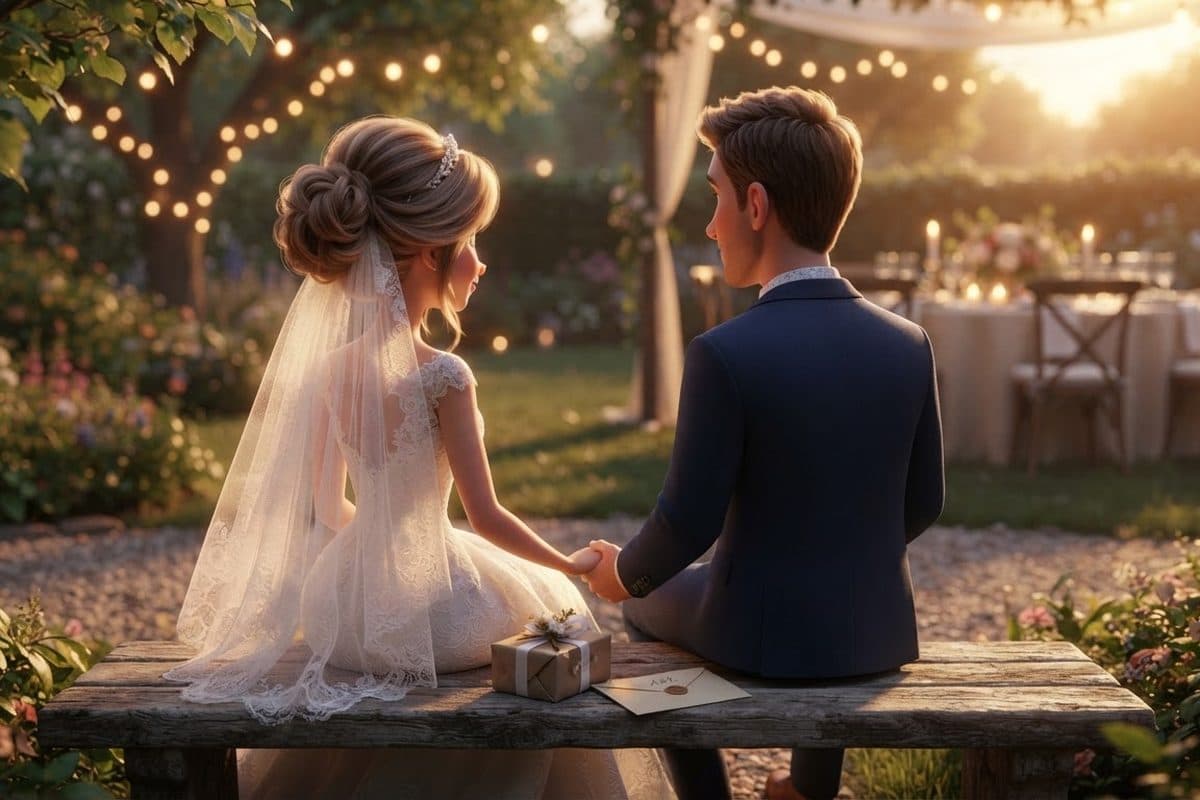
The Day We Said I Do is the wedding day in thirteen spreads: the first look in the garden, the tie that took forty minutes and then four seconds, the ring at the third try, a first dance that is mostly one of them standing on the other's feet, and a tunnel of sparklers at the end. Both of them are on every page, with their names in the words.
It works in two different ways.
- Between the two of you, before the day. Ordered by the bride or the groom and opened on the wedding morning. It is printed after you order, and the delivery dates are shown before you pay, so leave a margin.
- From guests or family, after the day. Ordered by a parent, a sibling or a close friend with a photo of the couple, and given when it arrives or kept for the first anniversary.
Two honest caveats. The story is ours, written once and the same for every couple: its moments are the ones most weddings share, not a record of theirs. And they are drawn in wedding clothes on every page, a dark suit and a white dress with a veil, so the book will not show their actual outfits.
What comes from the photo is their faces, their hair and how they look side by side, so any clear picture of the two of them works, not only one from the wedding. We cut each face out ourselves; each just needs to be reasonably clear and roughly facing the camera. For a surprise, an engagement photo usually does the job, and you can try it with the photo you have in mind before anyone else knows.
Giving each other the storybook: a practical checklist
If one of you is ordering the book for the other, or the two of you are ordering it together to open after the day, this is the short list of what to get right. None of it is hard, but wedding weeks have a way of eating the easy things.
- Pick the photo. Any clear picture of the two of you works, and one photo with both of you in it is enough: we find both faces in it and draw each one separately. For a surprise, look through your own phone or your engagement photos rather than asking your partner for one.
- Run the free preview first. There is no card and no account. Each face is drawn in about half a minute, so for the two of you it takes about a minute. If one face does not look like them, try a different photo where that face is clearer and turned toward the camera.
- Type the names exactly as you want them read. The names are in the words of the story, so use the name your partner actually goes by and check the spelling twice.
- Write the dedication. It is printed after the story word for word, exactly as you type it, so read it aloud once before you order. Two or three lines are plenty: whose day it was, the date, and one thing only the two of you would understand.
- Check the delivery dates before you pay. The book is printed after you order, and the book page and the cart show the dates before you pay. Leave a margin: the last week before a wedding is the wrong time to be refreshing a tracking page.
- Choose where it goes. If it is a surprise, send it somewhere your partner will not open the package: a parent, a friend, the best man or the maid of honor, who can also bring it along on the morning.
- Decide on the extra copy. The second copy we offer beside the book is meant for both your families, who were there that day. It is easier to order both together than to remember later.
Here is the same thing as a timeline, working back from the day you want to open it.
| When | What the two of you do | Why then |
|---|---|---|
| As soon as you have the idea | Run the free preview with the photo you plan to use | You find out at once whether the photo works, with time to try another |
| A few weeks before the wedding | Order, with the names and the dedication checked | Printed after you order, with a margin for everything else that week |
| When the package arrives | Open it alone, check it, then wrap it or hand it to whoever will deliver it | The wedding week is too busy to discover a problem on the morning |
| The wedding morning | Send it through a friend, together with your letter | The first sight of each other still happens at the ceremony |
| Or the first anniversary | Give it as the paper gift instead | The day has had a year to become a memory, and the book gives it back |
Every book is checked by a real artist before it goes to print, and it is printed in the United States. If you are comparing us with other companies before you decide, our guide on how to choose a personalized book company covers what to look for, including in our own books. When you are ready, let the preview draw you both, and decide afterward.
Unique wedding gifts that are not on any registry
For the guest or parent who wants to bring something nobody else will. Each passes at least two of the three tests, and each has a catch.
| The gift | Why it gets kept | The catch |
|---|---|---|
| A portrait of the two of them, painted or drawn | Tied to them, and it earns a wall | Needs wall space and a good photo, and artists often need weeks |
| A video of messages from people who could not be there | Nobody else could have made it | A month of chasing twenty people for clips |
| A family recipe book, one card per relative | Used every week, in real handwriting | Somebody has to chase the relatives |
| A print of the map or night sky over the venue on the date | Tied to the day, easy to hang | So common now that it is only unique if the place is |
| A tree or a rose bush planted for the wedding | Alive, dated, growing with the marriage | Needs a garden, or at least a balcony |
| A storybook of the wedding day | Both of them drawn in, and read again | The same story for every couple; the faces, names and dedication change |
If the couple are the kind who got engaged on a trip to the parks and each have a favorite princess, everything above still holds, with one extra trap: the themed object they will receive five times. We wrote a separate guide to Disney wedding gifts that are about their own fairy tale rather than somebody else's.
What to skip
Not because these are bad gifts, but because the couple will own several of each by the end of the reception.
- Signs and slogans. Mr. and Mrs., better together, a family name in curly script. One is charming. By the fourth, a donation box has been started.
- Anything that assumes a name change. Monograms, a Mrs. mug, a surname on the doormat. Not everybody changes their name, and a monogram with the wrong one can be neither fixed nor passed on.
- Large decor. A statement vase or a big framed print is a bet on their taste and their square footage at once.
- An empty keepsake box. A box with nothing in it is a job, not a memory. If you give one, put the first thing inside: the invitation, a photo, a letter.
The pattern is the three tests in reverse, and most gifts escape this list by adding what they lack: a date, a name or a note.
When guests ask the two of you what you want
Everything above is written for the people giving. If you are the couple, you will be asked, many times, and "nothing, just come" is a kind answer that leaves people guessing. Guessing is how the fourth sign arrives. A little honesty up front makes it easier for everyone to give you something you will keep.
- Keep the registry honest. Things you will really use, at a spread of prices, so a college friend and an aunt both have something to choose. A short list you believe in beats a long one padded out.
- Say out loud that a letter counts. Tell close friends and family that a card with a memory in it, or a photo they took of you, means as much as a present. People are often relieved to hear it.
- Name one or two personal projects. A family recipe book, messages for the first anniversary, a video from people who cannot travel. Then hand the job to one organizer, a sibling or the maid of honor, so it happens without you.
- If you would rather have money, say so kindly. One warm line on your wedding website is enough, with a word about what it is for: the first apartment, the trip, the sofa you keep sitting on in stores.
- Mention the space. If you live in a small apartment or are about to move, say it. Nobody wants to send a large object to a couple who will have to store it in a parent's garage.
After the wedding, the thank-you note is where the sentimental part comes back to you. Name the gift, then add one sentence about how you are using it or where it lives now. The guest who wrote about the lake will read that sentence more than once.
And when a parent or grandparent asks for an idea that is personal but not one more object, our personalized wedding story book is an easy one to pass on. They can watch the free preview draw the two of you, with any clear photo they already have on their phone.
The gift that arrives later
The wedding itself is a hard moment for a sentimental gift to be noticed: the gifts arrive in a heap, and your card gets opened weeks later alongside forty others. Send the registry gift on time; a sentimental second gift can wait for a quieter occasion.
- The first anniversary, traditionally the paper one. A letter, a book or a print from the day all fit, and we have a whole guide to paper anniversary gifts.
- Their first Christmas in their own home, often when the family ornaments get handed over. We wrote about Christmas gifts for couples separately.
- When the photographs come back. A framed print of your favorite, sent once the gallery is out, is a small gift with perfect timing.
If the storybook is your anniversary idea, there is no need to decide now: see the two of them drawn today, free, and come back nearer the date.
After that the occasions keep coming, and the same three tests keep working. For some couples the next one is news of a very different kind, with its own guide to ways to tell your husband you are pregnant. Then come the family books, the ones with a child in them, covered in our guide to personalized books for kids.
How to make any gift more sentimental in ten minutes
Whatever you give, these small additions move it from nice to kept.
- Write the date and both names by hand. Ten seconds, and an object becomes a keepsake.
- Name one specific memory. The evening at the lake, the terrible first apartment.
- Say what it is for. A coffee grinder for the first Sunday with nothing planned is a scene, not an appliance.
- Add an envelope for later, marked for the first anniversary.
The couple will not remember who gave them the blender. They will remember who wrote about the lake.
Sources
- Choosing a Wedding Gift · The Emily Post Institute
Questions couples ask
Is it OK to give a wedding gift that is not on the registry?
Yes. The Emily Post Institute describes a registry as a convenience for guests rather than an obligation. The safest approach is a small registry item plus something personal, easy to store and not a duplicate of anything the couple asked for.
What are good sentimental wedding gift ideas for the couple?
Anything tied to the two of them or to the day, easy to use or display, and impossible to give to another couple: a photo you took of them, a family recipe book, letters to open on their firsts, a portrait, or a storybook of their wedding day.
What should the bride give the groom on the wedding day?
Most often something he wears that day, such as a watch or cufflinks engraved with the date, with a letter handed over before the ceremony. The letter is usually the part that gets kept. Keep the engraving short, the date and a few words only the two of you understand, and send it through a friend if you want to save the first sight of each other for the ceremony.
What does the groom give the bride on the wedding morning?
Traditionally jewelry she can wear at the ceremony, cleared first with whoever has seen the dress, plus a letter. Small kindnesses for the morning, breakfast for her or flowers for the bridesmaids, are remembered more than grooms expect. If the two of you are exchanging gifts, agree on a rough scale first.
How long after the wedding can you send a gift?
Not as long as most people think. The Emily Post Institute calls the idea that guests have a year a rumor: send it soon after the invitation arrives, and within about three months of the wedding at the latest. A sentimental second gift can come later on purpose, for the first anniversary.
Do parents give the couple a wedding gift?
Usually, though it varies between families, and for many parents a contribution to the wedding is part of it. The sentimental gift tends to be small and separate: an heirloom with its story written down, a letter on the morning, or their own wedding photo, framed.
Should the bride and groom exchange gifts on the wedding day?
Only if the two of you want to: it is a custom, not a rule, and plenty of couples agree on letters only. If you do exchange gifts, settle on a rough scale beforehand so one of you is not giving a watch while the other gives a card, and send them through a friend so the first sight of each other still happens at the ceremony.
What should I write in a letter to my partner on our wedding morning?
Keep it to one page. Start with a specific scene from when you met, add one thing you have learned about them since and one moment from the weeks of planning, then make a small, practical promise and sign it with the date. Leave the vows for the ceremony and the old arguments out entirely.
What should we tell guests who ask what we want for our wedding?
Be honest rather than saying nothing. Point them to a short registry of things you will really use, tell close friends and family that a card with a memory in it counts as a gift, and if you would prefer money, say so in one kind line on your wedding website. Mentioning a small apartment helps too.
Disney is a trademark of its owner. Dreamtale Cartoons is an independent studio, not affiliated with, sponsored or endorsed by it.