
Choosing a book
Books About Dogs for Kids: The Best for Every Age, From the First Puppy to the Last Goodbye
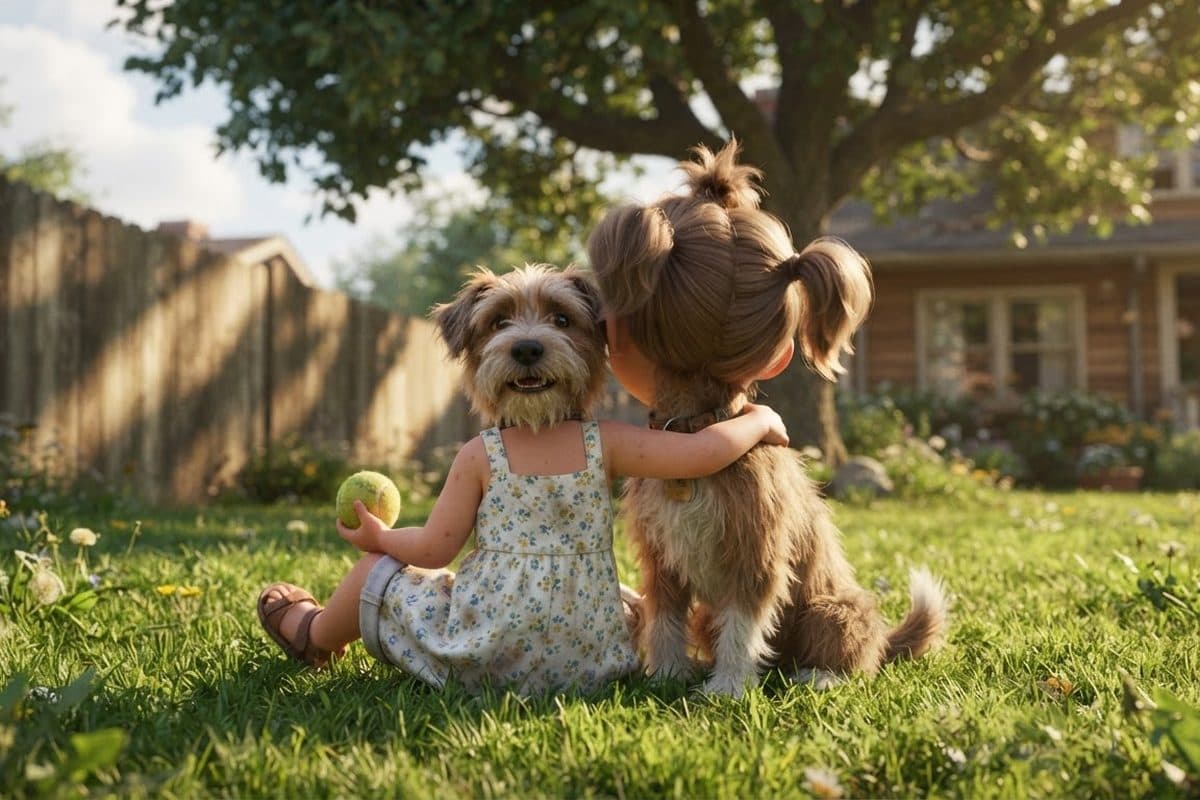
Search for books about dogs for kids and the first page is mostly long lists, one of them more than two hundred titles deep, in no particular order. They rarely say how old the child should be, and almost never what the dog actually does in the story.
That second question matters more than it sounds. A dog in a children's book always has a job: the best friend, the troublemaker, the one who goes missing, the one who finds you, the new puppy, the one who dies. Each does different work on a child, and the right one depends on what is happening in your house: a puppy that just arrived, a dog that is getting old, or a child who wants one badly.
Below, the books are sorted by age and by the dog's job, each title, author and age range checked on October 1, 2026, against a publisher, library or trade review listing. Then Dog Man for parents, books for before a new puppy and after a death, reading to a dog, and the one kind of dog book we make ourselves, limits included.
Why children love books about dogs
Ask a child why they love dogs and you will hear about the tail and the tongue. Underneath is something more useful: the dog is the one member of the family who listens to everything and repeats nothing.
That is more than a hunch. When University of Cambridge researchers surveyed twelve year olds from 77 families with at least one pet and more than one child, the children told their pets about as much as they told their brothers and sisters, had less conflict with them, and those with dogs were more satisfied than those with other pets. The lead researcher suggested why: a pet cannot judge you. It is one small study of older children, run with a pet food company's research center, so it describes a feeling rather than proving a rule; anyone who has overheard a child confiding in the dog will recognize it.
Good dog books build on exactly that. The dog in them follows, waits, guards and above all finds people. Cat stories tend to be about going off alone and finding the way back, as we wrote in our guide to children's books about cats; dog stories are about loyalty, and about being found.
Choose by what the dog does in the story
Almost every dog book for children gives the dog one of a handful of jobs. They are not interchangeable: a child whose dog has just died needs a different book from a child campaigning for a puppy.
| The dog's job | What it gives a child | Books to try |
|---|---|---|
| The best friend | Company, and someone always on their side | Henry and Mudge; Officer Buckle and Gloria; Clifford the Big Red Dog |
| The troublemaker | Permission to laugh at mess and rules from a safe distance | Harry the Dirty Dog; Bark, George; Dog Man |
| The dog who goes missing | A search that ends in the right place | Where's Spot?; The Stray Dog |
| The dog who changes everything | Proof that one friend can open up the rest of the world | Because of Winn-Dixie |
| The dog who finds you | The certainty that someone will come, even after dark | Come and Find Me (ours) |
| The new puppy | A rehearsal of what a dog really needs | Biscuit; The Puppy Place |
| The dog who needs saving | A real question about doing the right thing | Shiloh |
| The sad dog, or the goodbye | A safe place to feel loss, from a popped ball to a death | A Ball for Daisy; I'll Always Love You; Dog Heaven |
A child who worries about being lost or left may get the most from the dog who finds you; a child who simply loves dogs deserves the troublemaker on repeat. Ours sits in the dog-who-finds-you row: if it sounds like the one, see your child drawn as the one hiding at the fair, free, before reading on.
First dog books for babies and toddlers
Under three, the dog is a shape and a sound, and the book is really a game. Look for few words, a dog drawn big, and something for small hands to do.
- Where's Spot? by Eric Hill (1980). Spot's mother, Sally, looks for him all over the house, and behind every flap is someone else: a bear, a crocodile, three penguins. It is hide and seek, the oldest game a toddler knows, and Penguin Random House lists the board book for 1 to 3.
- Go, Dog. Go! by P.D. Eastman (1961). Dogs on bicycles, skis and roller skates, all heading for a party on top of a tree, in only 75 different words. Listed for 3 to 7, with a board book edition for younger hands.
- Biscuit by Alyssa Satin Capucilli, illustrated by Pat Schories (HarperCollins, 1996). A little yellow puppy who will not go to sleep and keeps asking for one more thing first. It belongs to the publisher's earliest reading line, made for sharing, so the same book can later be one of the first a child reads alone.
Every parent recognizes Biscuit's bedtime, which is the joke. If that is your evening too, the bedtime routine that ends the stalling deals with the human version.
At this age, hand over the barking. A toddler who supplies the woof on cue is reading with you rather than listening to you.
Picture books about dogs for ages 3 to 6
From three, a dog book needs a real problem in the middle, and the ones that last pick a problem a preschooler knows: a bath, a lost ball, a stray who has to be left behind.
- Harry the Dirty Dog by Gene Zion, illustrated by Margaret Bloy Graham (1956). Harry, a white dog with black spots, hates baths, runs off, and comes home so dirty that his family does not recognize him until he is scrubbed clean, which is thrilling at four.
- Bark, George by Jules Feiffer (1999). George's mother tells him to bark, and he meows, quacks, oinks and moos, until the vet reaches deep inside him and pulls out a cat. Publishers Weekly listed it for 2 to 6.
- A Ball for Daisy by Chris Raschka, the 2012 Caldecott Medal winner. Wordless: another dog at the park pops Daisy's favorite ball, and her sadness fills the pages before a cheerful ending. Listed for 3 to 7, and the gentlest first book about losing something.
- Officer Buckle and Gloria by Peggy Rathmann, the 1996 Caldecott Medal winner. Nobody listens to Officer Buckle's safety tips until Gloria, the police dog, starts acting them out behind his back, and when he finds out, the friendship has to be mended. Listed for 4 to 8.
- The Stray Dog by Marc Simont, a 2002 Caldecott Honor book. A family meets a scruffy dog at a picnic, names him Willy, leaves him because he must belong to somebody, and thinks about him all week. Kirkus listed it for 4 to 8, and the ending needs a belt and a hair ribbon.
- Clifford the Big Red Dog by Norman Bridwell (Scholastic, 1963). Emily Elizabeth and a dog so enormous that ordinary life gets complicated, listed for 3 to 5.
What changes between a three and a four year old, dogs or no dogs, is in the best books for 3 and 4 year olds.
Dog books a new reader can read alone
Somewhere between five and seven, a child wants to read the dog book themselves, and publishers make whole lines for that moment: short sentences, big type, a few words per page.
Henry and Mudge: The First Book by Cynthia Rylant, illustrated by Suçie Stevenson, is the classic. Henry is lonely on a street with no other children until he gets Mudge, his 180 pound dog. Simon & Schuster lists it for 5 to 7, at the second level of its beginning reader line, and many more Henry and Mudge books follow.
Go, Dog. Go! is the other natural first: with only 75 different words, a child who knows them can finish the whole book alone, which is a bigger moment than it looks.
If there is a dog in the house, let your new reader read to it; there is a whole program built on that idea, further down. If your reader is also the one who tells the dog everything, the free preview takes one photo of your child and about half a minute, and the dog comes after.
Chapter books about dogs, from about seven
Once chapters arrive, dog stories get real stakes: a home to find, a dog to save, a family to mend. Roughly in order of difficulty:
- The Puppy Place series by Ellen Miles (Scholastic), starting with Goldie. Charles and Lizzie Peterson want a puppy more than anything, their mother is not sure, and their firefighter dad brings home a golden retriever pup who needs a family. Listed for 7 to 10, with puppy-care tips at the back.
- Because of Winn-Dixie by Kate DiCamillo, a 2001 Newbery Honor book. Ten-year-old Opal goes to the supermarket for groceries and comes home with a dog, and because of that dog she makes friends and finally asks her father about her mother, who left when she was three. Candlewick lists it for 9 to 12; we would read it aloud from about seven.
- Shiloh by Phyllis Reynolds Naylor, the 1992 Newbery Medal winner. Marty finds a thin beagle in the hills behind his house who comes to his whistle, and begins to suspect its owner, a man with a gun, is mistreating it. Listed for 8 to 12. It is about doing the right thing when it is hard, and heavier than the cover suggests: read it first if your child is sensitive.
Where the Red Fern Grows, the other famous one, belongs with the books about loss, further down.
Dog Man, explained for parents
If your child asked for a dog book and meant Dog Man, you are in good company. The series by Dav Pilkey, who also created Captain Underpants, turned ten this year, and in September Scholastic counted fourteen books, with a fifteenth, A Sprinkle in Time, due on November 3.
What it is. Graphic novels about a police officer with the head of a dog and the body of a human, who chases crooks and, being part dog, squirrels. The comics are presented as drawn by George and Harold, and the publisher notes that their drawing, grammar and spelling improve as the series goes on: the misspellings in the early books are part of the joke, not a lesson in spelling.
What age. Scholastic lists Dog Man for 7 and up. Its parents' blog adds that children who cannot yet read alone enjoy having the books read to them.
Is it a dog book? Not really. It is a comic about friendship, mistakes and forgiveness, and the dog part is mostly the jokes. That is not a criticism: Scholastic's pitch for the series is that it gets reluctant readers through whole books, and Pilkey himself was diagnosed with ADHD and dyslexia in second grade. If your Dog Man fan wants a story where a real dog matters, The Puppy Place is the easiest next step, and Because of Winn-Dixie read aloud is the best one.
Before a new puppy comes home
If a puppy is coming, pediatricians have advice that fits neatly into reading time. The American Academy of Pediatrics suggests that if the dog is meant as a companion for your child, it is a good idea to wait until they are about five or six, because younger children have trouble telling an animal from a toy.
- Read about the care first. The AAP suggests pet care books from the library, and a visit to a friend's dog, so the work is real before the puppy is.
- Consider an older dog. A puppy can bite out of sheer friskiness, which is why an older animal, as long as it has lived with children, is often the better first dog.
- Teach the greeting. Stand still, let the dog sniff, then slowly offer a hand. Leave a dog alone while it eats or sleeps.
- Never leave a young child alone with a dog. Many bites happen in rough play, when the child does not notice the dog getting overexcited.
For the stories: Biscuit for a two year old, since puppies stall at bedtime too, The Stray Dog for the family where the first answer was no, and The Puppy Place: Goldie for the seven year old trying to prove they are ready. A book is also a good place to agree who feeds it in the morning.
And if the puppy is already asleep on the kitchen floor, draw your child first: the dog's photo can wait until it sits still in daylight.
When the family dog dies
Google's suggestions for this search include books about a dog dying, and it may be your child's first loss, so we will go carefully. The American Academy of Pediatrics has a pediatrician's guide to helping a child when a pet dies, and its main points come before any book:
- Let them see you sad. It is fine to cry in front of a child, and anger is a common way for children to grieve too.
- Expect the same question again. Toddlers may ask over and over where the dog is, or seem unbothered, because they do not understand death yet.
- If the dog is old or ill, prepare them. With a school-age child, talk honestly before the death rather than saying everything is fine.
- A new puppy is a new adventure, not a replacement. Otherwise a child may expect the new dog to be the old one, or learn that loved ones can be replaced.
The books:
- I'll Always Love You by Hans Wilhelm, listed for 3 to 7. Elfie the dachshund and her owner grow up together, and every night the owner tells her so: a book about saying it while you can.
- Dog Heaven by Cynthia Rylant, which Kirkus listed for 5 to 9. A heaven of open fields for running, with God in it, which suits some families and not others. Read it first.
- From the AAP's own list: The Forever Dog by Bill Cochran and The Old Dog by Charlotte Zolotow for preschoolers, and Love That Dog by Sharon Creech for school-age children.
- Where the Red Fern Grows by Wilson Rawls, listed for 8 to 12. Billy and his two hounds in the Ozarks; the publisher's own description speaks of heartbreak. Not the book for the week a child's own dog dies.
Some families later want a book with their dog in it, as a record. That is a decision for when you are ready, not this week, and an album of the real dog comes first.
Reading to the dog
There is a program built on the idea that a dog is the best audience a nervous reader can have. R.E.A.D., short for Reading Education Assistance Dogs, was started by Intermountain Therapy Animals at the main Salt Lake City library in November 1999, and its dogs are registered therapy animals who come with their owners to schools and libraries to listen to children read.
The program's own explanation is one any parent of a struggling reader will recognize: children who freeze up reading in front of classmates, worried about their mistakes, relax beside a dog that is not going to laugh. We cannot tell you how far it moves reading scores. What it changes, by the program's own account, is how reading aloud feels. Ask your library whether it runs a session.
At home, the family dog can do the same job: a new reader with a book, the dog on the rug, and you in the same room. The dog will not correct the hard words, which is the whole point, and you can help with them afterward.
Dog books by age, at a glance
The ranges are the publisher's or a trade review's where one is given, and ours where not.
| Age | What they want in a dog story | Titles to try |
|---|---|---|
| 1 to 3 | A dog to find, a sound to make, a flap to lift | Where's Spot? (board book) |
| 2 to 6 | A puppy who acts like them, and a joke they can see coming | Biscuit; Bark, George |
| 3 to 7 | Rhythm, a big dog and a small problem | Go, Dog. Go!; Clifford the Big Red Dog; A Ball for Daisy |
| 4 to 8 | A real problem in the middle, and a family around the dog | Harry the Dirty Dog; Officer Buckle and Gloria; The Stray Dog |
| 5 to 7 | A dog book they can read alone | Henry and Mudge |
| 7 to 10 | Chapters, comics and puppies who need homes | The Puppy Place; Dog Man (listed 7 and up) |
| 8 to 12 | Real stakes: a dog to save, a family to mend | Shiloh; Because of Winn-Dixie (listed 9 to 12) |
A sensitive child can do better one row younger for a while. If yours is between three and eight and tells the dog everything, try the preview with their photo before reading about our book below.
A dog book with your own dog in it
Every dog family runs into the same problem: the dog in the story is spotted, or enormous and red, and yours is a gray-muzzled mix with one white sock. That is the one thing a personalized book fixes cleanly, and we make one, so here it is with its limits. Come and Find Me is our personalized dog book, for ages 3 to 8, in rhyme across thirteen spreads. On the last evening of the fair your child hides much too well, and by the time they come out the sky is black, the music has stopped sounding like music and every way out looks like every other one. Your dog was asleep under a table, and is already coming, because a dog does not need to see you to know where you are.
What we need: one photo of your child, and one of your dog in daylight with the whole body showing, plus its size, small, medium or large, because a chihuahua and a labrador are not the same picture. With a mix, the markings matter more than the breed.
What it is not: your dog's own adventures. The story is ours and the same for every family, and your dog is not in the four spreads where your child hides alone, which is the point. What is yours: your child drawn in the look of a modern 3D animated film, your dog from its markings at its real size, the names in the words, and the dedication you write, printed word for word after the story (what to write in a book for a child helps if you are stuck).
A real artist checks every book before it is printed in the United States, after you order; the book page and the cart show the delivery dates before you pay. If your child's real fear is the dark itself, see books for kids afraid of the dark.
Why seeing themselves on the page matters is in why kids love seeing themselves in books, and how to tell a keepsake from a name swap in our guide to personalized books for kids. Our personalized pet book shelf has the cat too. The preview is free, no card and no account: start with your child's photo, and keep the dog's ready.
Sources
- Pets are a child's best friend, not their siblings · University of Cambridge, 2017
- How to Choose the Right Pet for Your Family · HealthyChildren.org, American Academy of Pediatrics, 2026
- When a Pet Dies: How to Help Your Child Cope · HealthyChildren.org, American Academy of Pediatrics, 2023
- About ITA · Intermountain Therapy Animals
- R.E.A.D. FAQ · Intermountain Therapy Animals
- Where's Spot (color) by Eric Hill · Penguin Random House, 1980
- Go, Dog. Go! by P.D. Eastman · Penguin Random House, 1961
- Biscuit (My First I Can Read) · Amazon (publisher: HarperCollins), 1996
- Harry the Dirty Dog by Gene Zion · Publishers Weekly
- Bark, George by Jules Feiffer · Publishers Weekly, 1999
- A Ball for Daisy by Chris Raschka · Penguin Random House, 2011
- Officer Buckle and Gloria by Peggy Rathmann · Penguin Random House, 1995
- The Stray Dog by Marc Simont · Kirkus Reviews, 2001
- Clifford the Big Red Dog (press kit) · Scholastic
- Clifford the Big Red Dog (Vintage Hardcover Edition) · The Scholastic Store, 1963
- Henry and Mudge: The First Book · Simon & Schuster
- The Puppy Place: Goldie by Ellen Miles · Scholastic Book Clubs
- Because of Winn-Dixie · Candlewick Press
- Shiloh · Simon & Schuster
- Dog Man · Scholastic
- The World of Dav Pilkey (press kit) · Scholastic
- 10 Reasons Why We Love Dog Man More Than Ever · Scholastic Parents, 2026
- I'll Always Love You by Hans Wilhelm · Penguin Random House, 1988
- Dog Heaven by Cynthia Rylant · Kirkus Reviews, 1995
- Where the Red Fern Grows by Wilson Rawls · Penguin Random House
- Caldecott Medal & Honor Books, 1938 to present · Association for Library Service to Children, American Library Association
- Newbery Medal Winners & Honor Books, 1922 to Present · Association for Library Service to Children, American Library Association
Questions parents ask
What is the most classic children's book about dogs?
There is no single winner, but four have been in print for decades and are still easy to find: Harry the Dirty Dog (1956), Go, Dog. Go! (1961), Clifford the Big Red Dog (1963) and Where's Spot? (1980). Among award winners, Officer Buckle and Gloria won the Caldecott Medal in 1996 and A Ball for Daisy in 2012. For older readers, the classics are Shiloh, the 1992 Newbery Medal winner, and Because of Winn-Dixie.
What are good books about dogs for a 3 year old?
At three, look for a dog drawn big, few words and something to do. Where's Spot? lets them lift the flaps, Bark, George turns into a game of animal sounds, and Biscuit's bedtime stalling is one they will recognize. Go, Dog. Go! is listed from three, and Harry the Dirty Dog works as soon as they find it funny that a family might not recognize its own dog.
What are some good chapter books about dogs for kids?
From about seven, The Puppy Place series by Ellen Miles, where a family fosters a new puppy in each book, and Dog Man, the graphic novel series listed for 7 and up. From eight or nine, Shiloh, the 1992 Newbery Medal winner about a mistreated beagle, and Because of Winn-Dixie, a 2001 Newbery Honor book. Henry and Mudge, listed for 5 to 7, is the step before chapters.
What age is Dog Man for?
Scholastic lists Dog Man for ages 7 and up. The books are fast, very funny graphic novels, and the publisher says children who cannot read alone yet enjoy having them read aloud. The misspellings belong to George and Harold, the characters who supposedly draw the comics, and their spelling improves as the series goes on. In September 2026 there were fourteen books, with a fifteenth due in November.
What book helps a child when the dog dies?
For ages 3 to 7, I'll Always Love You by Hans Wilhelm, about Elfie the dachshund and the owner who told her the words of the title every night. Dog Heaven by Cynthia Rylant suits families comfortable with a heaven that has God in it. The American Academy of Pediatrics adds The Forever Dog and The Old Dog for preschoolers. Pair any book with plain words, and expect a young child to ask where the dog is more than once.
What should we read before we get a puppy?
Something with the work in it, not only the cuddles. The American Academy of Pediatrics suggests pet care books from the library and a visit to a friend's dog before an animal arrives. For stories, Biscuit shows a toddler that puppies stall at bedtime too, and The Puppy Place: Goldie, for 7 to 10, ends with real puppy-care tips. Pediatricians also suggest waiting until a child is about five or six.
Why do kids love books about dogs?
Because a dog is the friend who follows them everywhere, listens to everything and repeats nothing. In a University of Cambridge study of twelve year olds, children told their pets about as much as they told their siblings, and had less conflict with them. Dog stories build on that loyalty: the dog waits, follows and finds people, which is a deeply reassuring idea for a small child.
Can I get a children's book with our own dog in it?
Yes. Ours is Come and Find Me, for ages 3 to 8: your child hides much too well at a fair, and your dog finds them. It needs one photo of your child and one of your dog in daylight with the whole body showing, plus its size. The story is the same for every family; the faces, the names and your dedication are yours. Whoever makes it, ask to see the drawn dog before you pay.
Dog Man, Captain Underpants, Clifford the Big Red Dog, Spot, Biscuit, Henry and Mudge, The Puppy Place, Winn-Dixie, R.E.A.D., Caldecott Medal and Newbery Medal are trademarks of their respective owners. Dreamtale Cartoons is an independent studio, not affiliated with, sponsored or endorsed by any of them.